


The US and China yesterday piled pressure on North Korea to abandon its nuclear missile program after the UN Security Council approved tough sanctions which could cost Pyongyang US$1 billion a year.
One day after council members voted unanimously for a partial ban on exports aimed at slashing Pyongyang’s foreign revenue by a third, top diplomats from the key powers in the dispute met in Manila.
US Secretary of State Rex Tillerson said he was encouraged by the vote, but officials said that Washington would closely watch China — North Korea’s biggest trade partner — to ensure sanctions are enforced.
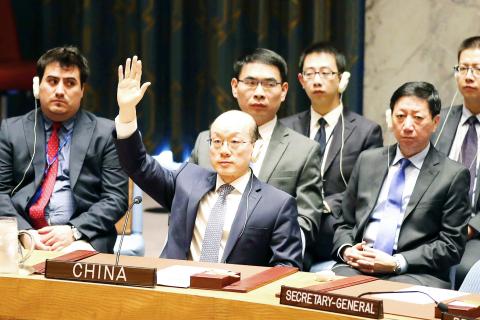
Photo: AP
Chinese Minister of Foreign Affairs Wang Yi (王毅) met his North Korean counterpart Ri Hong-yo before a major regional security forum being hosted by ASEAN.
He urged the North to halt its nuclear and ballistic missile tests.
“It will help the DPRK [Democratic People’s Republic of Korea] to make the right and smart decision,” Wang told reporters, speaking through a translator, after talks with Ri — referring to the sanctions and to Ri’s presence in Manila.
Pyongyang’s top envoy has so far avoided the media in Manila.
However, in a characteristically fiery editorial before the latest sanctions were approved, the North’s ruling party newspaper Rodong Sinmun warned against US aggression.
“The day the US dares tease our nation with a nuclear rod and sanctions, the mainland US will be catapulted into an unimaginable sea of fire,” it said.
Tillerson also met Russian Minister of Foreign Affairs Sergei Lavrov yesterday and was to see Wang later.
“It was a good outcome,” Tillerson said of the UN vote, before he met with South Korean Minister of Foreign Affairs Kang Kyung-wha.
Senior US envoy Susan Thornton said Washington was “still going to be watchful” on the implementation of sanctions, cautioning that previous votes had been followed by China “slipping back.”
However, she added that China’s support for the UN resolution “shows that they realize that this is a huge problem that they need to take on.”
The urgency of the situation was underlined by US President Donald Trump’s national security adviser, Lieutenant General H.R. McMaster, who told MSNBC news that the US leader was reviewing plans for a “preventive war.”
“He said he’s not going to tolerate North Korea being able to threaten the United States,” McMaster said. “It’s intolerable from the president’s perspective. So of course we have to provide all options to do that. And that includes a military option.”
Saturday’s UN resolution banned exports of coal, iron and iron ore, lead and lead ore as well as fish and seafood by the cash-starved state. If fully implemented it would strip North Korea of a third of its export earnings — estimated to total US$3 billion per year despite successive rounds of sanctions since the North’s first nuclear test in 2006.
The resolution also prevents North Korea from increasing the number of workers it sends abroad.
It prohibits all new joint ventures with North Korea, bans new investment in current joint companies and adds nine North Korean officials and four entities, including the North’s main foreign-exchange bank to the UN sanctions blacklist.
Trump hailed the vote — saying in a tweet that the sanctions will have “very big financial impact!” — and thanked Russia and China for backing a measure that either could have halted with their UN veto.
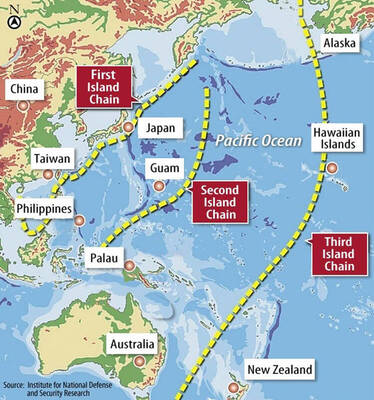
The US government has signed defense cooperation agreements with Japan and the Philippines to boost the deterrence capabilities of countries in the first island chain, a report by the National Security Bureau (NSB) showed. The main countries on the first island chain include the two nations and Taiwan. The bureau is to present the report at a meeting of the legislature’s Foreign Affairs and National Defense Committee tomorrow. The US military has deployed Typhon missile systems to Japan’s Yamaguchi Prefecture and Zambales province in the Philippines during their joint military exercises. It has also installed NMESIS anti-ship systems in Japan’s Okinawa

‘WIN-WIN’: The Philippines, and central and eastern European countries are important potential drone cooperation partners, Minister of Foreign Affairs Lin Chia-lung said Minister of Foreign Affairs Lin Chia-lung (林佳龍) in an interview published yesterday confirmed that there are joint ventures between Taiwan and Poland in the drone industry. Lin made the remark in an exclusive interview with the Chinese-language Liberty Times (the Taipei Times’ sister paper). The government-backed Taiwan Excellence Drone International Business Opportunities Alliance and the Polish Chamber of Unmanned Systems on Wednesday last week signed a memorandum of understanding in Poland to develop a “non-China” supply chain for drones and work together on key technologies. Asked if Taiwan prioritized Poland among central and eastern European countries in drone collaboration, Lin

NO CONFIDENCE MOTION? The premier said that being toppled by the legislature for defending the Constitution would be a democratic badge of honor for him Premier Cho Jung-tai (卓榮泰) yesterday announced that the Cabinet would not countersign the amendments to the local revenue-sharing law passed by the Legislative Yuan last month. Cho said the decision not to countersign the amendments to the Act Governing the Allocation of Government Revenues and Expenditures (財政收支劃分法) was made in accordance with the Constitution. “The decision aims to safeguard our Constitution,” he said. The Constitution stipulates the president shall, in accordance with law, promulgate laws and issue mandates with the countersignature of the head of the Executive Yuan, or with the countersignatures of both the head of the Executive Yuan and ministers or

Renewed border fighting between Thailand and Cambodia showed no signs of abating yesterday, leaving hundreds of thousands of displaced people in both countries living in strained conditions as more flooded into temporary shelters. Reporters on the Thai side of the border heard sounds of outgoing, indirect fire yesterday. About 400,000 people have been evacuated from affected areas in Thailand and about 700 schools closed while fighting was ongoing in four border provinces, said Thai Rear Admiral Surasant Kongsiri, a spokesman for the military. Cambodia evacuated more than 127,000 villagers and closed hundreds of schools, the Thai Ministry of Defense said. Thailand’s military announced that


 RSS
RSS