


Indonesia has named waters in its exclusive economic zone that overlap with China’s expansive claim to the South China Sea as the North Natuna Sea in an assertion of sovereignty that has angered Beijing.
The decision announced on Friday by the Indonesian Ministry of Maritime Affairs has been in the works since the middle of last year and is vital to law enforcement at sea and securing Indonesia’s exclusive economic zone, Indonesian Deputy Minister for Maritime Sovereignty Arif Havas Oegroseno said.
He said the name would reduce confusion and is already used by the oil and gas industry.
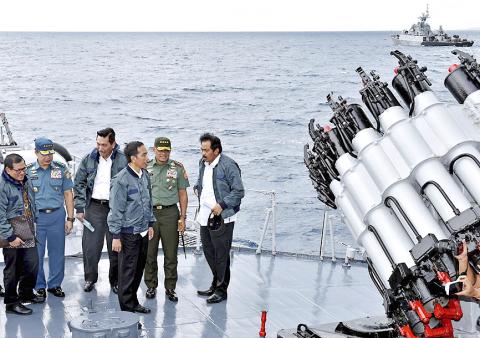
Photo: AP
A Chinese Ministry of Foreign Affairs spokesman said at a regular news briefing that the “so-called change of name makes no sense.”
“We hope the relevant countries can work with China for the shared goal and jointly uphold the current hard-won sound situation in the South China Sea,” he said.
China claims most of the South China Sea, putting it in dispute with many Southeast Asian nations, including Taiwan, and has carried out extensive land reclamation and construction on reefs and atolls to bolster its claims.
Indonesia does not have a territorial dispute with China, but Beijing’s “nine-dash line,” which signifies its claims, overlaps with Indonesia’s internationally recognized exclusive economic zone extending from the Natuna Islands.
“The map of Indonesia has clear coordinates, dates and data, and the government would not negotiate with other nations that make unconventional claims ... including those who insist on a map of nine broken lines,” Oegroseno said.
Meanwhile, Philippine officials behind an arbitration case in which the Philippines won a resounding victory over China last year are expressing alarm that Beijing continues to defy the decision, in what they are calling a setback to the rule of law.
Last week, they urged Philippine President Rodrigo Duterte, who has indefinitely set aside the decision that invalidated China’s sweeping historic claims in the South China Sea, to explore diplomatic and legal means by which to pressure China into complying.
Duterte has promised to take up the arbitration ruling with China, but is also courting China as an economic partner and ally.
“Despite its friendlier face, we do not see restraint in China’s militarization and unlawful activity in the West Philippine Sea,” the former Philippine Secretary for Foreign Affairs said.
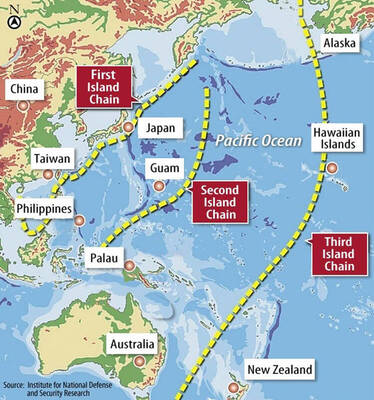
The US government has signed defense cooperation agreements with Japan and the Philippines to boost the deterrence capabilities of countries in the first island chain, a report by the National Security Bureau (NSB) showed. The main countries on the first island chain include the two nations and Taiwan. The bureau is to present the report at a meeting of the legislature’s Foreign Affairs and National Defense Committee tomorrow. The US military has deployed Typhon missile systems to Japan’s Yamaguchi Prefecture and Zambales province in the Philippines during their joint military exercises. It has also installed NMESIS anti-ship systems in Japan’s Okinawa

‘WIN-WIN’: The Philippines, and central and eastern European countries are important potential drone cooperation partners, Minister of Foreign Affairs Lin Chia-lung said Minister of Foreign Affairs Lin Chia-lung (林佳龍) in an interview published yesterday confirmed that there are joint ventures between Taiwan and Poland in the drone industry. Lin made the remark in an exclusive interview with the Chinese-language Liberty Times (the Taipei Times’ sister paper). The government-backed Taiwan Excellence Drone International Business Opportunities Alliance and the Polish Chamber of Unmanned Systems on Wednesday last week signed a memorandum of understanding in Poland to develop a “non-China” supply chain for drones and work together on key technologies. Asked if Taiwan prioritized Poland among central and eastern European countries in drone collaboration, Lin

NO CONFIDENCE MOTION? The premier said that being toppled by the legislature for defending the Constitution would be a democratic badge of honor for him Premier Cho Jung-tai (卓榮泰) yesterday announced that the Cabinet would not countersign the amendments to the local revenue-sharing law passed by the Legislative Yuan last month. Cho said the decision not to countersign the amendments to the Act Governing the Allocation of Government Revenues and Expenditures (財政收支劃分法) was made in accordance with the Constitution. “The decision aims to safeguard our Constitution,” he said. The Constitution stipulates the president shall, in accordance with law, promulgate laws and issue mandates with the countersignature of the head of the Executive Yuan, or with the countersignatures of both the head of the Executive Yuan and ministers or

CABINET APPROVAL: People seeking assisted reproduction must be assessed to determine whether they would be adequate parents, the planned changes say Proposed amendments to the Assisted Reproduction Act (人工生殖法) advanced yesterday by the Executive Yuan would grant married lesbian couples and single women access to legal assisted reproductive services. The proposed revisions are “based on the fundamental principle of respecting women’s reproductive autonomy,” Cabinet spokesperson Michelle Lee (李慧芝) quoted Vice Premier Cheng Li-chiun (鄭麗君), who presided over a Cabinet meeting earlier yesterday, as saying at the briefing. The draft amendment would be submitted to the legislature for review. The Ministry of Health and Welfare, which proposed the amendments, said that experts on children’s rights, gender equality, law and medicine attended cross-disciplinary meetings, adding that


 RSS
RSS