


When China allowed Nobel laureate Liu Xiaobo (劉曉波) to die in police custody, it made a bet that world governments were more invested in improving trade ties than defending political dissidents.
Even as Beijing has stepped up its crackdown on civil society, activists say, its trade partners have largely stepped down from their soap boxes.
Lured by the prospect of doing business with the world’s second-largest economy and growing, many nations have toned down their criticism of Beijing’s human rights violations, voicing their concerns behind closed doors, if at all.
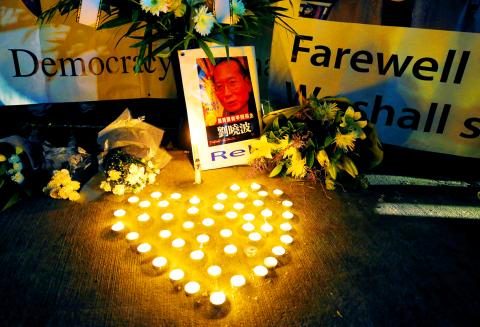
Photo: Reuters
“The Chinese government figured out 10 to 15 years ago that there was no real price to be paid,” Human Rights Watch China director Sophie Richardson said. “There was never going to be any greater consequence than public rhetoric.”
Shortly after Liu’s death, Beijing’s propaganda machine was already predicting the world would soon forget the democracy advocate, who lost a battle with liver cancer on Thursday at the age of 61.
“The West has bestowed on Liu a halo that will not linger,” an editorial in the state-owned Global Times said. “In Chinese history, none of China’s heroes were conferred by the West.”
Tributes to Liu poured in from around the world after his death, with several governments urging Beijing to release his wife, Liu Xia (劉霞), who has been held under house arrest since 2010.
China lodged official protests with the US, France, Germany and the UN human rights office over their “irresponsible remarks.”
A handful of governments had sought to secure Liu’s release.
As he lay in a heavily guarded hospital ward, Beijing declined offers by Taiwan, Germany and the US to host him, citing his deteriorating condition and denouncing the proposals as interference in China’s internal affairs.
The lack of public pressure meant “China was able to kill a Nobel peace laureate with impunity,” said Jay Nordlinger, a political commentator and author of a book on the Nobel Peace Prize’s history.

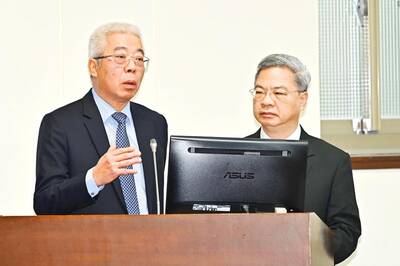
Taiwan has arranged for about 8 million barrels of crude oil, or about one-third of its monthly needs, to be shipped from the Red Sea this month to bypass the Strait of Hormuz and ease domestic supply pressures, CPC Corp, Taiwan (CPC, 台灣中油) said yesterday. The state-run oil company has worked with Middle Eastern suppliers to secure routes other than the Strait of Hormuz, through which about 20 percent of the world’s oil and liquefied natural gas typically passes, CPC chairman Fang Jeng-zen (方振仁) said at a meeting of the legislature’s Economics Committee in Taipei. Suppliers in Saudi Arabia have indicated they
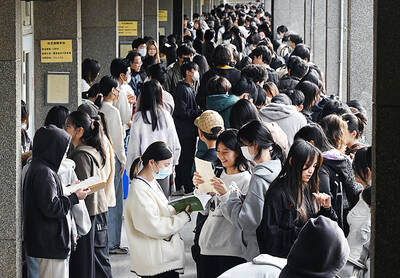
A global survey showed that 60 percent of Taiwanese had attained higher education, second only to Canada, the Ministry of the Interior said. Taiwan easily surpassed the global average of 43 percent and ranked ahead of major economies, including Japan, South Korea and the US, data from the Organisation for Economic Co-operation and Development (OECD) for 2024 showed. Taiwan has a high literacy rate, data released by the ministry showed. As of the end of last year, Taiwan had 20.617 million people aged 15 or older, accounting for 88.5 percent of the total population, with a literacy rate of 99.4 percent, the data

CCP ‘PAWN’? Beijing could use the KMT chairwoman’s visit to signal to the world that many people in Taiwan support the ‘one China’ principle, an academic said Chinese Nationalist Party (KMT) Chairwoman Cheng Li-wun (鄭麗文) yesterday arrived in China for a “peace” mission and potential meeting with Chinese President Xi Jinping (習近平), while a Taiwanese minister detailed the number of Chinese warships currently deployed around the nation. Cheng is visiting at a time of increased Chinese military pressure on Taiwan, as the opposition-dominated Legislative Yuan stalls a government plan for US$40 billion in extra defense spending. Speaking to reporters before going to the airport, Cheng said she was going on a “historic journey for peace,” but added that some people felt uneasy about her trip. “If you truly love Taiwan,

NEW LOW: The council in 2024 based predictions on a pessimistic estimate for the nation’s total fertility rate of 0.84, but last year that rate was 0.69, 17 percent lower An expected National Development Council (NDC) report expects the nation’s population to drop below 12 million by 2065, with the old-age dependency ratio to top 100 percent sooner than 2070, sources said yesterday. The council is slated to release its latest population projections in August, using an ultra-low fertility model, the sources said. The previous report projected that Taiwan’s population would fall to 14.37 million by 2070, but based on a new estimate of the total fertility rate (TFR) — the average number of children born to a woman over her lifetime — the population is expected to reach 12 million by


 RSS
RSS