


Seventy members of Academia Sinica, the nation’s top academic institute, yesterday issued a joint statement denouncing the Control Yuan’s impeachment of former Academia Sinica president Wong Chi-huey (翁啟惠).
Wong in January was indicted by the Shilin District Court on corruption charges relating to biotech company OBI Pharma Inc (台灣浩鼎).
While the trial continues, the Control Yuan on Tuesday impeached Wong, saying that he engaged in profiteering and other financial crimes linked to the OBI Pharma scandal.
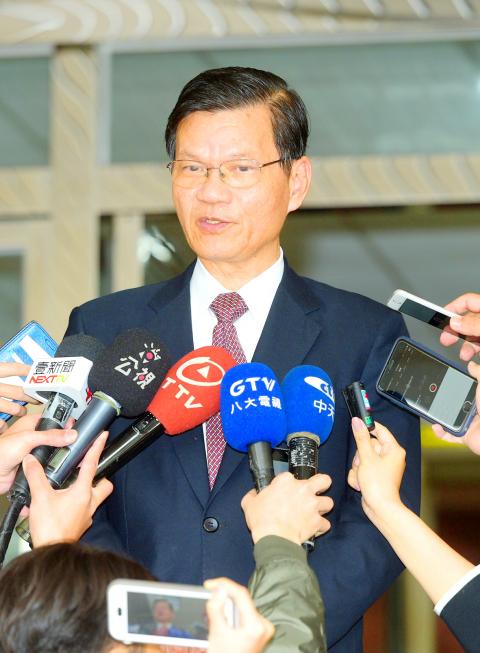
Photo: Chang Chia-ming, Taipei Times
It forwarded the case to the Judicial Yuan’s Public Functionary Disciplinary Sanction Commission to decide what punishment Wong would face.
The statement said the Control Yuan was being abusive and made an unsound judgement, citing Wong’s stature as a top scientist with international honors and his contributions to the institution during his tenure.
“We hope Wong’s involvement in the OBI Pharma case will be judged fairly. However, the judicial authorities did not abide by the fundamental principles of secrecy of investigation and presumption of innocence. As a result, the media produced many misleading reports, which greatly damaged Wong’s reputation,” the statement said.
“Despite Wong’s case still being in the court, the Control Yuan adopted the prosecutors’ partial accusations and hurried to finalize his impeachment without ever giving him the opportunity to defend himself,” it said.
“We express our serious concerns about the undue procedure,” it said. “Also, we strongly condemn the Control Yuan’s unsound and abusive judgement on the highest academic institution’s former president. We call on the judicial authorities to follow procedural justice and conduct just trials.”
“Why have the authorities embarrassed him like this?” academic Lee Kuo-hsiung (李國雄) asked.
Wong transferred patent techniques to OBI Pharma when there was no review procedure, Lee said, adding that Wong helped set up Academia Sinica’s review procedure during his tenure.
Despite the procedure, Wong’s patent transfer was called illegal, which might affect investment in the biotech industry, Lee said.
Academic Wang Fan-sen (王汎森) said that the Control Yuan should not have made a rash judgement before the trial is complete.
Wong is a prominent biochemist who has worked in the US and had been touted as a potential winner of a Nobel prize for his research.
Appointed Academia Sinica president in October 2007, Wong began working on new cancer vaccine technologies and collaborated on research projects with OBI Pharma chairman Michael Chang (張念慈), a friend from the time he was at the Massachusetts Institute of Technology.
Wong tendered his resignation in March last year, which was approved by the Presidential Office two months later.
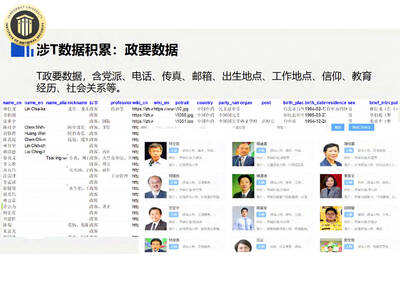
NETWORK-MAPPING PROJECT: The database contains 170 detailed files of Taiwanese politicians and about 23 million records of household registration data in Taiwan China has developed a network-mapping project targeting political figures and parties in Taiwan to monitor public opinion during elections and to craft tailored influence campaigns aimed at dividing Taiwanese society, according to documents leaked by Chinese technology firm GoLaxy (中科天璣). The documents, collected by Taipei-based Doublethink Lab, showed a database was specifically created to gather detailed information on Taiwanese political figures, including their political affiliations, job histories, birthplaces, residences, education, religion and a brief biography about them. Several notable Taiwanese politicians are in the database, including President William Lai (賴清德), former president Tsai Ing-wen (蔡英文), Minister of Foreign Affairs Lin Chia-lung (林佳龍),
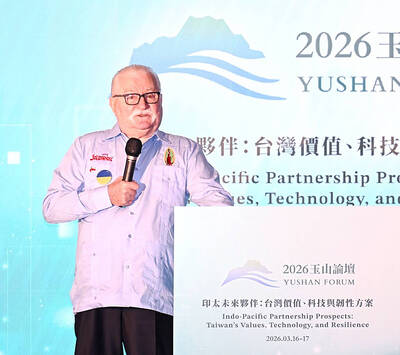
RECOGNITION: Former Fijian prime minister Mahendra Chaudhry said that Taiwan’s New Southbound Policy serves as a stabilizing force in the Indo-Pacific region Taiwan can lead the unification of the Chinese people, Nobel Peace Prize laureate and former Polish president Lech Walesa said in Taipei yesterday, adding that as the world order is changing, peaceful discussion would find good solutions, and that the use of force and coercion would always fail. Walesa made the remarks during his keynote address at a luncheon of the Yushan Forum in Taipei, titled “Indo-Pacific Partnership Prospects: Taiwan’s Values, Technology and Resilience,” organized by the Taiwan-Asia Exchange Foundation with the Ministry of Foreign Affairs. Walesa said that he had been at the forefront of a big peaceful revolution and “if
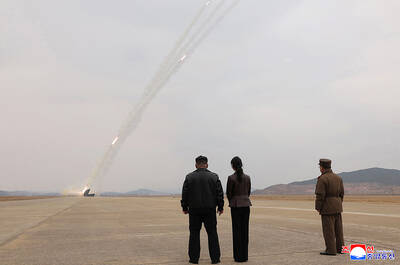
North Korea tested nuclear-capable rocket launchers, state media reported yesterday, a day after Seoul detected the launch of about 10 ballistic missiles. The test comes after South Korean and US forces launched their springtime military drills, due to run until Thursday. North Korean leader Kim Jong-un on Saturday oversaw the testing of the multiple rocket launcher system (MRLS), the Korean Central News Agency (KCNA) said. The test involved 12 600mm-caliber ultra-precision multiple rocket launchers and two artillery companies, it said. Kim said the drill gave Pyongyang’s enemies, within the 420km striking range, a sense of “uneasiness” and “a deep understanding
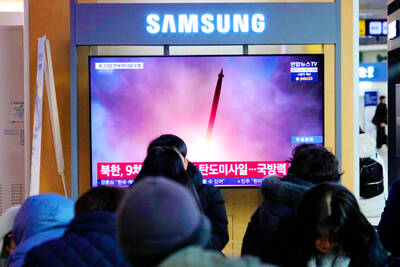
North Korea yesterday fired about 10 ballistic missiles to the sea toward Japan, the South Korean Joint Chiefs of Staff (JCS) said, days after Pyongyang warned of “terrible consequences” over ongoing South Korea-US military drills. Pyongyang recently dashed hopes of a diplomatic thaw with Seoul, Washington’s security ally, describing its latest peace efforts as a “clumsy, deceptive farce.” Seoul’s military detected “around 10 ballistic missiles launched from the Sunan area in North Korea toward the East Sea [Sea of Japan] at around 1:20pm,” JCS said in a statement, referring to South Korea’s name for the body of water. The missiles


 RSS
RSS