


A research team at Taipei Medical University (TMU) has begun using a “smart” wearable device that monitors patients’ health condition and helps stop violent acts by patients against hospital staff.
Two hundred and ninety-four cases of emergency room (ER) violence were reported last year, one-third of which were caused by people who were drunk, according to Ministry of Health and Welfare statistics.
Providing medical care to people who were drunk is often difficult, as they tend to exhibit emotional problems, said Li Yu-chuan (李友專), dean of the university’s College of Medical Science and Technology.
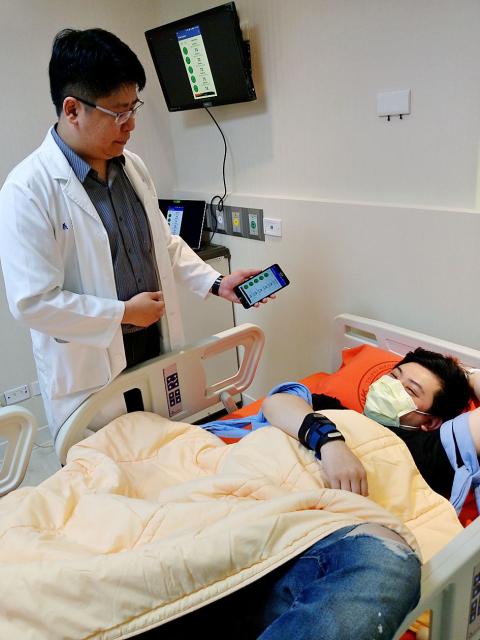
Photo: Wu Liang-yi, Taipei Times
Healthcare workers are also exposed to violent behavior from such patients, Li added.
Fighting among drunk patients occurs more often in the nation’s south, E-Da Hospital physician Lin Kuo-hsuan (林國軒) said.
Drunk people found on the streets are also taken to emergency rooms, further adding to the problem, Lin said.
Drunk people are often restless and might damage medical equipment or hurt healthcare workers, he said, adding that the patients need to be monitored until they sober up, as they might suffocate from vomiting or lose consciousness.
A collaborated clinical experiment involving TMU Hospital and E-da Hospital used a “smart” wearable device on drunk patients in the emergency room to monitor their heartbeat and make sure they were not in critical condition.
The device also allowed healthcare professionals to keep a safe distance from such patients.
Simulated “smart wards” are included in the college’s curriculum, allowing students to learn as if they are in an actual emergency room performing medical treatment, Chou Kuei-ru (周桂如) said, TMU College of Nursing dean.
“Smart” wearable devices are utilized in the simulations where patients’ vital signs can be checked without disturbing them, Chou said.
Li said the College of Medical Science and Technology also established a Healthcare Internet of Things (IoT) medical research alliance earlier this year, promoting “IoT in acute care” and “IoT in chronic care” using “smart” wearable devices.
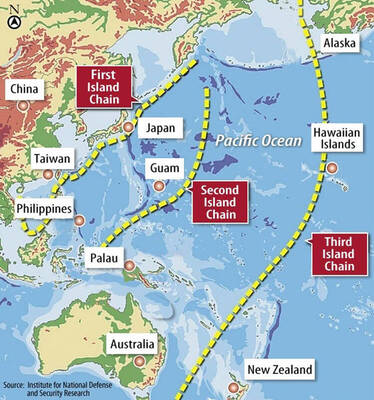
The US government has signed defense cooperation agreements with Japan and the Philippines to boost the deterrence capabilities of countries in the first island chain, a report by the National Security Bureau (NSB) showed. The main countries on the first island chain include the two nations and Taiwan. The bureau is to present the report at a meeting of the legislature’s Foreign Affairs and National Defense Committee tomorrow. The US military has deployed Typhon missile systems to Japan’s Yamaguchi Prefecture and Zambales province in the Philippines during their joint military exercises. It has also installed NMESIS anti-ship systems in Japan’s Okinawa
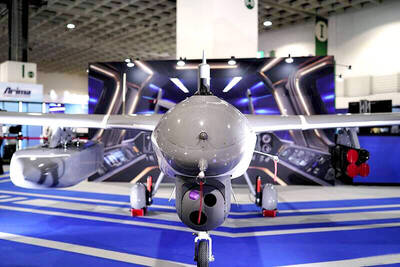
‘WIN-WIN’: The Philippines, and central and eastern European countries are important potential drone cooperation partners, Minister of Foreign Affairs Lin Chia-lung said Minister of Foreign Affairs Lin Chia-lung (林佳龍) in an interview published yesterday confirmed that there are joint ventures between Taiwan and Poland in the drone industry. Lin made the remark in an exclusive interview with the Chinese-language Liberty Times (the Taipei Times’ sister paper). The government-backed Taiwan Excellence Drone International Business Opportunities Alliance and the Polish Chamber of Unmanned Systems on Wednesday last week signed a memorandum of understanding in Poland to develop a “non-China” supply chain for drones and work together on key technologies. Asked if Taiwan prioritized Poland among central and eastern European countries in drone collaboration, Lin
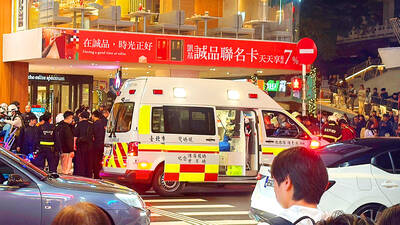
TRAGEDY STRIKES TAIPEI: The suspect died after falling off a building after he threw smoke grenades into Taipei Main Station and went on a killing spree in Zhongshan A 27-year-old suspect allegedly threw smoke grenades in Taipei Main Station and then proceeded to Zhongshan MRT Station in a random killing spree that resulted in the death of the suspect and two other civilians, and seven injured, including one in critical condition, as of press time last night. The suspect, identified as a man surnamed Chang Wen (張文), allegedly began the attack at Taipei Main Station, the Taipei Fire Department said, adding that it received a report at 5:24pm that smoke grenades had been thrown in the station. One man in his 50s was rushed to hospital after a cardiac arrest

ON ALERT: Taiwan’s partners would issue warnings if China attempted to use Interpol to target Taiwanese, and the global body has mechanisms to prevent it, an official said China has stationed two to four people specializing in Taiwan affairs at its embassies in several democratic countries to monitor and harass Taiwanese, actions that the host nations would not tolerate, National Security Bureau (NSB) Director-General Tsai Ming-yen (蔡明彥) said yesterday. Tsai made the comments at a meeting of the legislature’s Foreign Affairs and National Defense Committee, which asked him and Minister of National Defense Wellington Koo (顧立雄) to report on potential conflicts in the Taiwan Strait and military preparedness. Democratic Progressive Party (DPP) Legislator Michelle Lin (林楚茵) expressed concern that Beijing has posted personnel from China’s Taiwan Affairs Office to its


 RSS
RSS