


Taiwan is not under China’s political control, the Presidential Office said yesterday in response to China’s blocking of Taiwan from attending this year’s World Heath Assembly (WHA) in Geneva, Switzerland.
“Taiwan is not a province that is governed by the People’s Republic of China [PRC]. The Republic of China [ROC] is a sovereign nation,” the statement said.
The ROC government does not recognize or accept the actions of the government of the PRC, the statement added.
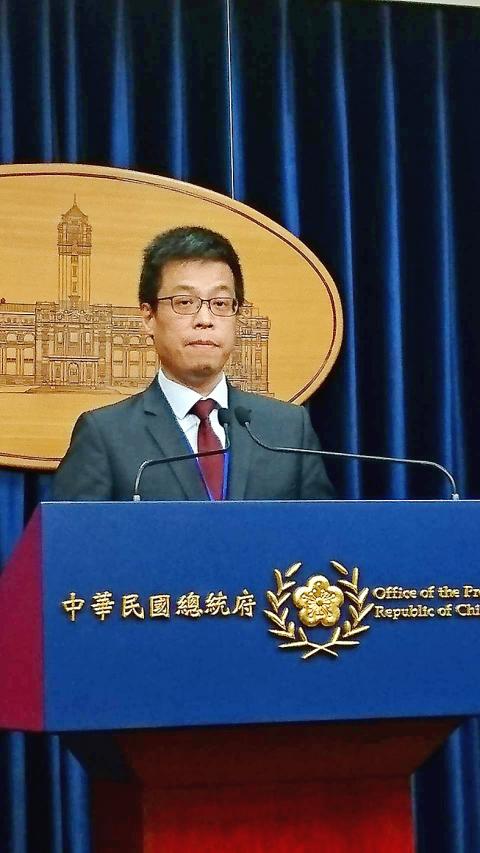
Photo: Chung Li-hua, Taipei Times
Chinese National Health and Family Planning Commission Chairperson Li Bin (李斌) has all but closed the door on Taiwan’s participation at the WHO’s annual assembly until Taiwan accepts Beijing’s “one China” principle.
Speaking to reporters on Sunday, Li said that China had previously “agreed to let the Taiwan region attend” WHA meetings under a “special arrangement” based on acceptance of the “one China” principle, adding that the refusal of President Tsai Ing-wen’s (蔡英文) Democratic Progressive Party (DPP) to accept the principle “has destroyed the goodwill basis for the continuous attendance of the Taiwan region at the assembly.”
“It is the DPP itself which has set the barrier that has impeded the participation of the Taiwan region at the WHA,” Li said. “Only when the political basis that reflects the ‘one China’ principle has been confirmed can regular exchanges across the [Taiwan] Strait be sustained.”
Presidential Office spokesman Alex Huang (黃重諺) said China’s use of political reasoning to force the exclusion of Taiwan from international organizations would cause it to lose the support of the international community.
“The prevention of epidemics should have nothing to do with the borders of nations; the WHO belongs to the world,” Huang said.
Taiwanese are members of the global community and have the same rights to health as people elsewhere, he said, adding that Taiwan is committed to continuing working with the international community on health-related issues.
The Mainland Affairs Council yesterday said the government has never adhered to Beijing’s “one China” principle.
The council strongly criticized China’s “confusion of the international community and attempt to conceal the facts.”
Taiwan’s years of contributions to world health have been achieved through the hard work of the public and the government, and has nothing to do with the “one China” principle, it said.
“China will not achieve its political aims by pressuring Taiwan. Doing so will only cause the two nations to drift farther apart,” the council said.
The Ministry of Foreign Affairs said China’s insistence on adherence to the “one China” principle is unilateral and not in accordance with the facts.
The DPP said in a statement that as a sovereign nation, Taiwan’s right to join the WHO should not be unilaterally decided by Beijing.
Additional reporting by Chiu Yan-ling and AP

The Legislative Yuan’s Finance Committee yesterday approved proposed amendments to the Amusement Tax Act (娛樂稅法) that would abolish taxes on films, cultural activities and competitive sporting events, retaining the fee only for dance halls and golf courses. The proposed changes would set the maximum tax rate for dance halls and golf courses at 50 and 20 percent respectively, with local governments authorized to suspend the levies. Article 2 of the act says that “amusement tax shall be levied on tickets sold or fees charged by amusement places, facilities or activities” in six categories: “Cinema; professional singing, story-telling, dancing, circus, magic show, acrobatics

Tainan, Taipei and New Taipei City recorded the highest fines nationwide for illegal accommodations in the first quarter of this year, with fines issued in the three cities each exceeding NT$7 million (US$220,639), Tourism Administration data showed. Among them, Taipei had the highest number of illegal short-term rental units, with 410. There were 3,280 legally registered hotels nationwide in the first quarter, down by 14 properties, or 0.43 percent, from a year earlier, likely indicating operators exiting the market, the agency said. However, the number of unregistered properties rose to 1,174, including 314 illegal hotels and 860 illegal short-term rental
INFLATION UP? The IMF said CPI would increase to 1.5 percent this year, while the DGBAS projected it would rise to 1.68 percent, with GDP per capita of US$44,181 The IMF projected Taiwan’s real GDP would grow 5.2 percent this year, up from its 2.1 percent outlook in January, despite fears of global economic disruptions sparked by the US-Iran conflict. Taiwan’s consumer price index (CPI) is projected to increase to 1.5 percent, while unemployment would be 3.4 percent, roughly in line with estimates for Asia as a whole, the international body wrote in its Global Economic Outlook Report published in the US on Monday. The figures are comparatively better than the IMF outlook for the rest of the world, which pegged real GDP growth at 3.1 percent, down from 3.3 percent
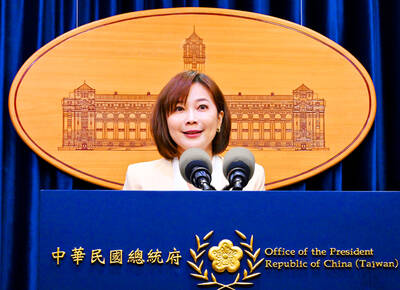
ECONOMIC COERCION: Such actions are often inconsistently applied, sometimes resumed, and sometimes just halted, the Presidential Office spokeswoman said The government backs healthy and orderly cross-strait exchanges, but such arrangements should not be made with political conditions attached and never be used as leverage for political maneuvering or partisan agendas, Presidential Office spokeswoman Karen Kuo (郭雅慧) said yesterday. Kuo made the remarks after China earlier in the day announced 10 new “incentive measures” for Taiwan, following a landmark meeting between Chinese President Xi Jinping (習近平) and Chinese Nationalist Party (KMT) Chairwoman Cheng Li-wun (鄭麗文) in Beijing on Friday. The measures, unveiled by China’s Xinhua news agency, include plans to resume individual travel by residents of Shanghai and China’s Fujian


 RSS
RSS