


The government yesterday denounced Taiwan’s exclusion from this year’s World Health Assembly (WHA), but said it would still send a delegation to Geneva, Switzerland, at the time the 10-day conference is being held.
Taiwan had hoped to once again attend the WHA, to be held in Geneva from May 22 to May 31, as an observer, but it did not receive an invitation from the WHO by the deadline on Monday for online registration because of Chinese obstruction.
The WHA is the WHO’s decisionmaking body.
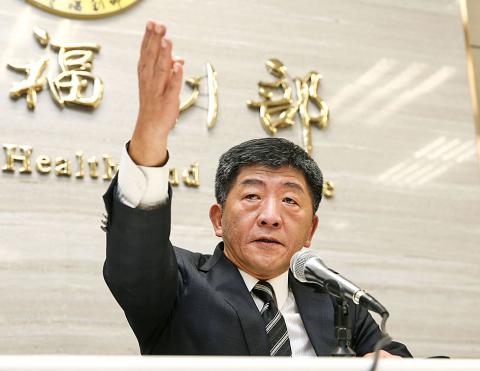
Photo: CNA
Ministry of Foreign Affairs spokesperson Eleanor Wang (王珮玲) said that Minister of Health and Welfare Chen Shih-chung (陳時中) would lead a delegation to Geneva at the time of the WHA.
If the delegation is not allowed to enter the conference venue, it would still take the opportunity to hold bilateral meetings on the sidelines with delegations of participating nations, Wang said.
Taiwan would have several opportunities to exchange views on global health issues with representatives from other nations during the WHA, she said.
The ministry also said in a statement that if the WHO “succumbs to political pressure” and ultimately decides not to invite Taiwan to the WHA, it would affect the health rights of the 23 million Taiwanese and create a serious gap in the international health system.
At a separate news conference yesterday, Chen said that “the main purpose of attending the WHA is to protect the health and safety of all Taiwanese,” adding that Taiwan also hopes to provide professional, substantial and meaningful contributions to help protect the health and safety of people around the world.
Chen said that if he comes across China’s representative on the sidelines of the WHA, he would stress the importance of Taiwan’s participation in light of global efforts to combat epidemics.
Meanwhile, the Mainland Affairs Council strongly protested China’s obstruction of Taiwan’s participation at the meeting.
In a statement yesterday, the council accused Beijing of using “unilateral political reasons” to exert pressure on the WHO and block it from extending an invitation to Taiwan to attend this year’s WHA.
“The Mainland Affairs Council expresses strong discontent and protests this suppression of our government in violation of the mission of the WHO, as well as the rights and interests of Taiwan’s 23 million people,” the council said.
Beijing has been obstructing the nation’s bids to take part in the International Civil Aviation Organization and the WHO in an attempt to exert pressure on Taipei to achieve its political objectives, it said.
“We will never succumb to Beijing’s pressure, but will continue to make our voice heard in the international community, and fight for our right to participate in the WHA and other international organizations,” the council said.
Saying that the nation’s participation in the WHA was highly anticipated by Taiwanese, the council urged Beijing to carefully consider the consequences of the move and the possible damage it could cause to cross-strait relations.
Additional reporting by Lee I-chia

The National Chungshan Institute of Science and Technology yesterday showcased its locally developed variants of the Vision 60 robotic patrol dog, which it plans to deploy on the nation’s outlying territories in the South China Sea. The variants were produced under the Joint Lab project — created by the institute and domestic companies — and assembled with domestically produced motors, lenses and artificial intelligence (AI) systems alongside licensed tech from the US, Missile and Rocket Systems Research Division deputy director Jen Kuo-kang (任國光) told the media event at a military base in Taipei’s Dazhi (大直) area. Taiwan has built up its strengths

RIGHT DIRECTION: Taiwan’s efforts to prevent forced labor include a proposal to ‘fully prohibit’ employers from withholding workers’ documents, an official said Taiwan is to establish a mechanism to restrict imports of goods linked to forced labor, the Executive Yuan said yesterday, after the US proposed imposing additional tariffs on Taiwanese goods over labor concerns. “The Ministry of Labor and the Ministry of Economic Affairs are to establish an interministerial review procedure,” Executive Yuan spokesperson Michelle Lee (李慧芝) said at a news briefing in Taipei. “The government is to use the Foreign Trade Act [貿易法] as the legal basis to restrict imports of goods produced with forced labor” and bring its supply chain governance more in line with international standards on human rights, resilience

NOT IMMEDIATE: Taiwan has a chance to appeal the proposed 10 percent tariff before it starts, while other countries face a 12.5 percent tariff from the trade office Taiwan is among 60 economies determined by the US to have failed to impose or enforce a ban on the importation of goods produced with forced labor, according to a notice released on Tuesday by the Office of the US Trade Representative (USTR), which proposed imposing an additional 10 percent or more tariff on them. The USTR in a statement said that following an investigation, it had determined under Section 301 of the Trade Act of 1974 that the failure of the 60 economies to impose and effectively enforce a prohibition on the importation of goods produced with forced labor is

TIT-FOR-TAT: The US allegedly revoked the visa of a Chinese national working at Xinhua News Agency in the US in response to Beijing’s expulsion of Vivian Wang The Presidential Office yesterday condemned China for expelling a New York Times correspondent from Beijing following the newspaper’s interview with President William Lai (賴清德), saying the move highlighted Beijing’s suppression of press freedom and its threat to international news media. Taiwan has noted a series of recent incidents in which Beijing used similar tactics to “threaten and pressure international media outlets and journalists,” Presidential Office spokeswoman Karen Kuo (郭雅慧) said in a statement. “This concerns not only press freedom and freedom of expression, but also the safety of journalists, and Taiwan and relevant partners are paying close attention to the situation,” she


 RSS
RSS