


Hamas on Monday unveiled a new policy document easing its stance on Israel after having called for years for the country’s destruction, as the Palestinian Islamist movement seeks to improve its international standing.
The move came ahead of a first face-to-face meeting today between US President Donald Trump and Palestinian President Mahmoud Abbas, whose Fatah party remains deeply divided from Hamas.
The document was unveiled in the Qatari capital, Doha, by exiled Hamas leader Khaled Meshaal, who is due to step down soon after serving his maximum of two terms.
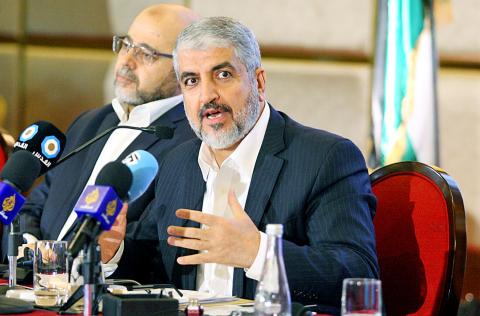
Photo: Reuters
Meshaal said he hoped the new US administration would “act with more seriousness on the Palestinian cause and change its misconceptions about the Palestinian people.”
The press conference was also broadcast live in the Gaza Strip, the Palestinian enclave controlled by Hamas, and the document was posted on the movement’s Web site.
“We in Hamas believe that renewal and reinvention is a necessity,” Meshaal said at the event in a Doha hotel.
While the new document does not amount to recognition of Israel as demanded by the international community, Hamas officials said, it formally softens its stance in a few key areas.
Hamas leaders have long spoken of the more limited aim of a Palestinian state in the West Bank and the Gaza Strip without explicitly setting this out in their charter.
However, after years of internal debate, the new document formally accepts the idea of a state in the territories occupied by Israel in the Six-Day War of 1967.
The document also says its struggle is not against Jews because of their religion, but against Israel as an occupier.
“We are not fighting against the Jews because they are Jewish,” Meshaal said.
“We are waging this struggle against the aggression of Zionists,” he said.
However, the original 1988 charter will not be dropped, just supplemented, in a move some analysts see as a way of maintaining the backing of hardliners.
Asked if Hamas would negotiate directly with Israelis, Meshaal said: “Our policy is we will not engage in direct negotiations with the Israelis, because nothing in the conditions and circumstances convinces us that any conclusions can be reached.”
Direct talks is “a process, it’s a game we will not fall for it,” he said.
The new document also continues to speak of liberating historic Palestine, including areas that are today part of Israel.
Hamas is considered a terrorist group by Israel, the US and the EU, and the new document is aimed in part at easing its international isolation.
One Hamas leader, Ahmed Yusef, earlier said that the updated charter was “more moderate, more measured and would help protect us against accusations of racism, anti-Semitism and breaches of international law.”
It also does not refer to the Muslim Brotherhood, to which Hamas was closely linked when formed.
However, Israel was not convinced, with David Keye, a spokesman for Israeli Prime Minister Benjamin Netanyahu, saying: “Hamas is attempting to fool the world, but it will not succeed.”
“They dig terror tunnels and have launched thousands upon thousands of missiles at Israeli civilians,” Keyes said in a statement, referring to rockets fired from Gaza and tunnels used to carry out attacks.

SILENCING CRITICS: In addition to blocking Taiwan, China aimed to prevent rights activists from speaking out against authoritarian states, a Cabinet department said The Ministry of Foreign Affairs (MOFA) yesterday condemned transnational repression by Beijing after RightsCon, a major digital human rights conference scheduled to be held in Zambia this week, was abruptly canceled due to Chinese pressure over Taiwanese participation. This year’s RightsCon, the world’s largest conference discussing issues “at the intersection of human rights and technology,” was scheduled to take place from tomorrow to Friday in Lusaka, and expected to draw 2,600 in-person attendees from 150 countries, along with 1,100 online participants. However, organizers were forced to cancel the event due to behind-the-scenes pressure from China, the ministry said, expressing its “strongest condemnation”
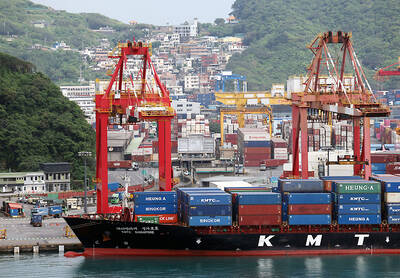
Taiwan’s economy grew far faster than expected in the first quarter, as booming demand for artificial intelligence (AI) applications drove a surge in exports, spilling over into investment and consumption, the Directorate-General of Budget, Accounting and Statistics (DGBAS) said yesterday. GDP growth was 13.69 percent year-on-year during the January-to-March period, beating the DGBAS’ February forecast by 2.23 percentage points and marking the most robust growth in nearly four decades, DGBAS senior official Chiang Hsin-yi (江心怡) told a news conference in Taipei. The result was powered by exports, which remain the backbone of Taiwan’s economy, Chiang said. Outbound shipments jumped 51.12 percent year-on-year to
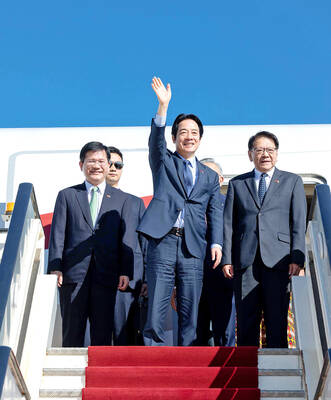
DELAYED BUT DETERMINED: The president’s visit highlights Taiwan’s right to international engagement amid regional pressure from China President Willaim Lai (賴清德) yesterday arrived in Eswatini, more than a week after his planned visit to Taiwan’s sole African ally was suspended because of revoked overflight permits. “The visit, originally scheduled for April 22, was postponed due to unforeseen external factors,” Lai wrote on social media. “After several days of careful arrangements by our diplomatic and national security teams, we successfully arrived today.” Lai said he looked forward to further deepening Taiwan-Eswatini relations through closer cooperation in the economy, agriculture, culture and education, as well as advancing the nation’s international partnerships. The president was initially scheduled to arrive in time to celebrate
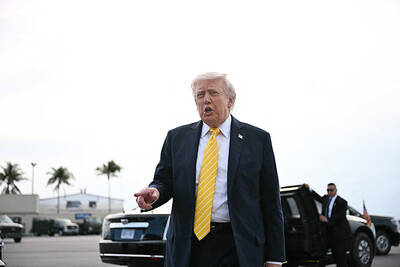
Iran’s Islamic Revolutionary Guard Corp (IRGC) yesterday said the US faced a choice between an “impossible” military operation or a “bad deal” with Tehran, after US President Donald Trump disparaged Iran’s latest peace proposal. Negotiations between the two countries have been deadlocked since a ceasefire came into effect on April 8, with only one round of direct peace talks held so far. Iran’s Tasnim and Fars news agencies reported that Tehran had submitted a 14-point proposal to mediator Pakistan, but Trump was quick to cast doubt on it. “I will soon be reviewing the plan that Iran has just sent to us, but


 RSS
RSS