


The Mainland Affairs Council yesterday stepped up the pressure on Beijing and turned to the international media to call for the release of detained human rights advocate Lee Ming-che (李明哲), saying the government would spare no efforts in defending the nation’s dignity and the rights of its citizens.
The council held an impromptu international news conference in Taipei hours after the legislature passed a motion proposed by the New Power Party accusing the government of being passive about Lee’s detention and urging it to bring the case to the attention of the international media.
“We must stress the government will do everything to defend our national security and people’s rights. Democracy and freedom are universal human rights that are protected by the Constitution and insisted upon by the 23 million Taiwanese,” Mainland Affairs Council Minister Katharine Chang (張小月) said.
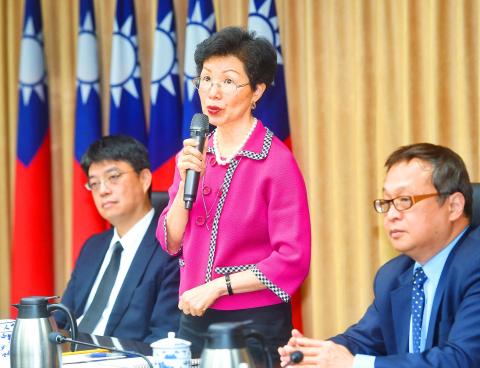
Photo: Fang Pin-chao, Taipei Times
Chang said the government’s priority is to ensure Lee’s safety, calling on Beijing to resolve the issue through dialogue and refrain from using political reasons to obstruct the case.
Reiterating the council’s three demands to Beijing, Chang said the Chinese government should immediately explain what offenses Lee has been accused of committing, disclose where he is being held and allow his family to visit him.
She dismissed criticism that the government has failed to play an active role in securing Lee’s release, saying both President Tsai Ing-wen (蔡英文) and Premier Lin Chuan (林全) have paid close attention to the case.
“The reason we decided to hold an international press conference today is indeed in response to the legislative motion, but another important factor is Beijing’s denial of a planned visit by Lee’s wife,” Chang said. “We have to express our stern protest and discontent over the denial of a visit that should have been permitted on humanitarian grounds.”
Lee’s wife, Lee Ching-yu (李凈瑜), planned to fly to Beijing on Monday to seek a meeting with her husband, but her “Taiwan compatriot travel document” was rescinded by the Chinese government.
Asked whether the government would consider resorting to private channels to handle the case, such as a Taiwanese man named Lee Chun-min (李俊敏), Chang said the council preferred to use “official cross-strait communication channels” due to the difficulty of verifying the authenticity of information from private sources.
Lee Chun-min allegedly acted as a go-between for the Chinese government, telling Lee Ching-yu that her refusal to give up her visit would result in her husband’s “confession” being broadcast on Chinese state media.
As for the possibility of the government turning to a third nation for assistance, Chang did not give a direct response, but said the council would “make progressive efforts.”
Meanwhile, Presidential Office spokesman Alex Huang (黃重諺) said that Tsai attaches great importance to the case.
Huang said the Presidential Office has instructed government agencies to spare no efforts to safeguard Lee Ming-che’s rights and ensure his safety, while providing care and assistance to his family and negotiating with Beijing.

The Legislative Yuan’s Finance Committee yesterday approved proposed amendments to the Amusement Tax Act (娛樂稅法) that would abolish taxes on films, cultural activities and competitive sporting events, retaining the fee only for dance halls and golf courses. The proposed changes would set the maximum tax rate for dance halls and golf courses at 50 and 20 percent respectively, with local governments authorized to suspend the levies. Article 2 of the act says that “amusement tax shall be levied on tickets sold or fees charged by amusement places, facilities or activities” in six categories: “Cinema; professional singing, story-telling, dancing, circus, magic show, acrobatics

Tainan, Taipei and New Taipei City recorded the highest fines nationwide for illegal accommodations in the first quarter of this year, with fines issued in the three cities each exceeding NT$7 million (US$220,639), Tourism Administration data showed. Among them, Taipei had the highest number of illegal short-term rental units, with 410. There were 3,280 legally registered hotels nationwide in the first quarter, down by 14 properties, or 0.43 percent, from a year earlier, likely indicating operators exiting the market, the agency said. However, the number of unregistered properties rose to 1,174, including 314 illegal hotels and 860 illegal short-term rental
INFLATION UP? The IMF said CPI would increase to 1.5 percent this year, while the DGBAS projected it would rise to 1.68 percent, with GDP per capita of US$44,181 The IMF projected Taiwan’s real GDP would grow 5.2 percent this year, up from its 2.1 percent outlook in January, despite fears of global economic disruptions sparked by the US-Iran conflict. Taiwan’s consumer price index (CPI) is projected to increase to 1.5 percent, while unemployment would be 3.4 percent, roughly in line with estimates for Asia as a whole, the international body wrote in its Global Economic Outlook Report published in the US on Monday. The figures are comparatively better than the IMF outlook for the rest of the world, which pegged real GDP growth at 3.1 percent, down from 3.3 percent
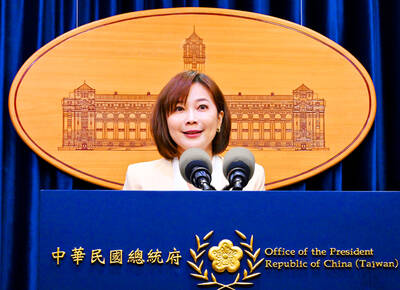
ECONOMIC COERCION: Such actions are often inconsistently applied, sometimes resumed, and sometimes just halted, the Presidential Office spokeswoman said The government backs healthy and orderly cross-strait exchanges, but such arrangements should not be made with political conditions attached and never be used as leverage for political maneuvering or partisan agendas, Presidential Office spokeswoman Karen Kuo (郭雅慧) said yesterday. Kuo made the remarks after China earlier in the day announced 10 new “incentive measures” for Taiwan, following a landmark meeting between Chinese President Xi Jinping (習近平) and Chinese Nationalist Party (KMT) Chairwoman Cheng Li-wun (鄭麗文) in Beijing on Friday. The measures, unveiled by China’s Xinhua news agency, include plans to resume individual travel by residents of Shanghai and China’s Fujian


 RSS
RSS