


A military source on Friday confirmed plans for the production of an upgraded version of the navy’s Tuo Chiang-class stealth corvette that is to incorporate expanded anti-aircraft capabilities.
The new vessel type is to be longer, wider and equipped with 3D radar systems and a ship-to-air version of the Tien Chien II (“Sky Sword”) guided missile system.
A total of 11 vessels are to be produced in three lots, for a total of 12 ships including the original Tuo Chiang-class corvette, the source said.
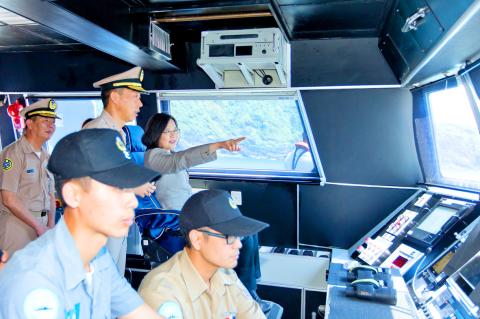
Photo courtesy of the Military News Agency
The navy plans to begin operating three of the new vessels and make design adjustments where needed before commissioning the subsequent two lots, the source said, adding that the first lot is scheduled to be completed by 2025 at a cost of NT$14.434 billion (US$471.68 million).
Navy contractors are to submit final designs by the end of this month, when final bidding for the contract is also to take place, the source said.
The displacement of the upgraded vessels is to increase by about 100 tonnes from the current model’s 567 tonnes. They are also being designed to reach a maximum speed of more than 30 knots (55.56kph), the source said.
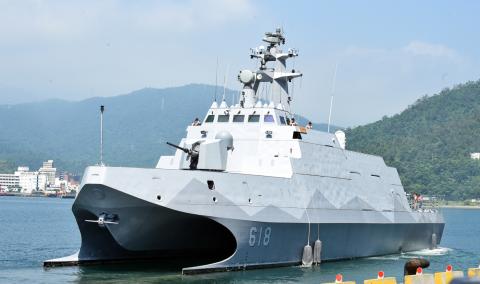
Photo: Liu Hsin-de, Taipei Times
The class’ length is to be increased from 60.4m to 65m, while width is to increase from 14m to 15m and draft is to increase from 2.3m to 3m, the source said.
The size increases would result in ships of the upgraded class being able to carry more personnel, from the original vessel’s 41 crew to 53, with sleeping quarters to be adjusted to accommodate the additional personnel, the source said.
The decision to upgrade the Tuo Chiang-class corvette was based primarily on a need to improve its anti-aircraft capabilities, the source said, adding that the Tien Chien II missile and 3D radar systems would complement the current model’s Hsiung Feng II and Hsiung Feng III (“Brave Wind”) anti-ship missiles.
“The Hsiung Feng and Tien Chien missile systems can be combined in whatever configuration the mission calls for,” the source added.
The biggest visible change would be to the radar mast, which is to be larger on the upgraded vessels due to the 3D radar system, the source said.
The bridge on the new vessels would be larger than the original’s, with a closed tower-style mast containing the radar system fitted above, the source added.

PROVOCATIVE: Chinese Deputy Ambassador to the UN Sun Lei accused Japan of sending military vessels to deliberately provoke tensions in the Taiwan Strait China denounced remarks by Japan and the EU about the South China Sea at a UN Security Council meeting on Monday, and accused Tokyo of provocative behavior in the Taiwan Strait and planning military expansion. Ayano Kunimitsu, a Japanese vice foreign minister, told the Council meeting on maritime security that Tokyo was seriously concerned about the situation in the East China and South China seas, and reiterated Japan’s opposition to any attempt to change the “status quo” by force, and obstruction of freedom of navigation and overflight. Stavros Lambrinidis, head of the EU delegation to the UN, also highlighted South China Sea

SILENCING CRITICS: In addition to blocking Taiwan, China aimed to prevent rights activists from speaking out against authoritarian states, a Cabinet department said The Ministry of Foreign Affairs (MOFA) yesterday condemned transnational repression by Beijing after RightsCon, a major digital human rights conference scheduled to be held in Zambia this week, was abruptly canceled due to Chinese pressure over Taiwanese participation. This year’s RightsCon, the world’s largest conference discussing issues “at the intersection of human rights and technology,” was scheduled to take place from tomorrow to Friday in Lusaka, and expected to draw 2,600 in-person attendees from 150 countries, along with 1,100 online participants. However, organizers were forced to cancel the event due to behind-the-scenes pressure from China, the ministry said, expressing its “strongest condemnation”
Taiwan Semiconductor Manufacturing Co (TSMC, 台積電), the world’s largest contract chipmaker, said it expects its 2-nanometer (2nm) chip capacity to grow at a compound annual rate of 70 percent from this year to 2028. The projection comes as five fabs begin volume production of 2-nanometer chips this year — two in Hsinchu and three in Kaohsiung — TSMC senior vice president and deputy cochief operating officer Cliff Hou (侯永清) said at the company’s annual technology symposium in Silicon Valley, California, last week. Output in the first year of 2-nanometer production, which began in the fourth quarter of last year, is expected to
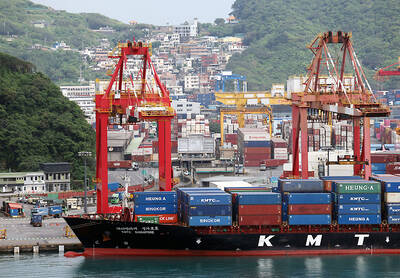
Taiwan’s economy grew far faster than expected in the first quarter, as booming demand for artificial intelligence (AI) applications drove a surge in exports, spilling over into investment and consumption, the Directorate-General of Budget, Accounting and Statistics (DGBAS) said yesterday. GDP growth was 13.69 percent year-on-year during the January-to-March period, beating the DGBAS’ February forecast by 2.23 percentage points and marking the most robust growth in nearly four decades, DGBAS senior official Chiang Hsin-yi (江心怡) told a news conference in Taipei. The result was powered by exports, which remain the backbone of Taiwan’s economy, Chiang said. Outbound shipments jumped 51.12 percent year-on-year to


 RSS
RSS