


Japanese Prime Minister Shinzo Abe will propose new Cabinet-level US-Japan talks on trade, security and macroeconomic issues, including currencies, when he meets US President Donald Trump today, a Japanese government official involved in planning the summit said.
Abe was late yesterday scheduled to head to Washington hoping promises to help create US jobs and bolster Japan’s military will persuade Trump to turn down the heat on trade and currency and stand by the decades-old alliance.
“In a situation in which security relations in the Asia-Pacific region are increasingly severe, it is very important to demonstrate the unshakable US-Japan alliance at home and abroad,” Japanese Chief Cabinet Secretary Yoshihide Suga told a news conference.
“This is the most important theme of the US-Japan leaders’ summit,” he said, adding that it was also vital to have constructive discussions on how to create a “win-win” relationship by further strengthening US-Japan economic ties.
Trump has lumped Japan with China and Mexico as big contributors to the US trade deficit, targeted its auto industry as “unfair” and accused Tokyo of using monetary policy to devalue its currency to boost exports.
“We use monetary easing, fiscal policy and structural reform in order to escape from deflation. We don’t engage in competitive currency devaluation or target specific levels,” said Masahiko Shibayama, an adviser to Abe. “We’ll explain based on the fact that Japanese automakers are contributing to US jobs through their local subsidiaries.”
During his election campaign, Trump complained Tokyo was not sharing enough of the cost of the US security umbrella, although US Secretary of Defense James Mattis assured Japan that the alliance was firm when he visited the country last week.
Abe, who is to be accompanied by Japanese Minister of Finance Taro Aso and Japanese Minister of Foreign Affairs Fumio Kishida, will present a package of steps Tokyo says could create 700,000 jobs in the US through private-public investment in infrastructure, such as high-speed trains, government sources said.
Trump, who abandoned the 12-nation Trans-Pacific Partnership trade pact championed by former US president Barack Obama and Abe as a counterweight to a rising China, has made clear he wants a bilateral free-trade agreement (FTA) with Tokyo instead.
Abe has left the door open to FTA talks, but Japanese officials worry such negotiations would boost pressure on politically sensitive sectors, such as agriculture, while yielding few economic benefits for Japan.
The new Cabinet-level talks would be a way of buying time rather than opening FTA talks at an early stage, the government official told reporters.
The new economic framework is to be headed by Aso, who is also deputy prime minister, and US Vice President Mike Pence, and would address a range of issues, with a focus on crafting trade policies and measures to bolster US employment, the Nikkei business daily reported.
Abe and Trump are also to play a round of golf in Florida this weekend after the meeting at the White House, with Trump saying that he would make sure Abe is his partner in the game, rather than a competitor.
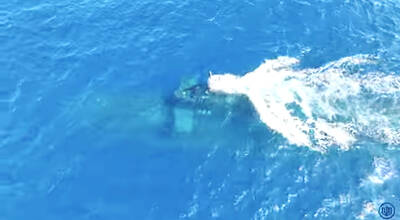
CSBC Corp, Taiwan (台灣國際造船) yesterday released the first video documenting the submerged sea trials of Taiwan’s indigenous defense submarine prototype, the Hai Kun (海鯤), or Narwhal, showing underwater navigation and the launch of countermeasures. The footage shows the vessel’s first dive, steering and control system tests, and the raising and lowering of the periscope and antenna masts. It offered a rare look at the progress in the submarine’s sea acceptance tests. The Hai Kun carried out its first shallow-water diving trial late last month and has since completed four submerged tests, CSBC said. The newly released video compiles images recorded from Jan. 29 to
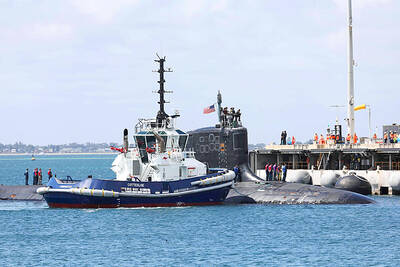
DETERRENCE EFFORTS: Washington and partners hope demonstrations of force would convince Beijing that military action against Taiwan would carry high costs The US is considering using HMAS Stirling in Western Australia as a forward base to strengthen its naval posture in a potential conflict with China, particularly over Taiwan, the Wall Street Journal reported on Saturday. As part of its Indo-Pacific strategy, Washington plans to deploy up to four nuclear-powered submarines at Stirling starting in 2027, providing a base near potential hot spots such as Taiwan and the South China Sea. The move also aims to enhance military integration with Pacific allies under the Australia-UK-US trilateral security partnership, the report said. Currently, US submarines operate from Guam, but the island could
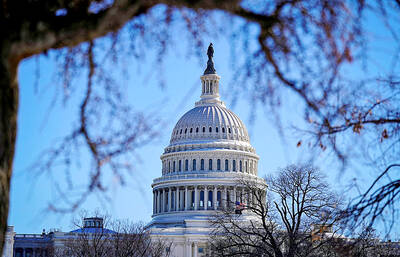
RESTRAINTS: Should China’s actions pose any threat to Taiwan’s security, economic or social systems, China would be excluded from major financial institutions, the bill says The US House of Representatives on Monday passed the PROTECT Taiwan Act, which states that Washington would exclude China from participating in major global financial organizations if its actions directly threaten Taiwan’s security. The bill, proposed by Republican Representative Frank Lucas, passed with 395 votes in favor and two against. It stipulates that if China’s actions pose any threat to Taiwan’s security, economic or social systems, the US would, “to the maximum extent practicable,” exclude Beijing from international financial institutions, including the G20, the Bank for International Settlements and the Financial Stability Board. The bill makes it clear that China must be prepared

Taiwanese trade negotiators told Washington that Taipei would not relocate 40 percent of its semiconductor production to the US, and that its most advanced technologies would remain in the nation, Vice Premier Cheng Li-chiun (鄭麗君) said on Sunday. “I told the US side very clearly — that’s impossible,” Cheng, who led the negotiation team, said in an interview that aired on Sunday night on Chinese Television System. Cheng was referring to remarks last month by US Secretary of Commerce Howard Lutnick, in which he said his goal was to bring 40 percent of Taiwan’s chip supply chain to the US Taiwan’s almost


 RSS
RSS