


President Tsai Ing-wen (蔡英文) yesterday urged government agencies to make sure everything is in order with the Mass Rapid Transit (MRT) line to Taiwan Taoyuan International Airport before it is launched next month to make the 20-year wait worthwhile.
Tsai made the remarks at Taoyuan High Speed Rail Station after riding an MRT train from the A1 stop at Taipei Main Station to the A13 Airport Terminal 2 Station and then continuing on to the high-speed rail station.
“The airport MRT line is the nation’s longest MRT system, spanning three special municipalities. It also connects the international airport with our high-speed rail, standard railway and Taipei MRT systems,” Tsai said.
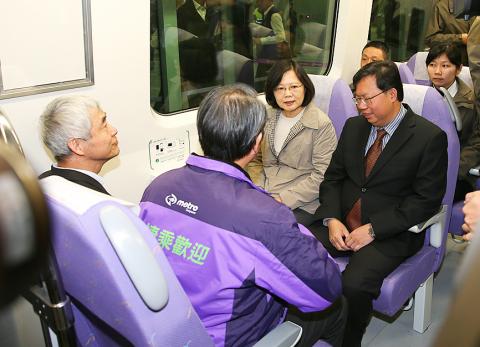
Photo: CNA
With the airport line to start a trial run tomorrow before its official launch on March 2, Tsai said public transportation will reach a new milestone with the opening of the line, which brings Taoyuan into the MRT era.
The airport line is not only expected to improve travel throughout Taipei, New Taipei City and Taoyuan, but also offers the most convenient option yet for people living in other parts of the nation who want to travel abroad, she said.
“The launch of the airport MRT line brings two significant advances. The first is that it would ... provide further impetus for the development of Taoyuan,” Tsai said.
“A more convenient transportation system will change the city’s lifestyle. [Taoyuan] Mayor Cheng Wen-tsan (鄭文燦) has also announced plans to build more social housing units along the line to help relieve population pressure in the capital,” Tsai said.
The second is that the new line would significantly increase the number of tourists and other travelers using the airport, she said.
The completion of the line is the result of concerted effort by the central and local governments to solve problems and ensure the system’s stability, Tsai said.
“The public has waited 20 years. Let us make the wait worthwhile by making sure all preparatory work is completed,” she said.
Tsai said the new line’s first test would be to see how tourists from around the world evaluate it, as it will show travelers the progress Taiwan has made.
The trial run is to be conducted in two phases. From tomorrow to Feb. 15, the line will be open to groups from government agencies and other organizations with advanced reservations.
From Feb. 16 through March 1, it will be open to the public from 8am to 4pm daily.
Planning for the line began in 1996 and construction in 2006.

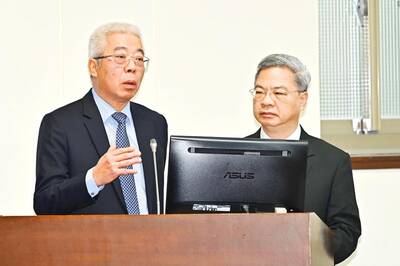
Taiwan has arranged for about 8 million barrels of crude oil, or about one-third of its monthly needs, to be shipped from the Red Sea this month to bypass the Strait of Hormuz and ease domestic supply pressures, CPC Corp, Taiwan (CPC, 台灣中油) said yesterday. The state-run oil company has worked with Middle Eastern suppliers to secure routes other than the Strait of Hormuz, through which about 20 percent of the world’s oil and liquefied natural gas typically passes, CPC chairman Fang Jeng-zen (方振仁) said at a meeting of the legislature’s Economics Committee in Taipei. Suppliers in Saudi Arabia have indicated they
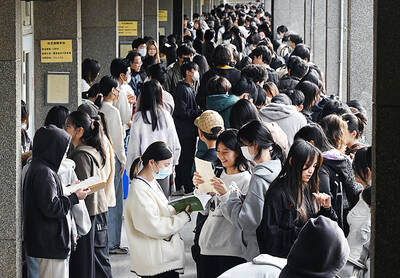
A global survey showed that 60 percent of Taiwanese had attained higher education, second only to Canada, the Ministry of the Interior said. Taiwan easily surpassed the global average of 43 percent and ranked ahead of major economies, including Japan, South Korea and the US, data from the Organisation for Economic Co-operation and Development (OECD) for 2024 showed. Taiwan has a high literacy rate, data released by the ministry showed. As of the end of last year, Taiwan had 20.617 million people aged 15 or older, accounting for 88.5 percent of the total population, with a literacy rate of 99.4 percent, the data

CCP ‘PAWN’? Beijing could use the KMT chairwoman’s visit to signal to the world that many people in Taiwan support the ‘one China’ principle, an academic said Chinese Nationalist Party (KMT) Chairwoman Cheng Li-wun (鄭麗文) yesterday arrived in China for a “peace” mission and potential meeting with Chinese President Xi Jinping (習近平), while a Taiwanese minister detailed the number of Chinese warships currently deployed around the nation. Cheng is visiting at a time of increased Chinese military pressure on Taiwan, as the opposition-dominated Legislative Yuan stalls a government plan for US$40 billion in extra defense spending. Speaking to reporters before going to the airport, Cheng said she was going on a “historic journey for peace,” but added that some people felt uneasy about her trip. “If you truly love Taiwan,

NEW LOW: The council in 2024 based predictions on a pessimistic estimate for the nation’s total fertility rate of 0.84, but last year that rate was 0.69, 17 percent lower An expected National Development Council (NDC) report expects the nation’s population to drop below 12 million by 2065, with the old-age dependency ratio to top 100 percent sooner than 2070, sources said yesterday. The council is slated to release its latest population projections in August, using an ultra-low fertility model, the sources said. The previous report projected that Taiwan’s population would fall to 14.37 million by 2070, but based on a new estimate of the total fertility rate (TFR) — the average number of children born to a woman over her lifetime — the population is expected to reach 12 million by


 RSS
RSS