


The Executive Yuan yesterday approved a multibillion-dollar project to develop the biomedical industry through a tax incentive scheme to increase innovation and export medical services to the world.
The project, which is part of President Tsai Ing-wen’s (蔡英文) campaign pledge to develop the “five plus two” innovative industries, aims to relax investment and recruitment regulations to lure and retain foreign capital and talent, and to encourage local businesses to acquire international companies and develop foreign markets, Executive Yuan spokesman Hsu Kuo-yung (徐國勇) said.
The government is to invest NT$10.94 billion (US$346.32 million) in the next year to develop 10 large-scale healthcare firms, 20 new drugs and 80 new medical devices to be marketed internationally by 2025 in a bid to boost the annual value of the biomedical industry to NT$1 trillion, Ministry of Science and Technology Department of Life Sciences Director-General Tsai Shaw-jenq (蔡少正) said.
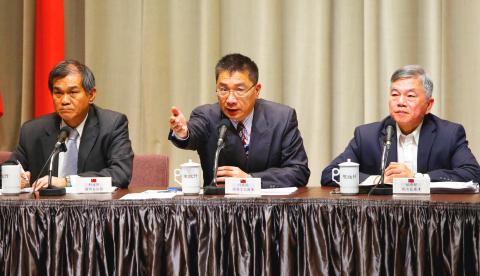
Photo: CNA
The ministry is to build a “biomedical corridor” connecting the nation’s science parks to maximize research capabilities, he said.
“The nation’s medical service is the best in Asia and the third best in the world, and we want to export the service by completing the infrastructure of the healthcare industry,” Tsai Shaw-jenq said.
The government is looking to tap into the global senior healthcare market, especially in Southeast Asia, while developing specialized medical therapies for diseases that people of Chinese ethnicity are prone to develop.
The program will also exempt biomedical start-ups from taxation in the early stages after an initial public offering, while restrictions that prohibit academics from assuming positions in private companies will be lifted to encourage university spin-off companies, Minister of Science and Technology Yang Hung-duen (楊弘敦) said.
The Executive Yuan also passed an amendment to the Act for the Development of Biotech and New Pharmaceuticals Industry (生技新藥產業發展條例) to provide tax incentives to companies as part of the development package.
The new incentive scheme allows a 35 to 50 percent tax credit on a company’s research and development expenses and personnel training cost. Shareholders are also to receive a 20 percent tax credit on the investment amount, or the purchase price of the stock, Vice Minister of Economic Affairs Shen Jong-chin (沈榮津) said.
“This is special legislation and it is the only legislation that offers a tax incentive scheme,” Shen said, adding that the act, even without the amendment, already saw investment in the biotechnology sector increase to NT$48.4 billion last year.
The amendment will also lift restrictions on the development and production of high-risk medical devices and new drugs to prompt manufacturers to develop such products, as current legislation lags behind technological advancement, Shen said.
The move will benefit about 50 medical instrument and 13 regenerative medicine firms in the fields of precision medicine, gene therapy and cell therapy, he added.

SILENCING CRITICS: In addition to blocking Taiwan, China aimed to prevent rights activists from speaking out against authoritarian states, a Cabinet department said The Ministry of Foreign Affairs (MOFA) yesterday condemned transnational repression by Beijing after RightsCon, a major digital human rights conference scheduled to be held in Zambia this week, was abruptly canceled due to Chinese pressure over Taiwanese participation. This year’s RightsCon, the world’s largest conference discussing issues “at the intersection of human rights and technology,” was scheduled to take place from tomorrow to Friday in Lusaka, and expected to draw 2,600 in-person attendees from 150 countries, along with 1,100 online participants. However, organizers were forced to cancel the event due to behind-the-scenes pressure from China, the ministry said, expressing its “strongest condemnation”
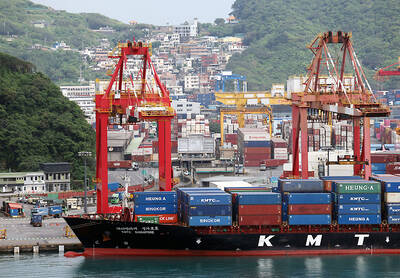
Taiwan’s economy grew far faster than expected in the first quarter, as booming demand for artificial intelligence (AI) applications drove a surge in exports, spilling over into investment and consumption, the Directorate-General of Budget, Accounting and Statistics (DGBAS) said yesterday. GDP growth was 13.69 percent year-on-year during the January-to-March period, beating the DGBAS’ February forecast by 2.23 percentage points and marking the most robust growth in nearly four decades, DGBAS senior official Chiang Hsin-yi (江心怡) told a news conference in Taipei. The result was powered by exports, which remain the backbone of Taiwan’s economy, Chiang said. Outbound shipments jumped 51.12 percent year-on-year to
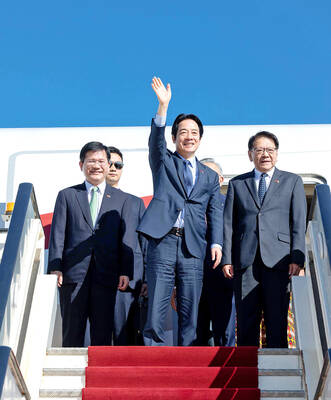
DELAYED BUT DETERMINED: The president’s visit highlights Taiwan’s right to international engagement amid regional pressure from China President Willaim Lai (賴清德) yesterday arrived in Eswatini, more than a week after his planned visit to Taiwan’s sole African ally was suspended because of revoked overflight permits. “The visit, originally scheduled for April 22, was postponed due to unforeseen external factors,” Lai wrote on social media. “After several days of careful arrangements by our diplomatic and national security teams, we successfully arrived today.” Lai said he looked forward to further deepening Taiwan-Eswatini relations through closer cooperation in the economy, agriculture, culture and education, as well as advancing the nation’s international partnerships. The president was initially scheduled to arrive in time to celebrate
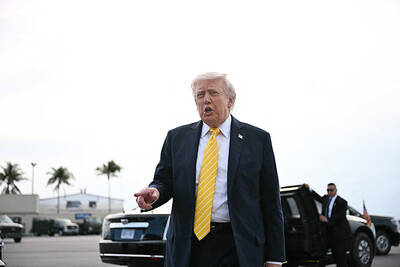
Iran’s Islamic Revolutionary Guard Corp (IRGC) yesterday said the US faced a choice between an “impossible” military operation or a “bad deal” with Tehran, after US President Donald Trump disparaged Iran’s latest peace proposal. Negotiations between the two countries have been deadlocked since a ceasefire came into effect on April 8, with only one round of direct peace talks held so far. Iran’s Tasnim and Fars news agencies reported that Tehran had submitted a 14-point proposal to mediator Pakistan, but Trump was quick to cast doubt on it. “I will soon be reviewing the plan that Iran has just sent to us, but


 RSS
RSS