


The Taipei High Administrative Court yesterday ruled against action taken by the Ill-gotten Party Assets Settlement Committee to freeze bank accounts belonging to the Chinese Nationalist Party (KMT).
The ruling came after the KMT last month applied to the court to lift the freeze, which the party said led to financial difficulties and forced it to borrow money to pay the salaries of nearly 800 party employees for September and last month.
The committee was set up by the Cabinet after the Act Governing the Handling of Ill-gotten Properties by Political Parties and Their Affiliate Organizations (政黨及其附隨組織不當取得財產處理條例) cleared the legislature in July and took effect in August.
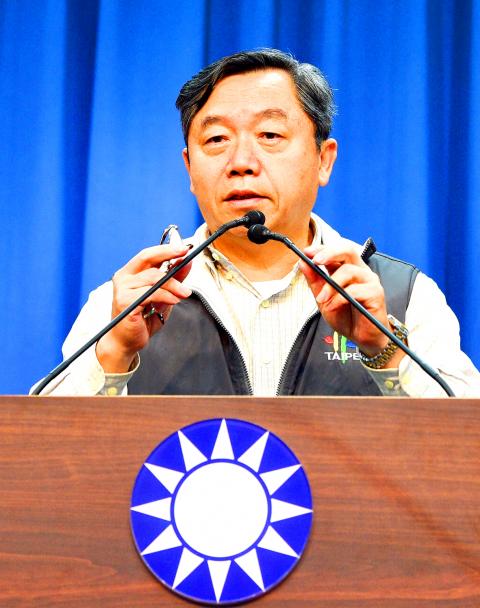
Photo: Peter Lo, Taipei Times
The committee in September froze a KMT bank account over the issuance of 10 checks worth a collective NT$520 million (US$16.52 million) immediately after the legislation — which prohibits political parties from disposing of assets presumed to have been obtained illegally — was promulgated.
Yesterday’s ruling said there were questions about the legality of the administrative injunction, as it lacked some of the legal requirements needed to freeze the KMT’s bank accounts, and therefore the committee’s action might have violated provisions in Article 9 of the act.
The committee may not impose the administrative injunction to freeze the KMT’s bank accounts, nor undertake other forms of punishment, before litigation on the case receives a final decision, the ruling said.
The KMT caucus yesterday called for the resignation of Ill-gotten Party Assets Settlement Committee Director Wellington Koo (顧立雄), saying the ruling is a slap in his face and he should be held accountable for violating the rule of law.
KMT caucus convener Sufin Siluko (廖國棟) said that the committee had, without following due legal process, “inferred” that the savings in the KMT’s accounts were ill-gotten assets and its actions meant the KMT was unable to pay its party workers.
“The just adjudication made by the court would give ‘Emperor Koo’ a lesson about the true meaning of law,” Sufin said, adding that he praised the court for its “bravery” and that Koo should step down to avoid further embarrassment.
KMT Legislator Lin Wei-chou (林為洲) said that while the KMT has always questioned the constitutionality of the act, “the committee, however, does not even abide by the act that [the DPP caucus] passed, as the court invoked the act to rule against the committee’s administrative injunction of freezing the KMT’s accounts.”
Meanwhile, KMT Administration and Management Committee Director Chiu Da-chan (邱大展) said that as the Ill-gotten Party Assets Settlement Committee is likely to appeal the court’s decision, the KMT’s accounts would remain frozen and the Supreme Administrative Court would likely be called upon to make a final ruling.
He said that the KMT is still in financial difficulty and might still have trouble paying party workers their salaries for this month.
The Ill-gotten Party Assets Settlement Committee later yesterday said it would appeal the ruling.
The judges’ ruling was erroneous and their reasons paradoxical, Koo said at a news conference, adding that the judges must have misunderstood the Act Governing the Handling of Ill-gotten Properties by Political Parties and Their Affiliate Organizations.
The Ill-gotten Party Assets Settlement Committee will be convening a session next week to discuss the “principle of clarity” that the court asked for, Koo said, adding that the committee was not ruling out handing out administrative punitive measures.
Having been a lawyer, Koo said he has learned to see difficulties at different stages, and that until the final ruling has been announced, it is too early to say whether the lawsuit has been won or lost.
Additional reporting by Chen Yu-fu and CNA
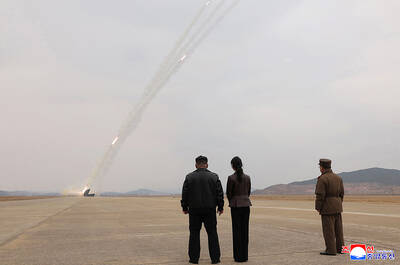
North Korea tested nuclear-capable rocket launchers, state media reported yesterday, a day after Seoul detected the launch of about 10 ballistic missiles. The test comes after South Korean and US forces launched their springtime military drills, due to run until Thursday. North Korean leader Kim Jong-un on Saturday oversaw the testing of the multiple rocket launcher system (MRLS), the Korean Central News Agency (KCNA) said. The test involved 12 600mm-caliber ultra-precision multiple rocket launchers and two artillery companies, it said. Kim said the drill gave Pyongyang’s enemies, within the 420km striking range, a sense of “uneasiness” and “a deep understanding
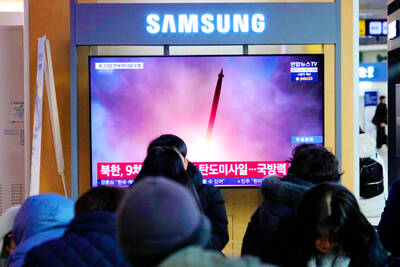
North Korea yesterday fired about 10 ballistic missiles to the sea toward Japan, the South Korean Joint Chiefs of Staff (JCS) said, days after Pyongyang warned of “terrible consequences” over ongoing South Korea-US military drills. Pyongyang recently dashed hopes of a diplomatic thaw with Seoul, Washington’s security ally, describing its latest peace efforts as a “clumsy, deceptive farce.” Seoul’s military detected “around 10 ballistic missiles launched from the Sunan area in North Korea toward the East Sea [Sea of Japan] at around 1:20pm,” JCS said in a statement, referring to South Korea’s name for the body of water. The missiles
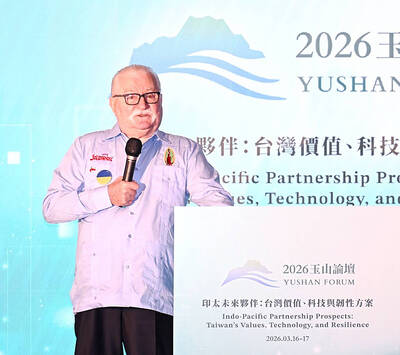
RECOGNITION: Former Fijian prime minister Mahendra Chaudhry said that Taiwan’s New Southbound Policy serves as a stabilizing force in the Indo-Pacific region Taiwan can lead the unification of the Chinese people, Nobel Peace Prize laureate and former Polish president Lech Walesa said in Taipei yesterday, adding that as the world order is changing, peaceful discussion would find good solutions, and that the use of force and coercion would always fail. Walesa made the remarks during his keynote address at a luncheon of the Yushan Forum in Taipei, titled “Indo-Pacific Partnership Prospects: Taiwan’s Values, Technology and Resilience,” organized by the Taiwan-Asia Exchange Foundation with the Ministry of Foreign Affairs. Walesa said that he had been at the forefront of a big peaceful revolution and “if

‘UNWAVERING FRIENDSHIP’: A representative of a Japanese group that co-organized a memorial, said he hopes Japanese never forget Taiwan’s kindness President William Lai (賴清德) yesterday marked the 15th anniversary of the Tohoku earthquake and tsunami, urging continued cooperation between Taiwan and Japan on disaster prevention and humanitarian assistance. Lai wrote on social media that Taiwan and Japan have always helped each other in the aftermath of major disasters. The magnitude 9 earthquake struck northeastern Japan on March 11, 2011, triggering a massive tsunami that claimed more than 19,000 lives, according to data from Japanese authorities. Following the disaster, Taiwan donated more than US$240 million in aid, making it one of the largest contributors of financial assistance to Japan. In addition to cash donations and


 RSS
RSS