


Senior officials from Japan, the US and South Korea yesterday agreed to step up pressure on North Korea as they stuck to their goal of persuading the communist state to abandon its nuclear weapons.
Their pledge comes just two days after US National Intelligence Director James Clapper publicly called that goal a “lost cause.”
He said the best hope is capping its capability instead.
The deputy foreign ministers who held talks in Tokyo made it clear that North Korea now poses a new level of threat, and requires broader international pressure and tougher sanctions.
US Deputy Secretary of State Antony Blinken, after meeting with his Japanese and South Korean counterparts, said their policy has not changed.
“We will not accept North Korea as nuclear state; we will not accept North Korea’s possession of nuclear weapons, period,” Blinken said. “We are focused on increasing the pressure on North Korea with one purpose: to bring it back to the table to negotiate in good faith. Denuclearization. That is the objective.”
Getting North Korea to give up its nuclear weapons program has long been a headache in multilateral diplomacy with Pyongyang.
Japanese Vice Minister of Foreign Affairs Shinsuke Sugiyama, who hosted the talks, cited North Korea’s recent tests showing that its missile and nuclear capability had entered a new level of threat.
“We need to respond differently than in the past,” Sugiyama said.
Officials cited the sanctions and missile defense that have already been put in place, but did not elaborate on their different approaches other than fresh sanctions pending at the UN and possible separate additional measures by the three countries.
Meanwhile, South Korea said it plans to restart talks with Japan on a military intelligence sharing agreement to better cope with threats from North Korea.
Information from Japan’s network of satellites and other intelligence-gathering systems would be critical in monitoring and preparing against the North’s fast-developing nuclear weapons and missile programs, the South Korean Ministry of National Defense said.
The US, South Korea and Japan signed a joint intelligence-sharing pact in 2014, but under the framework Seoul and Tokyo only share intelligence about North Korea’s nuclear and missile programs via Washington.
A bilateral agreement between South Korea and Japan would enable a quicker transfer of information between the two countries in urgent situations.
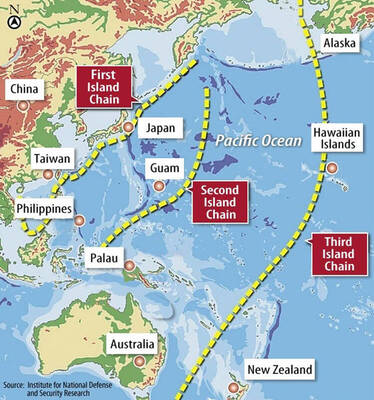
The US government has signed defense cooperation agreements with Japan and the Philippines to boost the deterrence capabilities of countries in the first island chain, a report by the National Security Bureau (NSB) showed. The main countries on the first island chain include the two nations and Taiwan. The bureau is to present the report at a meeting of the legislature’s Foreign Affairs and National Defense Committee tomorrow. The US military has deployed Typhon missile systems to Japan’s Yamaguchi Prefecture and Zambales province in the Philippines during their joint military exercises. It has also installed NMESIS anti-ship systems in Japan’s Okinawa

‘WIN-WIN’: The Philippines, and central and eastern European countries are important potential drone cooperation partners, Minister of Foreign Affairs Lin Chia-lung said Minister of Foreign Affairs Lin Chia-lung (林佳龍) in an interview published yesterday confirmed that there are joint ventures between Taiwan and Poland in the drone industry. Lin made the remark in an exclusive interview with the Chinese-language Liberty Times (the Taipei Times’ sister paper). The government-backed Taiwan Excellence Drone International Business Opportunities Alliance and the Polish Chamber of Unmanned Systems on Wednesday last week signed a memorandum of understanding in Poland to develop a “non-China” supply chain for drones and work together on key technologies. Asked if Taiwan prioritized Poland among central and eastern European countries in drone collaboration, Lin

TRAGEDY STRIKES TAIPEI: The suspect died after falling off a building after he threw smoke grenades into Taipei Main Station and went on a killing spree in Zhongshan A 27-year-old suspect allegedly threw smoke grenades in Taipei Main Station and then proceeded to Zhongshan MRT Station in a random killing spree that resulted in the death of the suspect and two other civilians, and seven injured, including one in critical condition, as of press time last night. The suspect, identified as a man surnamed Chang Wen (張文), allegedly began the attack at Taipei Main Station, the Taipei Fire Department said, adding that it received a report at 5:24pm that smoke grenades had been thrown in the station. One man in his 50s was rushed to hospital after a cardiac arrest
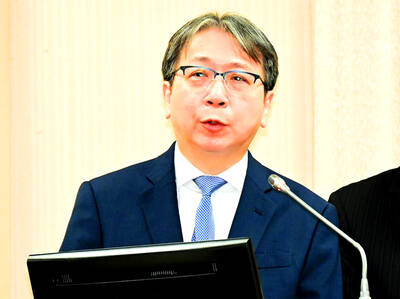
ON ALERT: Taiwan’s partners would issue warnings if China attempted to use Interpol to target Taiwanese, and the global body has mechanisms to prevent it, an official said China has stationed two to four people specializing in Taiwan affairs at its embassies in several democratic countries to monitor and harass Taiwanese, actions that the host nations would not tolerate, National Security Bureau (NSB) Director-General Tsai Ming-yen (蔡明彥) said yesterday. Tsai made the comments at a meeting of the legislature’s Foreign Affairs and National Defense Committee, which asked him and Minister of National Defense Wellington Koo (顧立雄) to report on potential conflicts in the Taiwan Strait and military preparedness. Democratic Progressive Party (DPP) Legislator Michelle Lin (林楚茵) expressed concern that Beijing has posted personnel from China’s Taiwan Affairs Office to its


 RSS
RSS