


Democratic Progressive Party (DPP) lawmakers yesterday urged the organizers of a protest over plans for government pensions to refuse help from the Chinese Nationalist Party (KMT) to avoid politicizing the event.
An alliance of retired and active military personnel, civil servants and public-school teachers is to take to the streets in Taipei this afternoon to protest what it called the “stigmatization” of public-sector pensioners.
The alliance said that the protest was organized to appeal for “respect for dignity and an end to defamation of character,” as well as being “a call for President Tsai Ing-wen (蔡英文) to stop the bullying of state employees.”
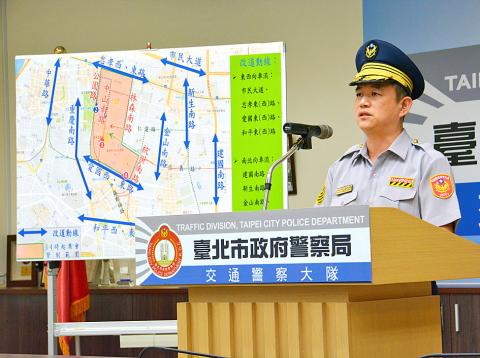
Photo: CNA
Public-sector pensioners are often depicted as enjoying generous retirement benefits and are wrongly blamed for the problems in the pension system, the groups said.
The KMT was expected to mobilize members of its Huang Fu-hsing military veterans’ branch, its Department of Women’s Affairs and its Department of Youth Affairs and said it would set up three support stations along the protest route.
A statement from the party described the protests as a fight by civil servants against a “Cultural Revolution-style attack on pensions.”
DPP Legislator Tsai Yi-yu (蔡易餘) said the KMT is like the Kagemusha character from the martial arts film of the same name: Wherever an activity is taking place, the KMT can be seen hiding in the shadows.
“They even went on [messaging app] Line to tell party members not to wear KMT uniforms or display the party emblem,” Tsai Yi-yu said. “The colors of political struggle are as thick as ever.”
DPP Legislator Chang Hung-lu (張宏陸) said that the KMT’s support of the protest — turning it into a political event — would confuse the alliance’s demands.
Chang said he is not opposed to public servants taking to the streets to express themselves, but protest organizers should resist involvement by the KMT.
“Raising money for people to protest against pension reform looks bad from a public perspective,” Chang said, citing a letter sent by the National Civil Service Association to members of related groups asking for NT$100 from each member to prepare for a lengthy campaign.
DPP Legislator Hsu Chih-chieh (許智傑) said civil servants’ pensions come out of state finances and are subject to revision.
He said that veterans must have their incomes maintained, but added: “Is it fair that some such as [former vice president] Lien Chan (連戰) should be paid more than NT$200,000 per month?”
While it is normal to have protests in a democracy, the KMT should refrain from making irrational comparisons with the Cultural Revolution, Hsu said.
“The younger generation of civil servants will bear the brunt for a long time — many are in favor of implementing a retirement savings interest rate of 18 percent,” he added.
KMT Legislator Lee Yen-hsiu (李彥秀) said that the protesters had signed up for the rally of their own volition.
She said the KMT has not had much contact with them and hopes that one statement will not muddle the event’s aims.
“If the Tsai administration hears the voices of public servants, that would be a good thing for society,” Lee added.
Minister Without Portfolio Lin Wan-i (林萬億) said the protests represented a multifaceted public view, but would not have any effect on the government’s promotion of pension reform.
He called on protesters to explain when and in what way Tsai has ever bullied public servants, adding that such slanderous remarks were not helpful in the interest of public peace.
Premier Lin Chuan (林全) said the protesters are within their rights to demonstrate and that society should respect that.
“Public policy encounters different perspectives as it goes through its process,” he said, adding that he hopes agreement can be reached through rational communication.

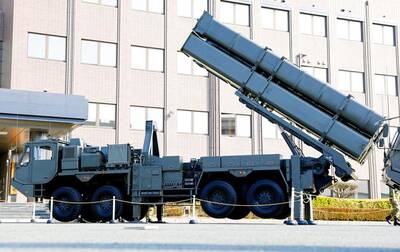
Japan has deployed long-range missiles in a southwestern region near China, the Japanese defense minister said yesterday, at a time when ties with Beijing are at their lowest in recent years. The missiles were installed in Kumamoto in the southern region of Kyushu, as Japan is attempting to shore up its military capacity as China steps up naval activity in the East China Sea. “Standoff defense capabilities enable us to counter the threat of enemy forces attempting to invade our country ... while ensuring the safety of our personnel,” Japanese Minister of Defense Shinjiro Koizumi said. “This is an extremely important initiative for

MORE POPULAR: Taiwan Pass sales increased by 59 percent during the first quarter compared with the same period last year, the Tourism Administration said The Tourism Administration yesterday said that it has streamlined the Taiwan Pass, with two versions available for purchase beginning today. The tourism agency has made the pass available to international tourists since 2024, allowing them to access the high-speed rail, Taiwan Railway Corp services, four MRT systems and four Taiwan Tourist Shuttles. Previously, five types of Taiwan Pass were available, but some tourists have said that the offerings were too complicated. The agency said only two types of Taiwan Pass would be available, starting from a three-day pass with the high-speed rail and a three-day pass with Taiwan Railway Corp. The former costs NT$2,800
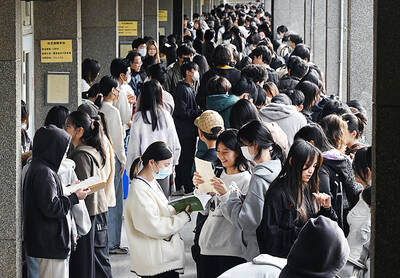
A global survey showed that 60 percent of Taiwanese had attained higher education, second only to Canada, the Ministry of the Interior said. Taiwan easily surpassed the global average of 43 percent and ranked ahead of major economies, including Japan, South Korea and the US, data from the Organisation for Economic Co-operation and Development (OECD) for 2024 showed. Taiwan has a high literacy rate, data released by the ministry showed. As of the end of last year, Taiwan had 20.617 million people aged 15 or older, accounting for 88.5 percent of the total population, with a literacy rate of 99.4 percent, the data

NEW LOW: The council in 2024 based predictions on a pessimistic estimate for the nation’s total fertility rate of 0.84, but last year that rate was 0.69, 17 percent lower An expected National Development Council (NDC) report expects the nation’s population to drop below 12 million by 2065, with the old-age dependency ratio to top 100 percent sooner than 2070, sources said yesterday. The council is slated to release its latest population projections in August, using an ultra-low fertility model, the sources said. The previous report projected that Taiwan’s population would fall to 14.37 million by 2070, but based on a new estimate of the total fertility rate (TFR) — the average number of children born to a woman over her lifetime — the population is expected to reach 12 million by


 RSS
RSS