


US Secretary of State John Kerry yesterday said Washington wanted to avoid “confrontation” in the South China Sea, after an international tribunal rejected Beijing’s claims to most of the waters.
Kerry made the remarks after meeting with Philippine Foreign Secretary Perfecto Yasay in Manila where they discussed the Southeast Asian nation’s sweeping victory in the arbitration case against China.
The US’ top diplomat said that Washington wanted China and the Philippines to engage in talks and “confidence-building measures.”
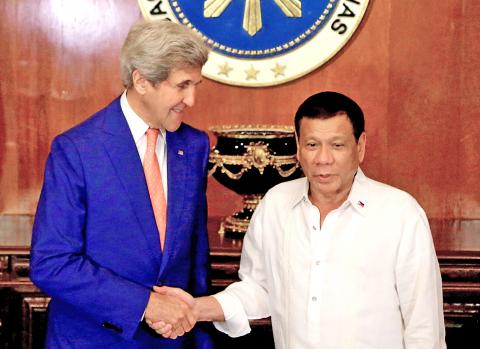
Photo: Liao Chen-huei, Taipei Times
“The decision itself is a binding decision, but we’re not trying to create a confrontation. We are trying to create a solution mindful of the rights of people established under the law,” Kerry said.
The Permanent Court of Arbitration in The Hague this month ruled that China’s claim to most of the strategic waterway was inconsistent with international law.
The decision angered Beijing, which vowed to ignore the ruling.
However, Kerry said the US saw an “opportunity” for claimants to peacefully resolve the row.
“We hope to see a process that will narrow the geographic scope of the maritime disputes, set standards for behavior in contested areas, lead to mutually acceptable solutions, perhaps even a series of confidence-building steps,” he said.
Taiwan, Vietnam, Malaysia and Brunei also have claims to the South China Sea, a vital waterway through which US$5 trillion in annual trade passes. It is also believed to sit atop vast reserves of oil and gas.
Kerry, who arrived in Manila on Tuesday after attending a regional summit in Laos, met with Philippine President Rodrigo Duterte.
Duterte’s spokesman Ernesto Abella said the president told Kerry that any bilateral talks with China would “begin with the ruling.”
Abella also said Duterte explained his war on crime and drugs to Kerry, who pledged US$32 million in US assistance for “training and services” for law enforcement.
Duterte has launched a bloody war on crime, urging law enforcers, communist rebels and even the public to kill criminals.
In related developments, Chinese Minister of Foreign Affairs Wang Yi (王毅) yesterday criticized the US, Japan and Australia for making a joint statement on the South China Sea he said was only “fanning the flames” of regional tension just as countries have agreed that the situation needs to cool down.
Wang said in a statement posted on the Chinese Ministry of Foreign Affairs’ Web site that the move by the three countries came at an inappropriate time and was not constructive.
“Now it is the time to test whether you are peacekeepers or troublemakers,” Wang said, referring to the three countries.
The trilateral statement had urged China not to construct military outposts and reclaim land in the disputed waters.

A signaling system malfunction disrupted high-speed rail (HSR) services beginning at 8am today, with trains temporarily reduced to three northbound and three southbound trains per hour as authorities conduct inspections. The malfunction occurred on a section of track in Miaoli County during pre-operation checks early this morning, forcing northbound and southbound trains to use a single track, the HSR operator said. The regular schedule has been replaced with three hourly trains offering only nonreserved seating in each direction, stopping at every station, it said, adding that business class cars would still have reserved seating. Departures from terminal stations are scheduled at the top

Taiwan is still in the process of assessing the possibility of recruiting workers from Eswatini, the Ministry of Foreign Affairs said yesterday, adding that its goal is to help Eswatini upgrade its vocational training centers. If there are plans to recruit workers from Eswatini, safeguarding national security, protecting public health and ensuring the employment rights of Taiwanese would be prerequisites, Department of West Asian and African Affairs Director-General Yen Chia-liang (顏嘉良) told a news conference. Key considerations would also include filling labor shortages in specific industries, and fostering bilateral professional and technical exchanges, he said. Yen was asked about the progress of labor

A US uncrewed surface vessel (USV) encountered multiple Chinese warships during an autonomous transit of the Taiwan Strait, US defense company Seasats said in a statement on Wednesday. Seasats announced that a Lightfish USV had completed the first autonomous transit of the Taiwan Strait. Over five days, the USV traversed the entire length of the Strait while constantly monitoring surface vessel traffic, the company said. The Lightfish encountered multiple Chinese warships, one of which was a Chinese People’s Liberation Army Navy (PLAN) Type 056 corvette, it said. The Chinese vessels were operating “well within Taiwan’s exclusive economic zone without transmitting their identity via the

VERBOSE VESSELS: A CGA cutter and a China Coast Guard exchanged verbal barbs for more than a day in Taiwanese-controlled waters before the Chinese vessel left The Taiwanese and Chinese coast guards had a standoff near the strategically located Pratas Islands (Dongsha Islands, 東沙群島) in the north of the South China Sea, the Coast Guard Administration (CGA) said yesterday. The two sides engaged in intense radio exchanges over sovereignty claims during the 33-hour standoff. China Coast Guard vessel 3501 eventually left the restricted waters, 26.6 nautical miles (49.2km) west of the Pratas Islands, at 5pm yesterday, the CGA said. Lying approximately between southern Taiwan and Hong Kong, the Taiwan-controlled Pratas are seen by some security experts as vulnerable to Chinese attack due to their distance — more than


 RSS
RSS