


Efforts to push ahead with proposed amendments to the Labor Standards Act (勞動基準法) stalled yesterday after a Democratic Progressive Party (DPP) legislator failed to show up for a review.
DPP Legislator Lin Shu-fen (林淑芬), co-convener of the Social Welfare and Environmental Hygiene Committee, was supposed to chair yesterday’s meeting.
New Power Party (NPP) legislators arrived hours ahead of the scheduled meeting to occupy the speaker’s podium and “hold a place” for Lin.
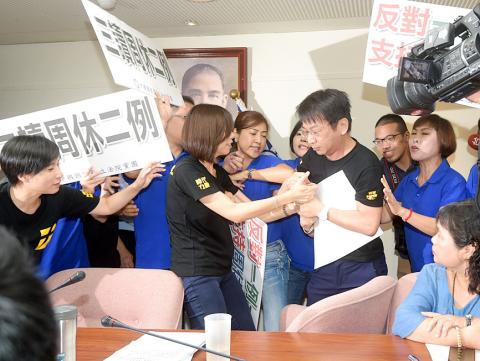
Photo: Huang Yao-cheng, Taipei Times
They refused to relinquish control to DPP Legislator Wu Yu-chin (吳玉琴), who said that Lin had authorized her to chair the meeting, demanding that Wu present a written statement of authorization.
“We say that [Lin] Shu-fen is unwilling to open today’s meeting to avoid endorsing the ruling party’s ‘flexible day off’ policy, but if she does not come, the basis for opening the meeting has to be clear,” NPP Legislator Freddy Lim (林昶佐) said.
The Executive Yuan has proposed a “flexible day off” policy that would guarantee a five-day work week when combined with the existing “mandatory day off” provision, but the idea has been criticized by workers’ rights activists, who said employees could still have to work overtime on their “flexible” days off days.
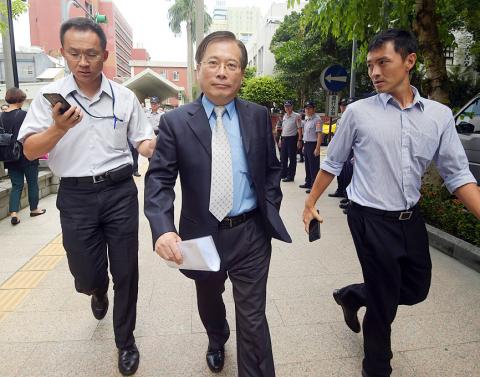
Photo: Huang Yao-cheng, Taipei Times
A reduction in national public holidays for workers benefiting from the proposal are expected if the proposed amendments pass.
“Lin is the co-convener who sent out the meeting notice and prepared the entrance permits. We would allow her to chair the meeting if she comes,” NPP Executive Chairman Huang Kuo-chang (黃國昌) said.
DPP caucus whip Ker Chien-ming (柯建銘) was “living in his own world” by saying that party caucuses had the right to approve an interim committee chairman, Huang said.
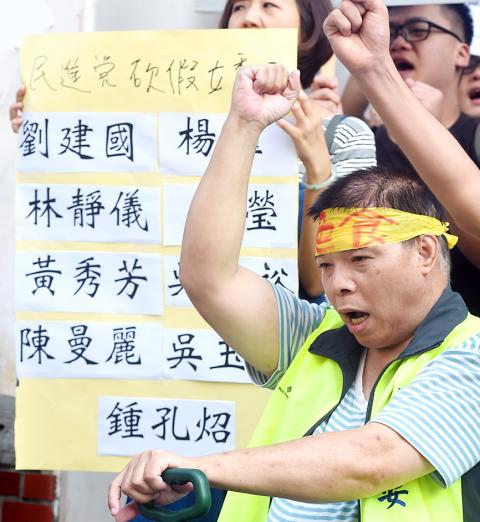
Photo: Liao Chen-huei, Taipei Times
“You can say that you have authorization [from Lin], but I could say the same. How can you persuade me, unless she steps forward?” he said.
Wu said that Lin had asked her during Wednesday’s legislative floor session to chair the meeting.
DPP legislators were “stunned” by the NPP’s occupation of the podium, Wu said.
“[Lin] Shu-fen has her own ideas, some of which have changed during this process,” she said, adding that a written statement of authorization had not been prepared because such a formality had not been needed before.
After failing to reach a resolution with their NPP colleagues, Ker, DPP caucus director-general Wu Ping-jui (吳秉叡) and the other DPP legislators left the committee room. They returned more than an hour later after a private meeting with Minister of Labor Kuo Fan-yu (郭芳煜) to say that the meeting would be postponed.
“Today has shown that people have different views, so it is not a problem for us to pick another day to allow more talks to be held,” Ker said against a background of drumming and shouting from people protesting on the street outside the building.
“Although I feel that the Legislative Yuan has the authority to appoint an interim committee chair, I also do not think it is necessary for us to spend time debating such a minor procedural matter,” he said.
His announcement drew jeers from Chinese Nationalist Party (KMT) legislators.
The KMT had sent more than 10 legislators, including several who serve on other committees, who arrived in their trademark blue “battle” shirts for what was expected to be a drawn-out fight over the proposed amendment.
“If the committee meeting is not going to be held, why set the agenda in the first place,” KMT Legislator Lin Wei-chou (林為洲) said. “We did not stop this meeting, the DPP’s own convener failed to show up for a review of their own version of the amendment, for an agenda passed by the DPP itself.”
The interlude between the DPP lawmakers leaving the room and Ker’s announcement was marked by shouting matches between NPP and KMT legislators, including a brief scuffle that broke out after KMT lawmakers encircled NPP lawmakers occupying the convener’s podium.
Lawmakers from both sides called each other “parasites” and accused each other of “putting on a show.”
NPP Legislator Hung Tzu-yung (洪慈庸), who holds the party’s sole Social Welfare and Environmental Hygiene Committee seat, said she welcomed the delay, although yesterday’s agenda had included a review of the NPP’s proposed amendments.
“The reason why we took action today is because we feel that the national government has not done enough to communicate with civil society about the proposed changes,” she said.
She said a public hearing should be held before the amendments are reviewed.
Failure to pass the DPP’s amendment yesterday is likely to delay its deliberation for at least a month, with the remaining days of the extraordinary legislative session taken up by general assembly meetings.
In related news, hunger strikers protesting against the DPP amendment announced outside the Legislative Yuan that they had ended their 52-hour fast, but promised more protests and marches to deter a “surprise” passage of the amendment next month after the extraordinary session concludes.
Protesters’ allegations that the DPP is siding with big business with its proposed amendment were rebutted by DPP Legislator Lee Chun-yi (李俊俋).
“We are not bowing to pressure from large corporations, because having two fixed holidays every week does not really have that much of an impact on them, but it could have a serious effect on small and medium-sized businesses [SMEs], which are the dominant businesses in the nation,” Lee said during an interview.
SMEs on average have about 20 employees or less, and therefore would need a more flexible way of planning work shifts, Lee said.
“A mandatory requirement that every employee has two days off per week might cause serious problems to production lines, yet, due to their smaller size, most of them cannot afford to hire extra people,” Lee said. “So we have proposed a compromise to allow employers to have more flexibility in planning shifts, while asking them to pay more overtime to those who work on their flexible rest day.”
The DPP expected to be criticized by both businesses and workers’ rights groups, “but when you are in power, you just have to look at an issue from all the angles to work out something that might benefit all parties,” he said.
Additional reporting by Loa Iok-sin
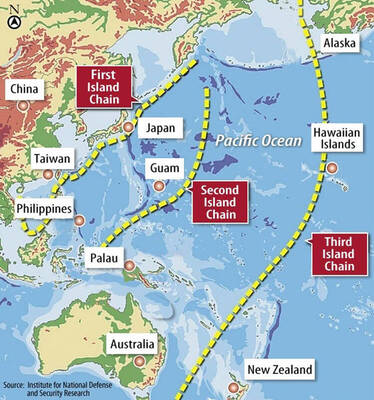
The US government has signed defense cooperation agreements with Japan and the Philippines to boost the deterrence capabilities of countries in the first island chain, a report by the National Security Bureau (NSB) showed. The main countries on the first island chain include the two nations and Taiwan. The bureau is to present the report at a meeting of the legislature’s Foreign Affairs and National Defense Committee tomorrow. The US military has deployed Typhon missile systems to Japan’s Yamaguchi Prefecture and Zambales province in the Philippines during their joint military exercises. It has also installed NMESIS anti-ship systems in Japan’s Okinawa

‘WIN-WIN’: The Philippines, and central and eastern European countries are important potential drone cooperation partners, Minister of Foreign Affairs Lin Chia-lung said Minister of Foreign Affairs Lin Chia-lung (林佳龍) in an interview published yesterday confirmed that there are joint ventures between Taiwan and Poland in the drone industry. Lin made the remark in an exclusive interview with the Chinese-language Liberty Times (the Taipei Times’ sister paper). The government-backed Taiwan Excellence Drone International Business Opportunities Alliance and the Polish Chamber of Unmanned Systems on Wednesday last week signed a memorandum of understanding in Poland to develop a “non-China” supply chain for drones and work together on key technologies. Asked if Taiwan prioritized Poland among central and eastern European countries in drone collaboration, Lin

TRAGEDY STRIKES TAIPEI: The suspect died after falling off a building after he threw smoke grenades into Taipei Main Station and went on a killing spree in Zhongshan A 27-year-old suspect allegedly threw smoke grenades in Taipei Main Station and then proceeded to Zhongshan MRT Station in a random killing spree that resulted in the death of the suspect and two other civilians, and seven injured, including one in critical condition, as of press time last night. The suspect, identified as a man surnamed Chang Wen (張文), allegedly began the attack at Taipei Main Station, the Taipei Fire Department said, adding that it received a report at 5:24pm that smoke grenades had been thrown in the station. One man in his 50s was rushed to hospital after a cardiac arrest
ON ALERT: Taiwan’s partners would issue warnings if China attempted to use Interpol to target Taiwanese, and the global body has mechanisms to prevent it, an official said China has stationed two to four people specializing in Taiwan affairs at its embassies in several democratic countries to monitor and harass Taiwanese, actions that the host nations would not tolerate, National Security Bureau (NSB) Director-General Tsai Ming-yen (蔡明彥) said yesterday. Tsai made the comments at a meeting of the legislature’s Foreign Affairs and National Defense Committee, which asked him and Minister of National Defense Wellington Koo (顧立雄) to report on potential conflicts in the Taiwan Strait and military preparedness. Democratic Progressive Party (DPP) Legislator Michelle Lin (林楚茵) expressed concern that Beijing has posted personnel from China’s Taiwan Affairs Office to its


 RSS
RSS