


An arbitration court ruled yesterday that China has no historic title over the waters of the South China Sea and has breached the Philippines’ sovereign rights with its actions, infuriating Beijing, which dismissed the case as a farce.
A defiant China, which boycotted the hearings at the Permanent Court of Arbitration in The Hague, vowed again to ignore the ruling, and said its armed forces would defend its sovereignty and maritime interests.
Xinhua news agency said shortly before the ruling was announced that a Chinese civilian aircraft had successfully tested two new airports in the disputed Spratly Islands (Nansha Islands, 南沙群島) and the Chinese Ministry of National Defense said a new guided-missile destroyer was formally commissioned at a naval base on Hainan, which has responsibility for the South China Sea.
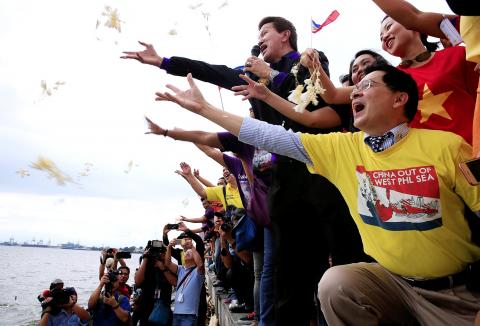
Photo: Reuters
“This award represents a devastating legal blow to China’s jurisdictional claims in the South China Sea,” Ian Storey of Singapore’s ISEAS Yusof Ishak Institute said. “China will respond with fury, certainly in terms of rhetoric and possibly through more aggressive actions at sea.”
The US, which China has accused of fueling tensions and militarizing the region with patrols and exercises, urged parties to comply with the legally binding ruling and avoid provocations.
“The decision today by the tribunal in the Philippines-China arbitration is an important contribution to the shared goal of a peaceful resolution to disputes in the South China Sea,” US Department of State spokesman John Kirby said.
US officials have previously said they feared China might respond to the ruling by declaring an air defense identification zone in the South China Sea, as it did in the East China Sea in 2013, or by stepping up its building and fortification of artificial islands.
China claims most of the energy-rich waters through which about US$5 trillion in ship-borne trade passes every year. Taiwan, Brunei, Malaysia, Vietnam and the Philippines also have claims.
Finding for the Philippines on a number of issues, the panel said there was no legal basis for China to claim historic rights to resources within its so-called “nine-dash line,” which covers almost 90 percent of the South China Sea.
It said China had interfered with traditional Philippine fishing rights at the Scarborough Shoal (Huangyan Island, 黃岩島) and had breached the Philippines’ sovereign rights by exploring for oil and gas near the Reed Bank (Lile Bank, 禮樂灘).
None of China’s reefs and holdings in the Spratly Islands entitled it to an exclusive economic zone, it added.
The Chinese Ministry of Foreign Affairs rejected the ruling, saying its people had more than 2,000 years of history in the South China Sea, that its islands did have exclusive economic zones and that it had announced to the world its “dotted line” map in 1948.
“China’s territorial sovereignty and maritime rights and interests in the South China Sea shall under no circumstances be affected by those awards,” the ministry said.
“The award is a complete and total victory for the Philippines... a victory for international law and international relations,” said Paul Reichler, lead lawyer for Manila.
Vietnam said it welcomed the ruling.
The ruling is significant, as it is the first time that a legal challenge has been brought in the dispute.
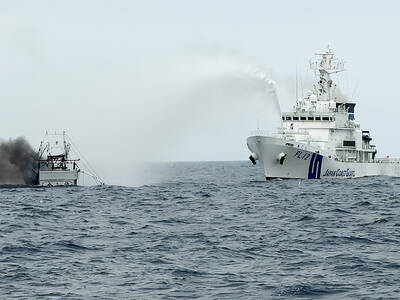
CREDIT-GRABBER: China said its coast guard rescued the crew of a fishing vessel that caught fire, who were actually rescued by a nearby Taiwanese boat and the CGA Maritime search and rescue operations do not have borders, and China should not use a shipwreck to infringe upon Taiwanese sovereignty, the Coast Guard Administration (CGA) said yesterday. The coast guard made the statement in response to the China Coast Guard (CCG) saying it saved a Taiwanese fishing boat. The Chuan Yu No. 6 (全漁6號), a fishing vessel registered in Keelung, on Thursday caught fire and sank in waters northeast of Diaoyutai Islands (釣魚台). The vessel left Keelung’s Badouzih Fishing Harbor (八斗子漁港) at 3:35pm on Sunday last week, with seven people on board — a 62-year-old Taiwanese captain surnamed Chang (張) and six
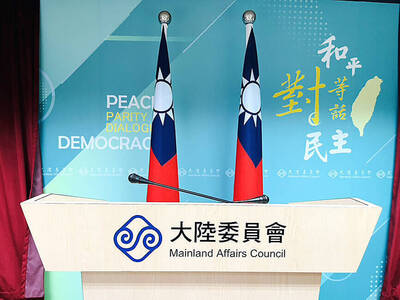
RISKY BUSINESS: The ‘incentives’ include initiatives that get suspended for no reason, creating uncertainty and resulting in considerable losses for Taiwanese, the MAC said China’s “incentives” failed to sway sentiment in Taiwan, as willingness to work in China hit a record low of 1.6 percent, a Ministry of Labor survey showed. The Directorate-General of Budget, Accounting and Statistics (DGBAS) also reported that the number of Taiwanese workers in China has nearly halved from a peak of 430,000 in 2012 to an estimated 231,000 in 2024. That marked a new low in the proportion of Taiwanese going abroad to work. The ministry’s annual survey on “Labor Life and Employment Status” includes questions respondents’ willingness to seek employment overseas. Willingness to work in China has steadily declined from

The Legislative Yuan’s Finance Committee yesterday approved proposed amendments to the Amusement Tax Act (娛樂稅法) that would abolish taxes on films, cultural activities and competitive sporting events, retaining the fee only for dance halls and golf courses. The proposed changes would set the maximum tax rate for dance halls and golf courses at 50 and 20 percent respectively, with local governments authorized to suspend the levies. Article 2 of the act says that “amusement tax shall be levied on tickets sold or fees charged by amusement places, facilities or activities” in six categories: “Cinema; professional singing, story-telling, dancing, circus, magic show, acrobatics
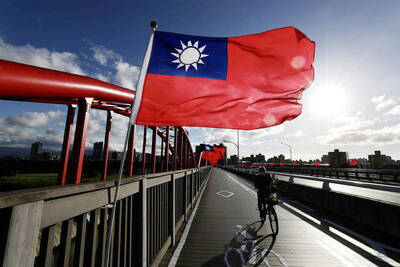
INFLATION UP? The IMF said CPI would increase to 1.5 percent this year, while the DGBAS projected it would rise to 1.68 percent, with GDP per capita of US$44,181 The IMF projected Taiwan’s real GDP would grow 5.2 percent this year, up from its 2.1 percent outlook in January, despite fears of global economic disruptions sparked by the US-Iran conflict. Taiwan’s consumer price index (CPI) is projected to increase to 1.5 percent, while unemployment would be 3.4 percent, roughly in line with estimates for Asia as a whole, the international body wrote in its Global Economic Outlook Report published in the US on Monday. The figures are comparatively better than the IMF outlook for the rest of the world, which pegged real GDP growth at 3.1 percent, down from 3.3 percent


 RSS
RSS