


Australian Prime Minister Malcolm Turnbull yesterday declared victory for the ruling Conservative Party after opposition Labor conceded defeat, but faces a tough time ahead after the narrow mandate in the closely fought election.
The declaration ended eight days of uncertainty about the new government’s identity. A tight race between the two major parties left neither of them with the 76 or more seats required for a parliamentary majority following polls on July 2, with vote counting still ongoing.
“We’ve won the election, that’s what we’ve done,” Turnbull told reporters in Sydney, adding that he received a call from Labor leader Bill Shorten congratulating him on his re-election as prime minister.
However, he immediately faced questions about whether he would be able to govern successfully, with Labor increasing its lower house seats and a higher number of minor party and independent senators to contend with in the upper house.
Turnbull’s ruling Liberal/National coalition was expected to secure 74 seats, and potentially two more in the 150-seat House of Representatives, according to national broadcaster ABC’s projections.
However, the Australian leader has won the support of three independent members of parliament on budget matters and on votes of no confidence, paving the way for him to form a minority government if necessary.
Labor has won 66 and with five independents elected, the opposition does not have sufficient seats to govern in Canberra, according to the projections.
The need for Turnbull to court the support of those outside his party saw him stress that he valued every parliamentarian’s contribution, even though he had warned Australians not to vote for minor parties and independents during the election campaign.
“It is vital that this parliament works,” Turnbull said, adding that Australia faced numerous challenges including a rocky transition away from dependence on mining-driven growth.
“Every member of the house and the senate deserves respect, because they have been elected by the Australian people,” he said.
Shorten earlier yesterday pledged in his concession speech that his party wanted to work well with the government, amid concerns the close result and higher number of lawmakers not from the two major parties could cause gridlock.
Even so, Turnbull faces an uphill task to get the senate to pass two bills about restoring a construction union watchdog. He had used the senate’s blocking of the bills to trigger a double-dissolution election, but could now face an even more hostile upper house.
There are also question marks over whether his multibillion-dollar plan to cut corporate tax announced in the May budget would get support from the smaller parties and independents, who were elected on more populist agendas.
The two seats the coalition hopes to pick up are among five in the balance, with the electoral commission still completing the painstaking task of counting postal votes and others cast outside people’s normal electorates.
Both Turnbull and Shorten said they supported an inquiry into electronic voting, amid the protracted counting process.
“I have been an advocate of electronic voting for a long time ... yes, this is something we must look at,” Turnbull said.
Turnbull lost the government’s comfortable majority in the House of Representatives in the election on Saturday last week after his campaign on “jobs and growth” and “innovation” failed to resonate equally across the continent.
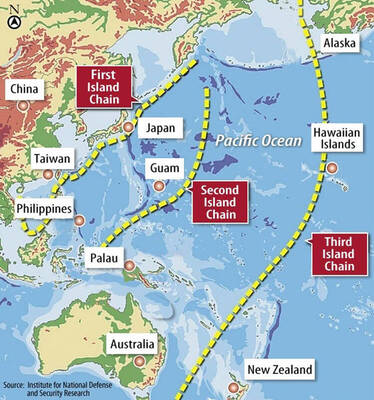
The US government has signed defense cooperation agreements with Japan and the Philippines to boost the deterrence capabilities of countries in the first island chain, a report by the National Security Bureau (NSB) showed. The main countries on the first island chain include the two nations and Taiwan. The bureau is to present the report at a meeting of the legislature’s Foreign Affairs and National Defense Committee tomorrow. The US military has deployed Typhon missile systems to Japan’s Yamaguchi Prefecture and Zambales province in the Philippines during their joint military exercises. It has also installed NMESIS anti-ship systems in Japan’s Okinawa

‘WIN-WIN’: The Philippines, and central and eastern European countries are important potential drone cooperation partners, Minister of Foreign Affairs Lin Chia-lung said Minister of Foreign Affairs Lin Chia-lung (林佳龍) in an interview published yesterday confirmed that there are joint ventures between Taiwan and Poland in the drone industry. Lin made the remark in an exclusive interview with the Chinese-language Liberty Times (the Taipei Times’ sister paper). The government-backed Taiwan Excellence Drone International Business Opportunities Alliance and the Polish Chamber of Unmanned Systems on Wednesday last week signed a memorandum of understanding in Poland to develop a “non-China” supply chain for drones and work together on key technologies. Asked if Taiwan prioritized Poland among central and eastern European countries in drone collaboration, Lin

The Chien Feng IV (勁蜂, Mighty Hornet) loitering munition is on track to enter flight tests next month in connection with potential adoption by Taiwanese and US armed forces, a government source said yesterday. The kamikaze drone, which boasts a range of 1,000km, debuted at the Taipei Aerospace and Defense Technology Exhibition in September, the official said on condition of anonymity. The Chungshan Institute of Science and Technology and US-based Kratos Defense jointly developed the platform by leveraging the engine and airframe of the latter’s MQM-178 Firejet target drone, they said. The uncrewed aerial vehicle is designed to utilize an artificial intelligence computer

Renewed border fighting between Thailand and Cambodia showed no signs of abating yesterday, leaving hundreds of thousands of displaced people in both countries living in strained conditions as more flooded into temporary shelters. Reporters on the Thai side of the border heard sounds of outgoing, indirect fire yesterday. About 400,000 people have been evacuated from affected areas in Thailand and about 700 schools closed while fighting was ongoing in four border provinces, said Thai Rear Admiral Surasant Kongsiri, a spokesman for the military. Cambodia evacuated more than 127,000 villagers and closed hundreds of schools, the Thai Ministry of Defense said. Thailand’s military announced that


 RSS
RSS