


Thousands of Hong Kong residents yesterday marched in protest on the 19th anniversary of the territory’s return to Chinese rule, as tensions simmer against Chinese authorities over the abductions of several Hong Kong booksellers.
Some waved banners criticizing Beijing over alleged cross-border abductions as the act of a “totalitarian” regime, as well as calling for the release of leading dissidents.
“This is a very grave threat to the safety of Hong Kong residents, that an unknown force is spying on people,” pro-democracy lawmaker Cyd Ho (何秀蘭) said at the rally. “The Hong Kong government has to follow up with the central government on what is really happening behind the scenes.”
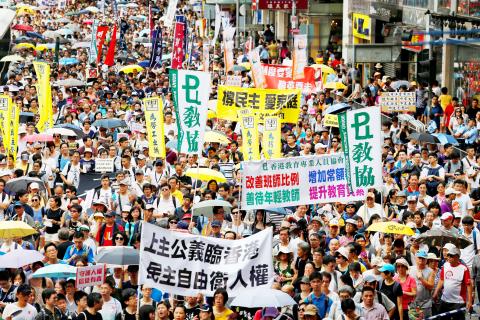
Photo: Reuters
The territory has been unnerved in the past year by the disappearances of five booksellers who specialized in works critical of Chinese leaders.
One of the men, Lam Wing-kei (林榮基), who was detained for eight months by Chinese agents and released last month, said Beijing was “violating Hong Kong’s rights” through illegal cross-border enforcement operations.
The tactics have raised fears that Chinese Communist Party (CCP) rulers in Beijing are eroding the so-called “one country, two systems” formula that has granted Hong Kong a high degree of freedom and autonomy since its 1997 return to Chinese rule.
China has denied any wrongdoing.
Lam, who had been due to lead the march that each year draws thousands of people, withdrew at the last minute, citing safety concerns after being followed by two strangers, a lawmaker said.
“He feels increasingly concerned about his personal safety,” Democratic Party Legislator Albert Ho (何俊仁) said.
Hong Kong and Macau Affairs Office of the State Director Wang Guangya (王光亞) said the booksellers had “destroyed” the one country, two systems formula by publishing books that are banned in mainland China.
However, Chinese President Xi Jinping (習近平), speaking in the Great Hall of the People in Beijing to mark the CCP’s 95th anniversary, yesterday said that “no matter what the difficulties and challenges, our confidence and determination toward one country, two systems will not waver.”
Xi said that Hong Kong would continue to enjoy a high degree of autonomy and Beijing would strictly adhere to the law.
Yesterday’s protests are considered a barometer of public sentiment toward Beijing ahead of territorial legislative elections in September.
A group of activists who advocate Hong Kong independence from China are planning an evening “black mask” protest outside the Liaison Office of the Central People’s Government in the Hong Kong Special Administrative Region.
A 79-day Umbrella movement in late 2014 demanding Beijing allow full democracy in Hong Kong brought chaos to the streets.
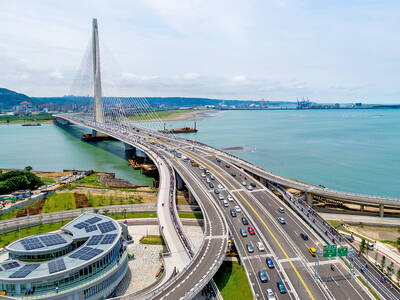
The Ministry of Transportation and Communications yesterday inaugurated the Danjiang Bridge across the Tamsui River in New Taipei City, saying that the structure would be an architectural icon and traffic artery for Taiwan. Feted as a major engineering achievement, the Danjiang Bridge is 920m long, 211m tall at the top of its pylon, and is the longest single-pylon asymmetric cable-stayed bridge in the world, the government’s Web site for the structure said. It was designed by late Iraqi-British architect Zaha Hadid. The structure, with a maximum deck of 70m, accommodates road and light rail traffic, and affords a 200m navigation channel for boats,
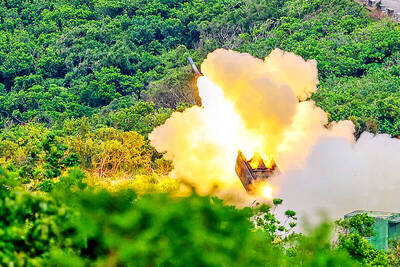
PRECISION STRIKES: The most significant reason to deploy HIMARS to outlying islands is to establish a ‘dead zone’ that the PLA would not dare enter, a source said A High Mobility Artillery Rocket System (HIMARS) would be deployed to Penghu County and Dongyin Island (東引) in Lienchiang County (Matsu) to force the Chinese military to retreat at least 100km from the coastline, a military source said yesterday. Taiwan has been procuring HIMARS and Army Tactical Missile Systems (ATACMS) from the US in batches. Once all batches have been delivered, Taiwan would possess 111 HIMARS units and 504 ATACMS, which have a range of 300km. Considering that “offense is the best defense,” the military plans to forward-deploy the systems to outlying islands such as Penghu and Dongyin so that
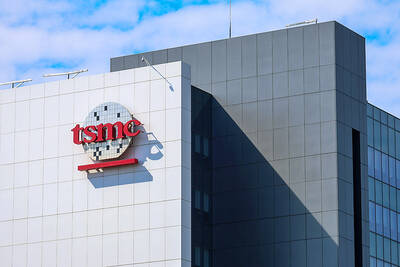
Taiwan Semiconductor Manufacturing Co (TSMC, 台積電), the world’s largest foundry service provider, yesterday said that global semiconductor revenue is projected to hit US$1.5 trillion in 2030, after the figure exceeds US$1 trillion this year, as artificial intelligence (AI) demand boosts consumption of token and compute power. “We are still at the beginning of the AI revolution, but we already see a significant impact across the whole semiconductor ecosystem,” TSMC deputy cochief operating officer Kevin Zhang (張曉強) said at the company’s annual technology symposium in Hsinchu City. “It is fair to say that in the past decade, smartphones and other mobile devices were
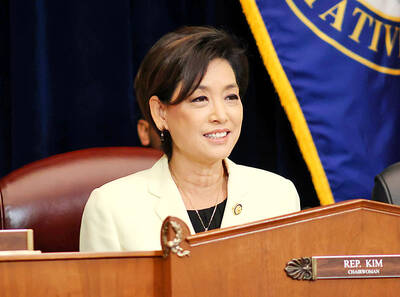
‘CLEAR MESSAGE’: The bill would set up an interagency ‘tiger team’ to review sanctions tools and other economic options to help deter any Chinese aggression toward Taiwan US Representative Young Kim has introduced a bill to deter Chinese aggression against Taiwan, calling for an interagency “tiger team” to preplan coordinated sanctions and economic measures in response to possible Chinese military or political action against Taiwan. “[Chinese President] Xi Jinping [習近平] has directed the People’s Liberation Army to be ready to invade Taiwan by 2027. China has a plan. America should have one too,” Kim said in a news release on Thursday last week. She introduced the “Deter PRC [People’s Republic of China] aggression against Taiwan act” to “ensure the US has a coordinated sanctions strategy ready should


 RSS
RSS