


Amid disputes over the legitimacy of former president Ma Ying-jeou’s (馬英九) application for an overseas trip later this month, Presidential Office spokesman Alex Huang (黃重諺) yesterday said the office has instructed the Ministry of Justice to clarify confusion over the process for individuals who have handled classified security information to apply to leave the country.
At a regular news briefing at the office yesterday, Huang said Ma’s application for an one-day trip to Hong Kong on June 15 is still being “prudently deliberated” in accordance with the Classified National Security Information Protection Act (國家機密保護法).
“Since the promulgation of the act in 2003, which applies to the retired president and vice president elected in 2008, it is the first time a former head of state has applied to leave the country within the three-year regulatory period,” Huang said.
“It is also the first time such an application has been filed in less than one month after a former president left office,” Huang added.
Turning to debates over whether the timing Ma submitted the application failed to conform to the law, Huang said past cases showed that different government agencies have their own regulations, with the deadlines for receipt of such applications ranging from 10 to 20 days prior to the planned departure date.
Huang said the office has instructed the Ministry of Justice, which serves as the competent authority of the act, to provide clarification on the application deadline.
Ma, whose term expired on May 20, sent his overseas visit application to the office on Wednesday, before announcing his plan to attend and give a speech at the Society of Publishers in Asia’s Awards for Editorial Excellence ceremony to be held at the Hong Kong Convention and Exhibition Centre on June 15.
Ma is required by Article 26 of the act to obtain prior approval for any international travel plans within three years after leaving office from the government body where he used to work.
However, Article 32 of the Enforcement Rules of the Classified National Security Information Protection Act (國家機密保護法施行細則) stipulates that such an application has to be filed 20 days prior to departure.
In related news, the Chinese-language Liberty Times (the Taipei Times’ sister paper) published an exclusive report yesterday alleging that Ma’s original plan was to visit Singapore, where he had a historical meeting with Chinese President Xi Jinping (習近平) in November last year.
Citing a “credible source” who requested anonymity, the report said the Singaporean government turned down Ma’s proposal because its priority is to establish ties with President Tsai Ing-wen’s (蔡英文) administration.
Instead, Ma is planning to visit Singapore between August and September, the report added.
Meanwhile, former Chinese Nationalist Party (KMT) spokesman Yang Wei-chung (楊偉中) yesterday urged the former president to talk about things closer to the lives of Hong Kongers, rather than lauding cross-strait peace as he has done for the past eight years.
“The situation in Hong Kong has changed significantly since Ma’s last visit [in 2001], primarily due to the predicaments facing the area’s democracy and public livelihood caused by the ‘one country, two systems’ framework, as well as the coercion and contradictions brought about by Xi’s authoritarian rule,” Yang said.
Many media works nominated by the awards ceremony in Hong Kong also talked about these issues, Yang said, calling on Ma to focus his speech on issues such as freedom of the press, universal suffrage, pro-localization movements and China’s democratization.

National Taiwan University (NTU) yesterday said it disqualified a person from an entrance examination for using AI smart glasses to cheat, along with two others for making untruthful statements in their curriculum vitae. The three applicants were given null scores, Taiwan’s highest-ranked university said, calling on prospective students to be honest in the admissions process. NTU registrar Lee Hung-sen (李宏森) said that the cheating applicant wore a hat and thick-rimmed glasses to the second written exam for medical school, claiming that they felt cold. Suspicions were aroused when the applicant stared oddly at the test for long stretches while steadily bringing the paper
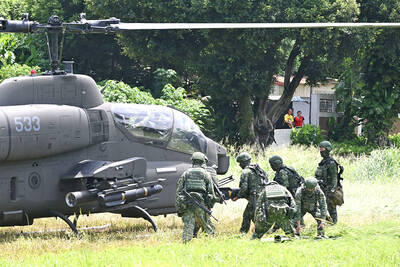
MILITARY ISSUES: A partisan divide between the Cabinet and the legislature ‘raised questions about Taiwan’s ability to adequately fund its defense,’ the report said Taiwan’s defense budget, military personnel numbers and resilience are challenges to its ability to meet national defense goals, the US Naval Institute said in a report published on Tuesday. In response to the perception of a growing military threat posed by China, Taiwan has embarked on an effort to enhance the capabilities needed to deter an attempt by Beijing to annex the nation by force, the institute said in the US Congressional Research Service report, titled Taiwan: Defense and Military Issues, which was filed on Thursday last week. Taiwan’s defense budget increased by about 7.5 percent from 2024 to last year, it
NOT JUST NUMBERS: What matters to intelligence work is crucial, reliable information, so even a few credible leads can be highly valuable to national security, a legislator said The National Security Bureau (NSB) yesterday said it has finished the establishment of an information-reporting channel for Chinese nationals, the aim of which is to broaden intelligence gathering on China’s political, military, economic and social developments. Chinese nationals can submit information on the Web page, https://report.nsb.gov.tw, the NSB said in a statement. The move aims to expand the bureau’s diverse intelligence sources and is pursuant to the National Intelligence Services Act (國家情報工作法), it said, adding that it referenced practices adopted by intelligence agencies in the US, the UK and Israel. An increasing number of people are approaching Taiwanese agencies to provide information, as

66 FIGHTER JETS: The aircraft is likely undergoing preparations for its transfer to Taiwan — a significant step forward in the nation’s modernization program, a lawmaker said The first of Taiwan’s order of F-16V Block 70 aircraft has been sighted in Texas ahead of delivery, Democratic Progressive Party (DPP) Legislator Wang Ting-yu (王定宇) said. Taiwan’s first F-16V Block 70 two-seat aircraft, tail number 6831, was seen flying from Lockheed Martin’s production facility in Greenville, South Carolina, to Naval Air Station Joint Reserve Base Fort Worth in Texas, Wang wrote on Facebook yesterday. The plane is likely undergoing preparations for its transfer to Taiwan, marking a significant step forward in the Republic of China Air Force’s modernization program, Wang said, citing military analysts. The F-16V Block 70 is a new-build version


 RSS
RSS