


Echoing the Chinese Nationalist Party (KMT) caucus’ boycott of the legislature yesterday, hundreds of protesters gathered outside the Legislative Yuan in Taipei to accuse the Democratic Progressive Party (DPP) of flip-flopping on the import of US pork products with ractopamine residue and “bowing down” to Japan on fishermen’s rights, and calling for Premier Lin Chuan’s (林全) resignation.
The crowd tried to break into the Legislative Yuan compound at about 10am and clashed with police at the gate on Qingdao E Road.
The protesters demanded that police open the gate, calling the legislature the “people’s place” and repeatedly citing the Sunflower movement, in which demonstrators broke into and occupied the Legislative Yuan’s main chamber in 2014.
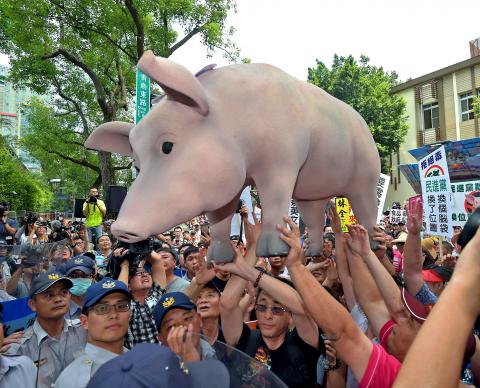
Photo: Huang Yao-cheng, Taipei Times
Politicians on the makeshift stage set up by the KMT, including KMT Tainan City Councilor Hsieh Lung-chieh (謝龍介) and Taipei City Councilor Wang Hung-wei (王鴻薇), asked the police to stop being “the autocrat’s bullyboys” and, appealing for police support, said Lin’s dropping of charges against the Sunflower protesters hurt frontline law enforcement officers.
At least three KMT lawmakers left the main chamber and went to greet the crowd and, at the other side of the gate, demanded that police open the gate to allow the lawmakers to enter.
The scuffling and pushing continued until the police slid the gate open slightly to allow the lawmakers to slip through and quickly closed it again.
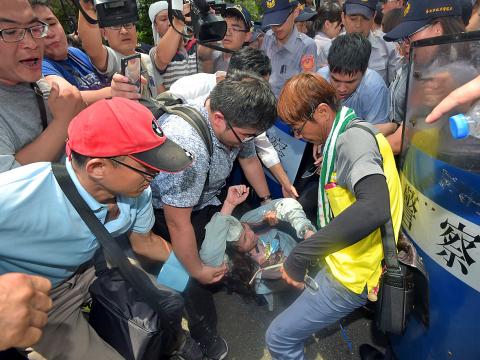
Photo: Huang Yao-cheng, Taipei Times
The crowd also passed a large pink polystyrene pig over the gate and into the compound, which was then taken by KMT Legislator Chen Chao-ming (陳超明) to the chamber and placed on the front lectern.
DPP lawmakers joked that the model represented US pigs because local pigs are black.
The protesters, reduced in number, but continuing to demonstrate outside the Qingdao E Road gate, initiated another round of pushing at about 11am, during which KMT Legislator Huang Chao-shun (黃昭順) called, along with the crowd, for the “removal of the blockades” —while the police responded: “There is no blockade” — and argued with the police to allow some of the protesters to sit in on the legislative floor meeting as visitors.
Mao Chia-ching (毛嘉慶), one of KMT Chairwoman Hung Hsiu-chu’s (洪秀柱) closest aides and now the KMT’s Culture and Communications Committee deputy director, said on the stage that the DPP would give up the nation’s sovereignty once the “rights concerning the pigs” and fishermen’s rights are conceded.
“Who else but we are to protect the Republic of China?” Mao said.
“Do you think we are here protesting to gain political benefits, like the DPP did?” Mao said.
The protest was reported to have been masterminded by KMT headquarters and closely supported by the caucus.
Local media on Monday night reported that the KMT wished to emulate the “Sunflower movement model” with a siege of the Legislative Yuan and a simple stage to allow legislators to take turns to deliver short talks to the crowd.
An anonymous KMT lawmaker told the Chinese-language NOWnews Web site on Monday night that the KMT would not “protest for no reason,” which would go against the “KMT style,” adding that the complaint had “the strong support of public opinion.”
The crowd began dispersing at about 11:40am and was gone by about 12pm.
There was a rumor Hung would greet the gathering, but she was not seen by the end of the rally.
New Power Party Legislator Hsu Yung-ming (徐永明) wrote on Facebook that former KMT legislator Wu Yu-sheng (吳育昇), during the protest, mocked President Tsai Ing-wen’s (蔡英文) unmarried status with a pun on the Chinese word for “women marrying” (chu-ge, 出閣) and for “a no-confidence vote against the Cabinet” (dao-ge, 倒閣).
“The KMT should have focused on the issues that they found unacceptable when they brought the people to the street, who toiled to follow the party [to the rally] and tried to obtain public support, rather than making personal attacks,” Hsu said, calling Wu’s remarks “a fake protest, but discrimination in essence.”

National Taiwan University (NTU) yesterday said it disqualified a person from an entrance examination for using AI smart glasses to cheat, along with two others for making untruthful statements in their curriculum vitae. The three applicants were given null scores, Taiwan’s highest-ranked university said, calling on prospective students to be honest in the admissions process. NTU registrar Lee Hung-sen (李宏森) said that the cheating applicant wore a hat and thick-rimmed glasses to the second written exam for medical school, claiming that they felt cold. Suspicions were aroused when the applicant stared oddly at the test for long stretches while steadily bringing the paper
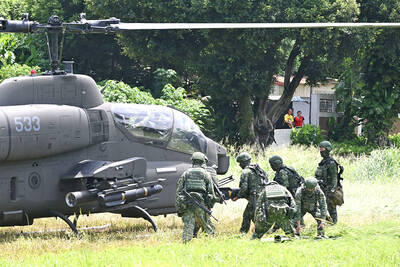
MILITARY ISSUES: A partisan divide between the Cabinet and the legislature ‘raised questions about Taiwan’s ability to adequately fund its defense,’ the report said Taiwan’s defense budget, military personnel numbers and resilience are challenges to its ability to meet national defense goals, the US Naval Institute said in a report published on Tuesday. In response to the perception of a growing military threat posed by China, Taiwan has embarked on an effort to enhance the capabilities needed to deter an attempt by Beijing to annex the nation by force, the institute said in the US Congressional Research Service report, titled Taiwan: Defense and Military Issues, which was filed on Thursday last week. Taiwan’s defense budget increased by about 7.5 percent from 2024 to last year, it
NOT JUST NUMBERS: What matters to intelligence work is crucial, reliable information, so even a few credible leads can be highly valuable to national security, a legislator said The National Security Bureau (NSB) yesterday said it has finished the establishment of an information-reporting channel for Chinese nationals, the aim of which is to broaden intelligence gathering on China’s political, military, economic and social developments. Chinese nationals can submit information on the Web page, https://report.nsb.gov.tw, the NSB said in a statement. The move aims to expand the bureau’s diverse intelligence sources and is pursuant to the National Intelligence Services Act (國家情報工作法), it said, adding that it referenced practices adopted by intelligence agencies in the US, the UK and Israel. An increasing number of people are approaching Taiwanese agencies to provide information, as

66 FIGHTER JETS: The aircraft is likely undergoing preparations for its transfer to Taiwan — a significant step forward in the nation’s modernization program, a lawmaker said The first of Taiwan’s order of F-16V Block 70 aircraft has been sighted in Texas ahead of delivery, Democratic Progressive Party (DPP) Legislator Wang Ting-yu (王定宇) said. Taiwan’s first F-16V Block 70 two-seat aircraft, tail number 6831, was seen flying from Lockheed Martin’s production facility in Greenville, South Carolina, to Naval Air Station Joint Reserve Base Fort Worth in Texas, Wang wrote on Facebook yesterday. The plane is likely undergoing preparations for its transfer to Taiwan, marking a significant step forward in the Republic of China Air Force’s modernization program, Wang said, citing military analysts. The F-16V Block 70 is a new-build version


 RSS
RSS