


Amendments to the Act of Military Service for Officers and Noncommissioned Officers of the Armed Forces (陸海空軍軍官士官服役條例) were yesterday approved to put a stop to military personnel convicted of espionage collecting a pension, while empowering judges to hand out more severe punishments for spying.
The amendments block military personnel found guilty of espionage or violating the National Security Act (國家安全法), the Classified National Security Information Protection Act (國家機密保護法), the National Intelligence Services Act (國家情報工作法) and the Anti-Corruption Act (貪汙治罪條例) from receiving a pension or other benefits.
Democratic Progressive Party (DPP) Legislator Liu Shih-fang (劉世芳), who chaired a meeting of the legislature’s Foreign and National Defense Committee, said the ruling is a victory for the public, after Taiwanese military officers who have been caught spying for China and leaking classified information to Chinese intelligence operatives have only received light sentences and have still been eligible to collect a pension and other retirement benefits.
The bill proposed changes to Article 24 of the act.
Committee members, as well as Chinese Nationalist Party (KMT) Legislator Johnny Chiang (江啟臣), who co-chaired the meeting, voted to forward the bill to the legislature for approval.
Political pundits expect the amendments to be passed, as the DPP holds a legislative majority and the party is known to support improving laws to protect national security.
“I am here on behalf of Taiwanese taxpayers who are fed up with having their tax money used to pay for pensions and other benefits for military personnel convicted of espionage. They have sold out our nation and betrayed their fellow military colleagues,” DPP Legislator Wang Ting-yu (王定宇) said.
Wang said the amendments are necessary, especially in espionage cases involving high-ranking officials selling military secrets for money.
Wang cited as an example a high-court conviction in the second ruling against Chinese intelligence officer Zheng Xiaojiang (鎮小江), who recruited at least nine military officers, including retired army major-general Hsu Nai-chuan (許乃權).
Hsu was given a two year, 10-month prison sentence, while Zheng received a four-year prison term — both could get out of jail early on good behavior.
Wang also cited convictions against Ko Cheng-sheng (柯政盛), a retired vice admiral and former deputy commander of the nation’s naval fleet, who only received a 14-month prison term in a 2014 high-court ruling for passing classified materials to Chinese officials.
However, under existing laws, Ko, who retired in 2003, can still receive a monthly pension of about NT$90,000 (US$2,752) for the rest of his life, and is also eligible for an 18 percent preferential interest rate on bank deposits.

Right-wing political scientist Laura Fernandez on Sunday won Costa Rica’s presidential election by a landslide, after promising to crack down on rising violence linked to the cocaine trade. Fernandez’s nearest rival, economist Alvaro Ramos, conceded defeat as results showed the ruling party far exceeding the threshold of 40 percent needed to avoid a runoff. With 94 percent of polling stations counted, the political heir of outgoing Costa Rican President Rodrigo Chaves had captured 48.3 percent of the vote compared with Ramos’ 33.4 percent, the Supreme Electoral Tribunal said. As soon as the first results were announced, members of Fernandez’s Sovereign People’s Party
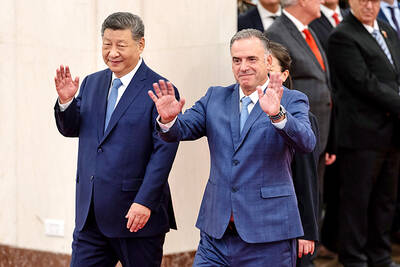
EMERGING FIELDS: The Chinese president said that the two countries would explore cooperation in green technology, the digital economy and artificial intelligence Chinese President Xi Jinping (習近平) yesterday called for an “equal and orderly multipolar world” in the face of “unilateral bullying,” in an apparent jab at the US. Xi was speaking during talks in Beijing with Uruguayan President Yamandu Orsi, the first South American leader to visit China since US special forces captured then-Venezuelan president Nicolas Maduro last month — an operation that Beijing condemned as a violation of sovereignty. Orsi follows a slew of leaders to have visited China seeking to boost ties with the world’s second-largest economy to hedge against US President Donald Trump’s increasingly unpredictable administration. “The international situation is fraught
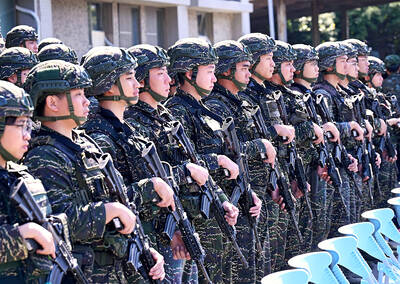
MORE RESPONSIBILITY: Draftees would be expected to fight alongside professional soldiers, likely requiring the transformation of some training brigades into combat units The armed forces are to start incorporating new conscripts into combined arms brigades this year to enhance combat readiness, the Executive Yuan’s latest policy report said. The new policy would affect Taiwanese men entering the military for their compulsory service, which was extended to one year under reforms by then-president Tsai Ing-wen (蔡英文) in 2022. The conscripts would be trained to operate machine guns, uncrewed aerial vehicles, anti-tank guided missile launchers and Stinger air defense systems, the report said, adding that the basic training would be lengthened to eight weeks. After basic training, conscripts would be sorted into infantry battalions that would take
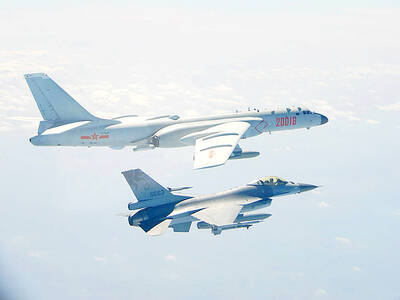
GROWING AMBITIONS: The scale and tempo of the operations show that the Strait has become the core theater for China to expand its security interests, the report said Chinese military aircraft incursions around Taiwan have surged nearly 15-fold over the past five years, according to a report released yesterday by the Democratic Progressive Party’s (DPP) Department of China Affairs. Sorties in the Taiwan Strait were previously irregular, totaling 380 in 2020, but have since evolved into routine operations, the report showed. “This demonstrates that the Taiwan Strait has become both the starting point and testing ground for Beijing’s expansionist ambitions,” it said. Driven by military expansionism, China is systematically pursuing actions aimed at altering the regional “status quo,” the department said, adding that Taiwan represents the most critical link in China’s


 RSS
RSS