


China yesterday condemned the US Department of Defense’s annual report on the Chinese military, calling it deliberate distortion that has “severely damaged” mutual trust.
In its annual report to the US Congress on Chinese military activities, the department on Friday said that China is expected to add substantial military infrastructure, including communications and surveillance systems, to artificial islands in the South China Sea this year.
Chinese Ministry of National Defense spokesman General Yang Yujun (楊宇軍) expressed “strong dissatisfaction” and “firm opposition” to the Pentagon report and said it has “severely damaged mutual trust,” Xinhua news agency reported.
The report “hyped up” China’s military threat and lack of transparency, “deliberately distorted” Chinese defense policies and “unfairly” depicted Chinese activities in the East China and South China seas, Yang was quoted as saying.
“China follows a national defense policy that is defensive in nature,” Yang said, adding that the nation’s military build-up and reforms are aimed at maintaining sovereignty, security and territorial integrity, and guaranteeing China’s peaceful development.
It is the US that has always been suspicious and flexing its military muscle by frequently sending military aircraft and warships to the region, Yang said.
Despite its calls for freedom of navigation and restraint for peace, the US has pushed forward militarization of the South China Sea with an “intention to exert hegemony,” Yang added.
The Pentagon report said the planned addition of military infrastructure would give China long-term “civil-military bases” in the contested waters.
It estimated that China’s reclamation work had added more than 1,300 hectares of land on seven features it occupies in the Spratly Islands (Nansha Islands, 南沙群島) in the space of two years.
Taiwan also claims the Spratlys.
The report said China completed its major reclamation efforts in October last year, switching focus to infrastructure development, including three 3,000m-long airstrips that can accommodate advanced fighter jets.
Yang defended the construction, saying it serves mostly civilian purposes and helps fulfil China’s international responsibilities and obligations by providing more public goods.
The Pentagon report came at a time of heightened tension over maritime territories claimed by China and disputed by several Asian nations, including Taiwan. Washington has accused Beijing of militarizing the South China Sea, while Beijing, in turn, has criticized increased US naval patrols and exercises in Asia.
The US report renewed accusations against China’s government and military for cyberattacks against US government computer systems, a charge Beijing denies.
The Pentagon said attacks last year appeared focused on intelligence collection.
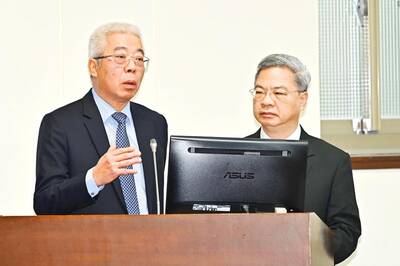
Taiwan has arranged for about 8 million barrels of crude oil, or about one-third of its monthly needs, to be shipped from the Red Sea this month to bypass the Strait of Hormuz and ease domestic supply pressures, CPC Corp, Taiwan (CPC, 台灣中油) said yesterday. The state-run oil company has worked with Middle Eastern suppliers to secure routes other than the Strait of Hormuz, through which about 20 percent of the world’s oil and liquefied natural gas typically passes, CPC chairman Fang Jeng-zen (方振仁) said at a meeting of the legislature’s Economics Committee in Taipei. Suppliers in Saudi Arabia have indicated they
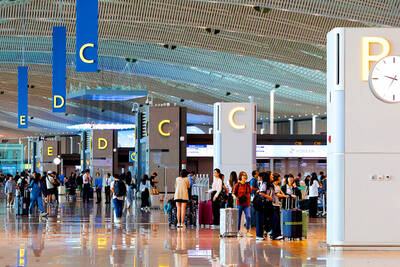
South Korea has adjusted its electronic arrival card system to no longer list Taiwan as a part of China, a move that the Ministry of Foreign Affairs said would help facilitate exchanges between the two sides. South Korea previously listed “Taiwan” as “Taiwan (China)” in the drop-down menus of its online arrival card system, where people had to fill out where they came from and their next destination. The ministry had requested South Korea make a revision and said it would change South Korea’s name on Taiwan’s online immigration system from “Republic of Korea” to “Korea (South),” should the issue not be
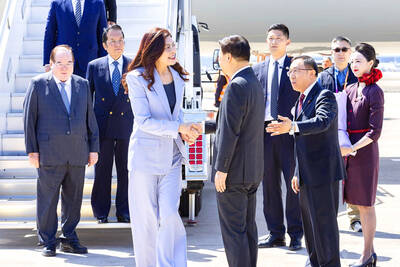
CCP ‘PAWN’? Beijing could use the KMT chairwoman’s visit to signal to the world that many people in Taiwan support the ‘one China’ principle, an academic said Chinese Nationalist Party (KMT) Chairwoman Cheng Li-wun (鄭麗文) yesterday arrived in China for a “peace” mission and potential meeting with Chinese President Xi Jinping (習近平), while a Taiwanese minister detailed the number of Chinese warships currently deployed around the nation. Cheng is visiting at a time of increased Chinese military pressure on Taiwan, as the opposition-dominated Legislative Yuan stalls a government plan for US$40 billion in extra defense spending. Speaking to reporters before going to the airport, Cheng said she was going on a “historic journey for peace,” but added that some people felt uneasy about her trip. “If you truly love Taiwan,
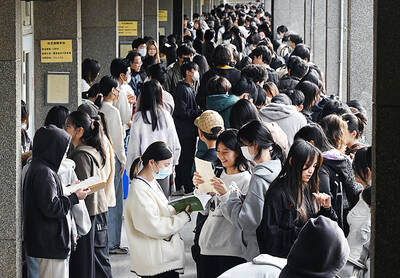
A global survey showed that 60 percent of Taiwanese had attained higher education, second only to Canada, the Ministry of the Interior said. Taiwan easily surpassed the global average of 43 percent and ranked ahead of major economies, including Japan, South Korea and the US, data from the Organisation for Economic Co-operation and Development (OECD) for 2024 showed. Taiwan has a high literacy rate, data released by the ministry showed. As of the end of last year, Taiwan had 20.617 million people aged 15 or older, accounting for 88.5 percent of the total population, with a literacy rate of 99.4 percent, the data


 RSS
RSS