


A Taiwanese group has intervened in the Philippines’ international court case against China’s claims in the South China Sea, pressing Taipei’s position that Taiwan is entitled to a swath of the disputed waterway as an economic zone.
The unusual submission has come to light just as judges at the Permanent Court of Arbitration in The Hague are poised to rule on the Philippines’ landmark case, brought under the UN Convention on the Law of the Sea (UNCLOS).
The move could delay the judges’ ruling, now expected within two months, and potentially complicates worsening territorial disputes roiling across the vital trade route.
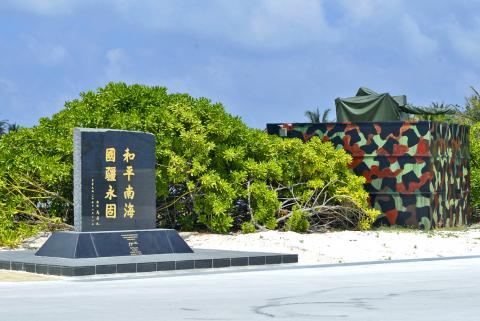
Photo:Reuters
Last month, the judges allowed written evidence from the government-linked Chinese (Taiwan) Society of International Law to be submitted, even though Taiwan is neither a member of the UN nor a signatory to the UNCLOS, legal and diplomatic sources said.
As well as reviewing several hundred pages of evidence from Taiwan, the judges have also sought further information from the Philippines and China, legal sources close to the case say.
Manila is challenging the legality of China’s claims to virtually the entire South China Sea, in part by arguing that no reefs, atolls or islets in the Spratly Islands (Nansha Islands, 南沙群島) can legally be considered an island, and therefore holds no rights to an 200 nautical mile (370km) exclusive economic zone.
Itu Aba Island (Taiping Island, 太平島), controlled by Taiwan, is the biggest feature in the Spratlys and the one some analysts believe has the strongest claim to island status and an economic zone. The Spratlys are also claimed by China, Vietnam and Malaysia, while Brunei claims nearby waters.
Taiwanese officials have bristled at the Philippines’ arguments that Itu Aba is a “rock” that cannot support natural human habitation, and therefore has no claims to either island status or an exclusive economic zone.
Citing various government reports and statements as evidence, the society’s submission to the court states “it is clear that Taiping Island is an island which can sustain human habitation and economic life of its own under ... UNCLOS.”
Reiterating Beijing’s refusal to recognize Manila’s case, the Chinese Ministry of Foreign Affairs said the Philippines was using the case to negate China’s territorial sovereignty.
“Chinese people on both sides of the Taiwan Strait all have a responsibility to jointly protect the ancestral property of the Chinese people,” the ministry said in a faxed reply to reporters.
While the society technically operates as a private body, it has close ties to the Republic of China government, including President Ma Ying-jeou (馬英九), who once headed the institution and remains on its board.
A spokesman for Ma said the submission was not made on behalf of the government, but its findings were consistent with Taipei’s official stance.
While the society’s arguments might aid China’s position, Beijing is likely to be wary of any move by the judges to bolster Taiwan’s standing in the international community, analysts said.
Chinese officials have repeatedly challenged the court’s jurisdiction and the rights of the Philippines to bring the case, refusing to participate.
Beijing has ignored invitations from the court to provide its own submission, but the judges have taken into account Chinese public statements, according to the court’s public statements.
Ian Storey, a senior fellow at the ISEAS Yusof Ishak Institute in Singapore who specializes in Asian security issues, including the South China Sea, said it was significant the judges’ had consented to review Taiwan’s arguments.
“It demonstrates that the judges are striving to be impartial, and that they have been at pains to take into account the views of all the concerned parties, even China, which has refused to participate, and Taiwan, which isn’t a member of the UN,” he said.
While China will not like the court giving Taiwan “international space” on this issue, “Beijing may decide to look the other way,” he said.

LEVERAGE: China did not ‘need to fire a shot’ to deny Taiwan airspace over Africa when it owns ‘half the continent’s debt,’ a US official said, calling it economic warfare The EU has raised concerns about overflight rights following the delay of President William Lai’s (賴清德) planned state visit to the Kingdom of Eswatini after three African nations denied overflight clearance for his charter at the last minute. Taiwanese allies Paraguay and Saint Kitts and Nevis, as well as several US lawmakers and the Inter-Parliamentary Alliance on China (IPAC) condemned China for allegedly pressuring the countries. Lai was scheduled to fly directly to Taiwan’s only African ally from yesterday to Sunday to celebrate the 40th anniversary of King Mswati III’s accession and his 58th birthday, but Seychelles, Mauritius and Madagascar suddenly revoked
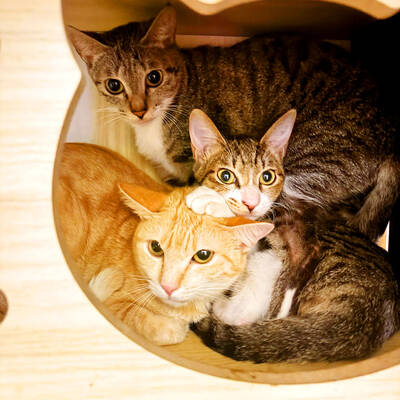
The number of pet cats in Taiwan surpassed that of pet dogs for the first time last year, reaching 1,742,033, a 32.8 percent increase from 2023, the Ministry of Agriculture said yesterday, citing a survey. By contrast, the number of pet dogs declined slightly by 1.2 percent over the same period to 1,462,528, the ministry said. Despite the shift, households with dogs still slightly outnumber those with cats by 1.2 percent. However, while the number of households with multiple dogs has remained relatively stable, households keeping more than two cats have increased, contributing to the overall rise in the feline population. The trend
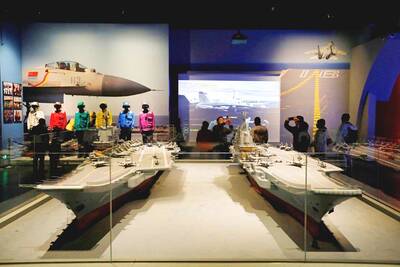
China on Wednesday teased in a video an aircraft carrier that could be its fourth, and the first using nuclear power, while making an allusion to Taiwan and vowing to further build up its islands, as it looks to boost maritime power, secure resources and bolster territorial claims. The video, issued on the eve of the 77th founding anniversary of the Chinese People’s Liberation Army Navy, featured fictional officers with names that are homophones of three commissioned aircraft carriers, the Liaoning (遼寧), Shandong (山東) and Fujian (福建). Titled Into the Deep, it showed a 19-year-old named “Hejian” (何劍) joining the group, sparking
BIG YEAR: The company said it would also release its A12 chip the same year to keep a ‘reliable stream of new silicon technologies’ flowing to its customers Taiwan Semiconductor Manufacturing Co (TSMC, 台積電) yesterday said its newest A13 chip is to enter volume production in 2029 as the chipmaker seeks to hold onto its tech leadership and demand for next-generation chips used in artificial intelligence (AI), high-performance-computing (HPC) and mobile applications. TSMC, the world’s biggest contract chipmaker, also unveiled its A12 chip at its annual technology symposium in Santa Clara, California. The A12 chip, which features TSMC’s super-power-rail technology to provide backside power delivery for AI and HPC applications, is also to enter volume production in 2029, a year after the scheduled release of the A14 chip. The technology moves


 RSS
RSS