


The Democratic Progressive Party (DPP) has not only failed to live up to the legacy of Peng Wan-ju (彭婉如), but the government under the nation’s first female president will feature a 40-member Cabinet with just four women, women’s rights groups said yesterday during a protest outside DPP headquarters in Taipei.
During the protest, an article published in yesterday’s Liberty Times (the Taipei Times’ sister newspaper) by women’s rights campaigner Lee Yuan-chen (李元貞) was read out loud.
Lee, who served as national policy adviser to former president Chen Shui-bian (陳水扁), criticized the gender imbalance in the proposed Cabinet.
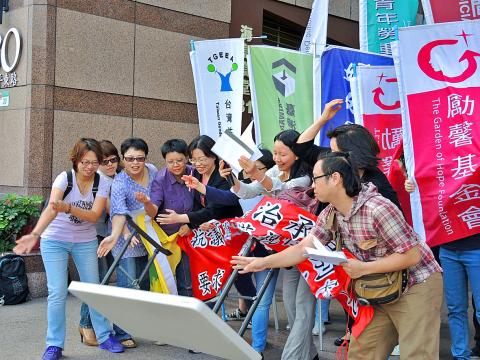
Photo: CNA
Tsai’s gender equality policy in 2012 promised that the gender ratio in governments — whether local or central, and regardless of pay grade — would at least be one-third women, but the last time there were so few women in the Cabinet was under then-premier Vincent Siew (蕭萬長) in 1997, she wrote. Tsai’s recent predecessors have done better, Lee said, referring to President Ma Ying-jeou (馬英九) and Chen.
Representatives of the Awakening Foundation, the Homemaker Union Consumer Co-op, the Garden of Hope Foundation and other groups put on a short play during the protest, showing Tsai closing a door behind her and picking just male staff.
Lee said she turned down an invitation to Tsai’s post-inaugural banquet because even though she is happy to see Tsai become the nation’s first female president, Tsai has “failed to live up to Peng’s legacy of introducing women to politics in the DPP.”
Peng, director of the DPP’s Women’s Affairs Department before she was murdered on Nov. 30, 1996, in Kaohsiung, is remembered for pushing for a legal amendment guaranteeing that at least one-quarter of all politicians should be female.
Garden of Hope Foundation executive manager Chi Hui-jung (紀惠容) said women’s rights groups will not give Tsai a honeymoon period after her inauguration because of her disappointing performance so far.
The groups plan to closely monitor Tsai’s administration.
Premier-designate Lin Chuan (林全) evidently lacks a sensitivity to gender issues since his Cabinet list includes many middle-aged to elderly men, Chi said, adding that the groups would watch how Lin’s Cabinet handles gender issues.
Executive Yuan spokesperson-designate Tung Chen-yuan (童振源) said that while Lin had reached out to many women, the “current results are not what was anticipated, but we are working toward that goal.”
The incoming government’s policies and decisions would emphasize the different thoughts across genders and seek to encourage women to enter politics, Tung said, adding that the incoming government hoped for “women in government’ to be a mainstream value in Taiwan’s future.
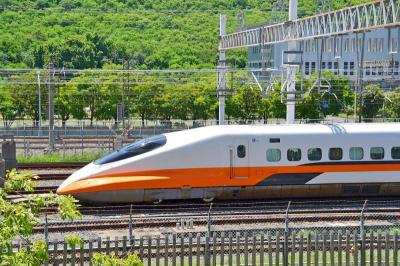
A signaling system malfunction disrupted high-speed rail (HSR) services beginning at 8am today, with trains temporarily reduced to three northbound and three southbound trains per hour as authorities conduct inspections. The malfunction occurred on a section of track in Miaoli County during pre-operation checks early this morning, forcing northbound and southbound trains to use a single track, the HSR operator said. The regular schedule has been replaced with three hourly trains offering only nonreserved seating in each direction, stopping at every station, it said, adding that business class cars would still have reserved seating. Departures from terminal stations are scheduled at the top

DRONE CENTRAL: Taiwan aims to become Asia’s democratic hub for drones, with most exports focused on high-quality military-grade models, an official said Taiwan’s drone industry is expected to expand significantly by 2030, producing 100,000 units per month and exporting half of them, the Ministry of Economic Affairs said yesterday. Current drone production capacity is about 15,000 units per month, but the industry can quickly scale up as demand increases, Industrial Development Administration Director-General Chiou Chyou-huey (邱求慧) told a news conference in Taipei. Taiwan’s drone output grew 2.5-fold last year to NT$12.9 billion (US$408.3 million) under a government program to develop the uncrewed vehicle sector, he said. The Executive Yuan in October last year approved plans to invest NT$44.2 billion into domestic production of uncrewed aerial
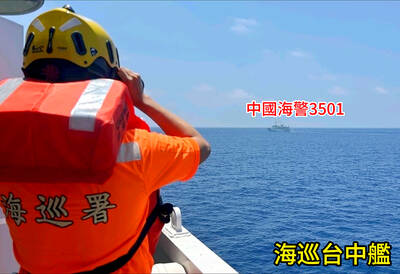
VERBOSE VESSELS: A CGA cutter and a China Coast Guard exchanged verbal barbs for more than a day in Taiwanese-controlled waters before the Chinese vessel left The Taiwanese and Chinese coast guards had a standoff near the strategically located Pratas Islands (Dongsha Islands, 東沙群島) in the north of the South China Sea, the Coast Guard Administration (CGA) said yesterday. The two sides engaged in intense radio exchanges over sovereignty claims during the 33-hour standoff. China Coast Guard vessel 3501 eventually left the restricted waters, 26.6 nautical miles (49.2km) west of the Pratas Islands, at 5pm yesterday, the CGA said. Lying approximately between southern Taiwan and Hong Kong, the Taiwan-controlled Pratas are seen by some security experts as vulnerable to Chinese attack due to their distance — more than
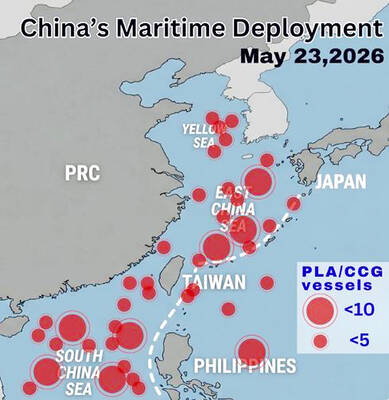
WARNING: China should stop engaging in actions that undermine regional peace and stability, as it would only build resentment among people across the Strait, the CGA said China has deployed more than 100 navy, coast guard and other vessels in waters from the Yellow Sea to the South China Sea and the western Pacific since US President Donald Trump and Chinese President Xi Jinping (習近平) met in Beijing, National Security Council Secretary-General Joseph Wu (吳釗燮) said yesterday. “In this part of the world, #China is the one & only PROBLEM wrecking the #StatusQuo & threatening regional peace & stability,” Wu wrote on X. In a separate post, he said Beijing was coercing Taiwan’s maritime domain, calling it illegal and provocative, after the Coast Guard Administration (CGA) expelled a


 RSS
RSS