


Army troops and other rescuers yesterday rushed to save scores of trapped residents after a pair of strong earthquakes in southwestern Japan killed at least 35 people, injured about 1,500 and left hundreds of thousands without electricity or water.
Rainfall was forecast to start pounding the area soon, threatening to further complicate the relief operation and set off more mudslides in isolated rural towns, where people were waiting to be rescued from collapsed homes.
Kumamoto Prefecture official Riho Tajima said the death toll stood at 22 from the magnitude 7.3 earthquake that shook the Kumamoto region on the southwestern island of Kyushu early yesterday. On Thursday night, Kyushu was hit by a magnitude 6.5 quake that left 10 dead.
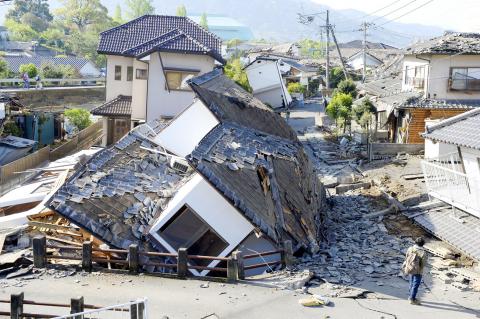
Photo: AP
Japanese media reported that nearly 200,000 homes were without electricity and that drinking-water systems had also failed in the area. Television footage showed people huddled in blankets, sitting or lying down shoulder-to-shoulder on the floors of evacuation centers. An estimated 400,000 households were without running water.
Japanese Chief Cabinet Secretary Yoshihide Suga said that 1,500 people had been injured in the quakes. Tajima said that 184 people were injured seriously and that more than 91,000 people had been evacuated from their homes. More than 200 homes and other buildings were either destroyed or damaged, she said.
Japanese Prime Minister Shinzo Abe expressed concerns about secondary disasters as forecasters predicted rain and strong winds later in the day. With soil already loosened by quakes, rainfall can set off mudslides.
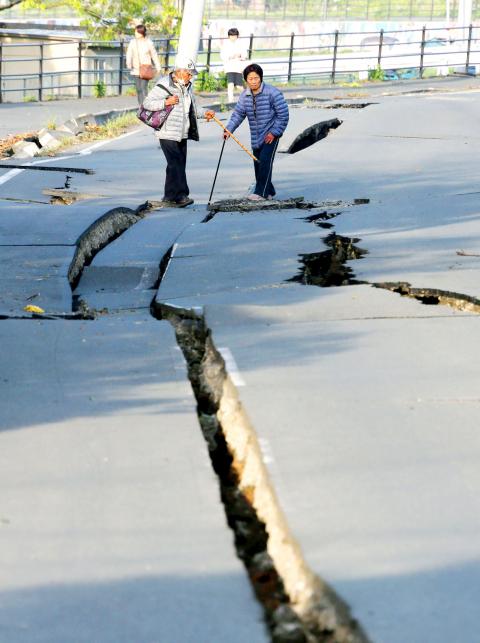
Photo: AP
“Daytime today is the big test” for rescue efforts, Abe said.
Landslides have already cut off roads and destroyed bridges, slowing down rescuers.
Police received reports of 97 cases of people trapped or buried under collapsed buildings, while 10 people were caught in landslides in three municipalities in the prefecture, Japan’s Kyodo news agency reported.
Kumamoto Prefecture has been rocked by aftershocks, including the strongest with a magnitude of 5.4 yesterday morning. The Japan Meteorological Agency said that the magnitude 7.3 quake early yesterday might have been the main one, with one from Thursday night a precursor.
The quakes’ epicenters have been relatively shallow — about 10km — resulting in more severe shaking and damage. National broadcaster NHK said as many as eight quakes were being felt per hour in the area.
Suga told reporters that the number of troops in the area was being raised to 20,000, while additional police and firefighters were also on the way.
He urged people not to panic.
“Please let us help each other and stay calm,” Suga said in a nationally televised news conference.
Kyushu island’s Mount Aso, the largest active volcano in Japan, erupted for the first time in a month, sending smoke rising about 100m into the air, but no damage was reported.
The Nuclear Regulation Authority reported no abnormalities at Kyushu’s Sendai nuclear plant.
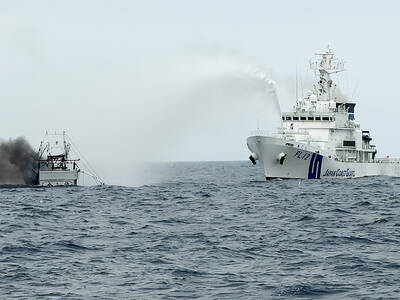
CREDIT-GRABBER: China said its coast guard rescued the crew of a fishing vessel that caught fire, who were actually rescued by a nearby Taiwanese boat and the CGA Maritime search and rescue operations do not have borders, and China should not use a shipwreck to infringe upon Taiwanese sovereignty, the Coast Guard Administration (CGA) said yesterday. The coast guard made the statement in response to the China Coast Guard (CCG) saying it saved a Taiwanese fishing boat. The Chuan Yu No. 6 (全漁6號), a fishing vessel registered in Keelung, on Thursday caught fire and sank in waters northeast of Diaoyutai Islands (釣魚台). The vessel left Keelung’s Badouzih Fishing Harbor (八斗子漁港) at 3:35pm on Sunday last week, with seven people on board — a 62-year-old Taiwanese captain surnamed Chang (張) and six

RISKY BUSINESS: The ‘incentives’ include initiatives that get suspended for no reason, creating uncertainty and resulting in considerable losses for Taiwanese, the MAC said China’s “incentives” failed to sway sentiment in Taiwan, as willingness to work in China hit a record low of 1.6 percent, a Ministry of Labor survey showed. The Directorate-General of Budget, Accounting and Statistics (DGBAS) also reported that the number of Taiwanese workers in China has nearly halved from a peak of 430,000 in 2012 to an estimated 231,000 in 2024. That marked a new low in the proportion of Taiwanese going abroad to work. The ministry’s annual survey on “Labor Life and Employment Status” includes questions respondents’ willingness to seek employment overseas. Willingness to work in China has steadily declined from

The Legislative Yuan’s Finance Committee yesterday approved proposed amendments to the Amusement Tax Act (娛樂稅法) that would abolish taxes on films, cultural activities and competitive sporting events, retaining the fee only for dance halls and golf courses. The proposed changes would set the maximum tax rate for dance halls and golf courses at 50 and 20 percent respectively, with local governments authorized to suspend the levies. Article 2 of the act says that “amusement tax shall be levied on tickets sold or fees charged by amusement places, facilities or activities” in six categories: “Cinema; professional singing, story-telling, dancing, circus, magic show, acrobatics
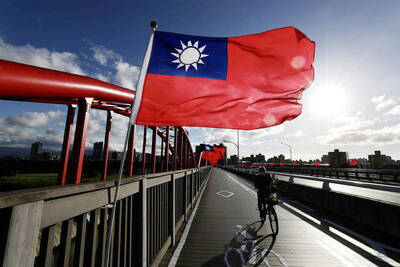
INFLATION UP? The IMF said CPI would increase to 1.5 percent this year, while the DGBAS projected it would rise to 1.68 percent, with GDP per capita of US$44,181 The IMF projected Taiwan’s real GDP would grow 5.2 percent this year, up from its 2.1 percent outlook in January, despite fears of global economic disruptions sparked by the US-Iran conflict. Taiwan’s consumer price index (CPI) is projected to increase to 1.5 percent, while unemployment would be 3.4 percent, roughly in line with estimates for Asia as a whole, the international body wrote in its Global Economic Outlook Report published in the US on Monday. The figures are comparatively better than the IMF outlook for the rest of the world, which pegged real GDP growth at 3.1 percent, down from 3.3 percent


 RSS
RSS