


Minister of Foreign Affairs David Lin (林永樂) yesterday said that legal action had been taken against Kenyan government officials for ignoring a court injunction and cooperating with China in its forced deportation of several Taiwanese last week.
On the sidelines of a meeting of the legislature’s Foreign Affairs and National Defense Committee yesterday, Lin said the Taipei Liaison Office in South Africa had instructed the defense attorneys of the first eight Taiwanese forcibly deported to Beijing to take legal action against the Kenyan interior minister, the inspector general of police and the attorney general.
The lawsuits were filed on Friday last week, the day the eight Taiwanese were deported to China following their acquittal in a 2014 telecoms fraud case, Lin said.
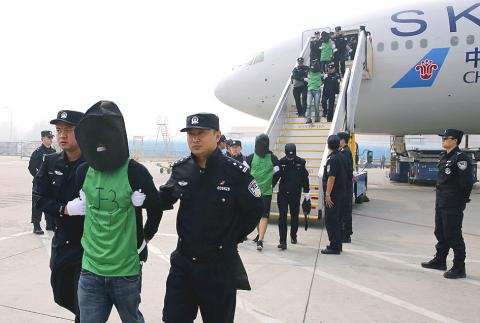
Photo: AP
Thirty-seven more Taiwanese — 15 of whom were also acquitted in the same case and the others, who were suspected of telecoms fraud and arrested on Friday last week — suffered the same fate on Tuesday, when they were forced by Chinese personnel into an airplane heading to China.
Lin said the grounds for the lawsuits were that the defendants disregarded the Kenyan High Court’s injunction barring the eight’s deportation, that they detained the Taiwanese for more than 24 hours and illegally cooperated with China in deporting the Taiwanese to Beijing.
During the legislative session, Lin also refuted remarks by Kenyan Minister of Foreign Affairs Amina Mohamed, who on Tuesday said that Taipei had not contacted Nairobi about the matter.
“We don’t have official relations with Taiwan. We believe in the ‘one China’ policy. We have diplomatic relations with China. We haven’t seen the official protest, we are actually hearing it from the media,” Mohamed said.
“An official of the liaison office filed for a court injunction in Kenya. Our representative to South Africa, John Chen (陳忠), has also lodged a protest over the matter. Due to the absence of diplomatic ties [between Taipei and Nairobi], the protest was not filed directly with the Kenyan foreign ministry, but rather through Nairobi’s embassy in South Africa,” Lin said.
Calling Mohamed’s comments “utterly unacceptable,” Lin said such remarks would give the international community the wrong impression that Taiwan had not acted on the matter.
Department of West Asian and African Affairs Director-General Chen Chun-shen (陳俊賢) said John Chen also expressed the government’s protest in front of Kenyan news media when the acquitted Taiwanese were illegally deported.
With regard to the fate of the five Taiwanese still in Kenya, who were also involved in the 2014 fraud case and whose verdicts were reportedly to be given in early June, Lin said the ministry was doing all in its power to protect them from being seized by China.
Lin also expressed “confidence” in the safety of the 31 Taiwanese who were arrested in Indonesia earlier this month for suspected involvement in telecoms fraud.
“We are highly confident that the case would be handled properly. Communications between Taipei and Jakarta have been smooth,” Lin added.

A signaling system malfunction disrupted high-speed rail (HSR) services beginning at 8am today, with trains temporarily reduced to three northbound and three southbound trains per hour as authorities conduct inspections. The malfunction occurred on a section of track in Miaoli County during pre-operation checks early this morning, forcing northbound and southbound trains to use a single track, the HSR operator said. The regular schedule has been replaced with three hourly trains offering only nonreserved seating in each direction, stopping at every station, it said, adding that business class cars would still have reserved seating. Departures from terminal stations are scheduled at the top

‘NO SECURITY RISK’: The Railway Bureau reassured the public that the technicians’ activities were limited to technical guidance and did not involve sensitive systems The Railway Bureau yesterday said it had invited eight Chinese technicians to assist with an airport MRT construction project. The bureau issued the confirmation after an Internet user said Chinese nationals had entered the construction zone of Taiwan Taoyuan International Airport’s Terminal 3 project. They asked why “individuals from an enemy state” were allowed access to such a major national infrastructure project, which raised serious concerns over Taiwan’s industrial safety, sensitive systems and information security. The bureau’s Northern Region Engineering Branch Office said subcontractor Taiwan Handle Industrial Co (台灣手把工業) of the Taoyuan airport MRT’s “Contract No. CU05 Project A14 Station Civil, MEP &

Taiwan is still in the process of assessing the possibility of recruiting workers from Eswatini, the Ministry of Foreign Affairs said yesterday, adding that its goal is to help Eswatini upgrade its vocational training centers. If there are plans to recruit workers from Eswatini, safeguarding national security, protecting public health and ensuring the employment rights of Taiwanese would be prerequisites, Department of West Asian and African Affairs Director-General Yen Chia-liang (顏嘉良) told a news conference. Key considerations would also include filling labor shortages in specific industries, and fostering bilateral professional and technical exchanges, he said. Yen was asked about the progress of labor

A US uncrewed surface vessel (USV) encountered multiple Chinese warships during an autonomous transit of the Taiwan Strait, US defense company Seasats said in a statement on Wednesday. Seasats announced that a Lightfish USV had completed the first autonomous transit of the Taiwan Strait. Over five days, the USV traversed the entire length of the Strait while constantly monitoring surface vessel traffic, the company said. The Lightfish encountered multiple Chinese warships, one of which was a Chinese People’s Liberation Army Navy (PLAN) Type 056 corvette, it said. The Chinese vessels were operating “well within Taiwan’s exclusive economic zone without transmitting their identity via the


 RSS
RSS