


President Ma Ying-jeou (馬英九) yesterday appointed Vice Premier Simon Chang (張善政) as the new premier after Ma signed off on outgoing Premier Mao Chi-kuo’s (毛治國) resignation.
“Premier Mao has led his Cabinet members to resign en masse. After thorough consideration, President Ma has decided to sign off on Mao’s resignation and appoint Chang as his successor,” Presidential Office spokesman Charles Chen (陳以信) said in a statement yesterday.
Chen said that while it is the president’s mandate to appoint a premier without the legislature’s approval, Ma is obligated by a consensus reached between the Chinese Nationalist Party (KMT) and the Democratic Progressive Party (DPP) when an amendment to the Constitution was passed in 1997 to respect the majority party in the legislature and appoint a premier it accepts to prevent the government from running idle.
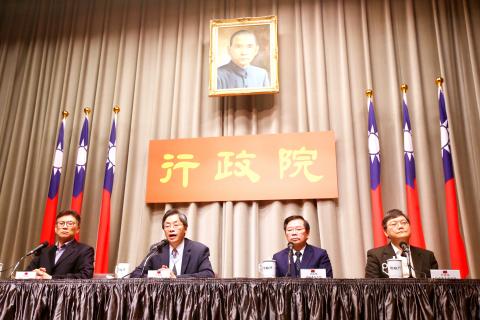
Photo: CNA
To adhere to this principle, Chen said Ma tried to contact DPP Chairperson and president-elect Tsai Ing-wen (蔡英文) yesterday to discuss Mao’s successor, but Tsai was occupied with other matters.
Instead, Ma requested that Presidential Office Secretary-General Tseng Yung-chuan (曾永權) call former DPP secretary-general Lin Hsi-yao (林錫耀) to sound out Tsai’s opinion on the matter, Chen said.
“Lin said on the telephone on behalf of Tsai that she does not have any opinion regarding the premier appointed by President Ma in accordance with his constitutional mandate, and that she would respect his decision,” Chen said, adding that Ma subsequently appointed Chang as the new premier.
Chang’s appointment came after Ma’s failed attempts to persuade Tsai into having her party — which won 68 seats in the 113-seat legislature in the Jan. 16 elections — form a Cabinet before her inauguration on May 20.
Tsai officially turned down Ma’s offer on Sunday, saying it could cause confusions of responsibility.
At an afternoon news conference at the Executive Yuan after the announcement of his appointment, Chang pledged to stick to his post, cooperate with his colleagues and steer the nation toward a better future.
Asked why he decided to assume the premiership, despite indicating otherwise last week, Chang said he had worried that he might not be respected by the new legislature that is to be sworn in on Monday next week and that it might be a waste of time to take up a job that is set to expire four months later.
“However, the DPP has promised not to give Cabinet members a hard time and I also feel that we should still do our jobs right in the next four months,” Chang said.
Chang also announced a minor Cabinet reshuffle involving five ministers, including National Development Council Minister Woody Duh (杜紫軍), who succeeded him as vice premier; Mainland Affairs Council Deputy Minister Lin Chu-chia (林祖嘉), who filled the vacancy left by Duh; Financial Supervisory Commission Vice Chairwoman Jennifer Wang (王儷玲), who was promoted to head the commission; Vice Minister of Agriculture Chen Tze-ching (陳志清), who assumed the council’s ministership; and Executive Yuan Science and Technology Advisory Group executive secretary Chung Char-dir (鐘嘉德), who replaced Minister Without Portfolio Yan Hong-sen (顏鴻森).
Chang holds a master’s degree in civil engineering from Stanford University and a doctoral degree in the same discipline from Cornell University. He served as the head of search engine giant Google Inc’s Asia-Pacific hardware operations and is a former minister without portfolio.
Additional reporting by Chung Li-hua
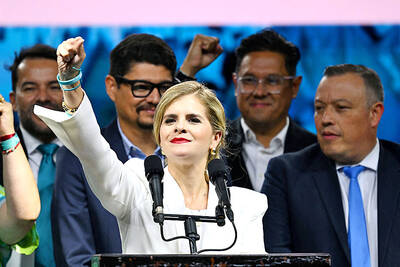
Right-wing political scientist Laura Fernandez on Sunday won Costa Rica’s presidential election by a landslide, after promising to crack down on rising violence linked to the cocaine trade. Fernandez’s nearest rival, economist Alvaro Ramos, conceded defeat as results showed the ruling party far exceeding the threshold of 40 percent needed to avoid a runoff. With 94 percent of polling stations counted, the political heir of outgoing Costa Rican President Rodrigo Chaves had captured 48.3 percent of the vote compared with Ramos’ 33.4 percent, the Supreme Electoral Tribunal said. As soon as the first results were announced, members of Fernandez’s Sovereign People’s Party
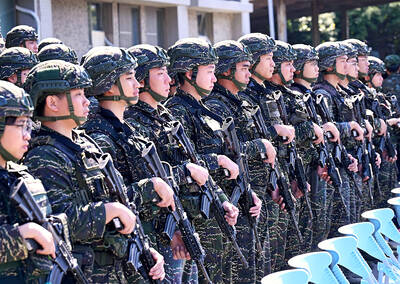
MORE RESPONSIBILITY: Draftees would be expected to fight alongside professional soldiers, likely requiring the transformation of some training brigades into combat units The armed forces are to start incorporating new conscripts into combined arms brigades this year to enhance combat readiness, the Executive Yuan’s latest policy report said. The new policy would affect Taiwanese men entering the military for their compulsory service, which was extended to one year under reforms by then-president Tsai Ing-wen (蔡英文) in 2022. The conscripts would be trained to operate machine guns, uncrewed aerial vehicles, anti-tank guided missile launchers and Stinger air defense systems, the report said, adding that the basic training would be lengthened to eight weeks. After basic training, conscripts would be sorted into infantry battalions that would take
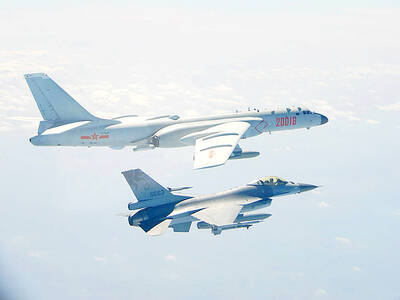
GROWING AMBITIONS: The scale and tempo of the operations show that the Strait has become the core theater for China to expand its security interests, the report said Chinese military aircraft incursions around Taiwan have surged nearly 15-fold over the past five years, according to a report released yesterday by the Democratic Progressive Party’s (DPP) Department of China Affairs. Sorties in the Taiwan Strait were previously irregular, totaling 380 in 2020, but have since evolved into routine operations, the report showed. “This demonstrates that the Taiwan Strait has become both the starting point and testing ground for Beijing’s expansionist ambitions,” it said. Driven by military expansionism, China is systematically pursuing actions aimed at altering the regional “status quo,” the department said, adding that Taiwan represents the most critical link in China’s
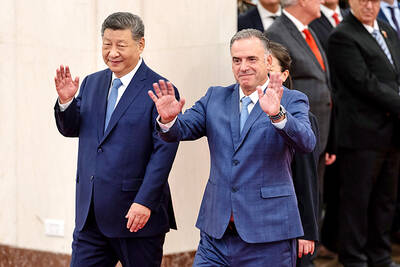
EMERGING FIELDS: The Chinese president said that the two countries would explore cooperation in green technology, the digital economy and artificial intelligence Chinese President Xi Jinping (習近平) yesterday called for an “equal and orderly multipolar world” in the face of “unilateral bullying,” in an apparent jab at the US. Xi was speaking during talks in Beijing with Uruguayan President Yamandu Orsi, the first South American leader to visit China since US special forces captured then-Venezuelan president Nicolas Maduro last month — an operation that Beijing condemned as a violation of sovereignty. Orsi follows a slew of leaders to have visited China seeking to boost ties with the world’s second-largest economy to hedge against US President Donald Trump’s increasingly unpredictable administration. “The international situation is fraught


 RSS
RSS