

Prosecutors yesterday conducted searches at executive offices of the Legislative Yuan and detained Legislative Yuan Secretary-General Lin Hsi-shan (林錫山) for questioning as part of an operation by the judiciary to investigate alleged corruption.
The prosecutors seized documents and gathered evidence at 19 locations, while taking in 33 people for questioning.
The investigation is focused on procurement contracts for computer software and hardware, networking system security and telecommunications equipment provided by Far Net Technologies Co (網遠科技), which won a series of public tenders over the past few years.
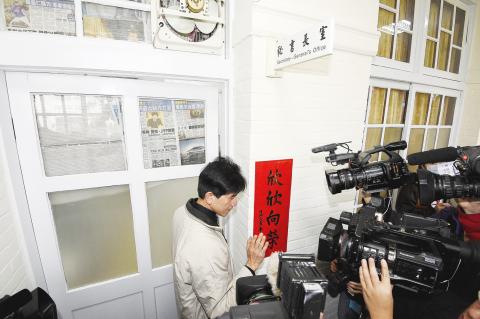
Photo: Chen Chih-chu, Taipei Times
Including setting up online documentation and information services, as well as an Internet service platform, and providing network security upgrades, Far Net Technologies received close to NT$300 million (US$8.87 million) for the procurement contracts.
Prosecutors reportedly received tip-offs that alleged Lin and Information Technology Department staff members had collectively received up to NT$3 million in kickbacks from Far Net Technologies.
Lin is a trusted aide to Legislative Speaker Wang Jin-Pyng (王金平).
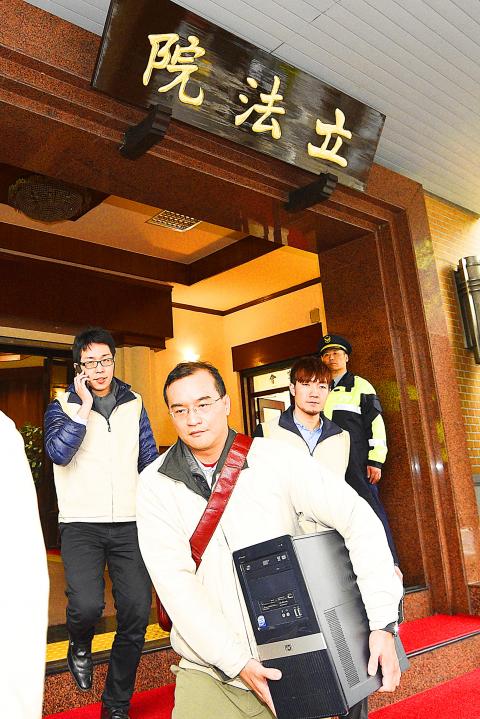
Photo: Chen Chih-chu, Taipei Times
When Wang assumed the speakership in 1999, he promoted Lin to secretary-general, and both have remained in the positions for the past 17 years.
Prior to that, Lin served three terms as a Chinese Nationalist Party (KMT) legislator from 1990 to 1999, elected from his native Changhua County.
Judicial investigators yesterday also searched Lin’s home in Changhua and Far Net Technologies’ headquarters in Hsinchu City, along with offices and residences in Taipei, New Taipei City, Hsinchu County and Changhua of suspects and witnesses associated with the procurement deals.
Prosecutors left the legislature with boxes of documents and several computers after a search that lasted about four hours, and they took one official with them to the prosecutors’ office to assist in the investigation.
Lin, who was not present during the morning raids, was picked up by investigators later in the day and as of press time last night was still being questioned.
Wang said Taipei District Prosecutors’ Office lead prosecutor Tsai Pi-yu (蔡碧玉) telephoned him twice about the search beforehand, but did not disclose what the investigation was about.
Wang, who tops the KMT’s list of legislators-at-large, denied a rumor that he is to resign from the speakership.
Media personality Clara Chou (周玉蔻) said that the search signaled the beginning of the third round of a political feud between President Ma Ying-jeou (馬英九) and Wang.
“Is the search of Lin Hsi-shan a move to force Wang out?” she asked.
Presidential Office Secretary-General “Tseng Yung-chuan (曾永權) could be added to the KMT’s list of legislators-at-large-elect if Wang resigns. Is that not a bit too much of a coincidence?” Chou said.
“Maybe Wang should just take his men with him and leave the KMT,” she added.
KMT Legislator Lo Shu-lei (羅淑蕾) said the timing was “too sensitive, when within a few days [of the presidential and legislative elections] there are calls demanding Wang’s resignation.”
Democratic Progressive Party Legislator Lin Shu-fen (林淑芬) said that “while corruption definitely should be investigated, [the probe] should not be wielded as a tool in a political feud, for which the case was ‘fed and kept’ until this moment.”
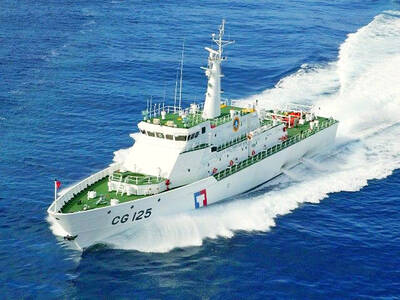
GEOPOLITICAL SIGNIFICANCE: The CGA’s nonmilitary role makes it a tool to avert diplomatic issues, an official said, while confirming the donation of a ship to Manila Coast Guard Administration (CGA) ships are scheduled to sail to the Philippines bearing the words “Taiwan Coast Guard” in a high-profile visit in October next year, the first such visit by a Taiwanese maritime law enforcement vessel to the Southeast Asian nation, the agency said yesterday. The CGA also confirmed that it had donated one of its decommissioned patrol vessels to the Philippines in a rare transfer of a retired ship to a nondiplomatic ally. The Republic of China (ROC) Navy last made such a visit in 1974, shortly before the Philippines switched diplomatic recognition to the People’s Republic of China in

SOFT TENNIS: Yu Kai-wen and Huang Shih-yuan narrowly defeated their Japanese rivals to capture Taiwan’s first gold at the Asian Games in Nagoya Yu Kai-wen (余凱文) and Huang Shih-yuan (黃詩媛) won Taiwan’s first gold of this year’s Asian Games, defeating a Japanese duo in a nail-biter in the soft tennis mixed doubles final in Nagoya, Japan, while Johnny Sun (孫家閎) won silver in wushu and Shih Cheng-chung (石政中) won bronze in men’s kumite. Yu and Huang narrowly defeated Japan’s Toshiki Uematsu and Rena Temma 5-4 (2-4, 5-3, 4-2, 1-4, 1-4, 4-0, 1-4, 4-1, 7-5) to give Taiwan its first gold in soft tennis mixed doubles at an Asian Games since 2018. Sun secured Taiwan’s first wushu medal at this year’s game, with a combined score

CALL FOR CHANGE: They urged the UN to facilitate Taiwan’s involvement in the body, recognize its peace efforts and to work with members in preventing military conflict Representatives to the UN from five of Taiwan’s diplomatic allies sent a joint letter to UN Secretary-General Antonio Guterres on Friday, calling for the country’s inclusion in the body. Allies in the letter sent ahead of the 81st session of the UN General Assembly General Debate made three demands in support of Taiwan: inclusion, recognition and camaraderie. They implored the UN to seek an appropriate way to facilitate Taiwan’s meaningful involvement in the world governing body, saying that UN Resolution 2758, which accepted the People’s Republic of China (PRC) as a member of the UN, does not exclude Taiwan. Beijing claims that the
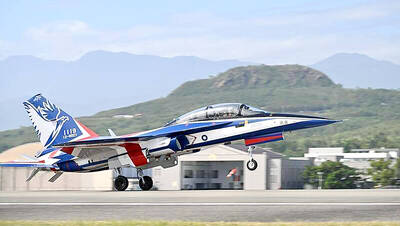
Aerospace Industrial Development Corp (AIDC, 漢翔航空工業) has finished production of the nation’s T-5 Brave Eagle (勇鷹) advanced jet trainers, with the final aircraft scheduled to be formally delivered at a ceremony on Thursday. The delivery of the trainer jets marks the end of the program, which dates back to 2017, with the first prototypes completed in 2019. Fifty-six of the 66 trainers had been delivered as of May. The Brave Eagle was developed and produced by AIDC and the National Chungshan Institute of Science and Technology. The program has provided a foundation for the development of a domestically produced next-generation primary trainer and


 RSS
RSS