


The three vice presidential candidates last night took part in a televised presentation of their campaign platforms and vision, at an event organized by the Central Election Commission.
Each candidate was given 30 minutes to present their statements, going in order according to a pre-show draw.
Former Academia Sinica vice president Chen Chien-jen (陳建仁), running mate of Democratic Progressive Party (DPP) presidential candidate Tsai Ing-wen (蔡英文), was the first to speak.
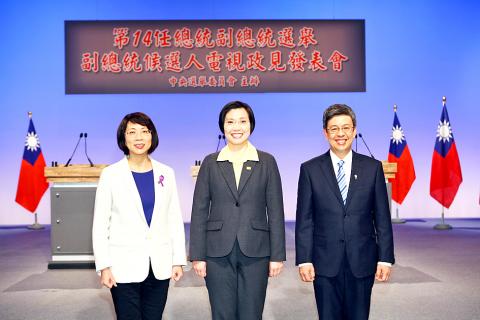
Photo: CNA
He talked about food safety and accused the government of being incompetent in managing crises.
If Tsai wins the election, her administration would work to restore Taiwan’s reputation as a food paradise, he said.
He also pledged that the DPP would assist the biomedical industry through policies and law revisions.
Republican Party Chairperson Hsu Hsin-ying (徐欣瑩), the running mate of People First Party (PFP) presidential candidate James Soong (宋楚瑜), started off her presentation by stressing that she was the youngest of the three candidates and therefore comes with “less baggage.”
She said it was time the pan-blue and the pan-green camps stopped their political feuding.
“Stop wrangling, stop wrangling, stop wrangling,” she said. “It is important so I have to repeat it three times.”
She pledged that if she and Soong were elected, she would promote public participation in the judicial process and abolish the Special Investigation Division of the Supreme Prosecutors’ Office. She also proposed upgrading the National Police Agency to ministry level to enhance its ability to crack down on drugs and uphold public security.
Jennifer Wang (王如玄), Chinese Nationalist Party (KMT) presidential candidate Eric Chu’s (朱立倫) running mate, discussed Chu’s proposal to boost the economy by raising the national minimum wage from NT$20,008 to NT$22,200 in his first year in office and to NT$30,000 in four years’ time.

Right-wing political scientist Laura Fernandez on Sunday won Costa Rica’s presidential election by a landslide, after promising to crack down on rising violence linked to the cocaine trade. Fernandez’s nearest rival, economist Alvaro Ramos, conceded defeat as results showed the ruling party far exceeding the threshold of 40 percent needed to avoid a runoff. With 94 percent of polling stations counted, the political heir of outgoing Costa Rican President Rodrigo Chaves had captured 48.3 percent of the vote compared with Ramos’ 33.4 percent, the Supreme Electoral Tribunal said. As soon as the first results were announced, members of Fernandez’s Sovereign People’s Party
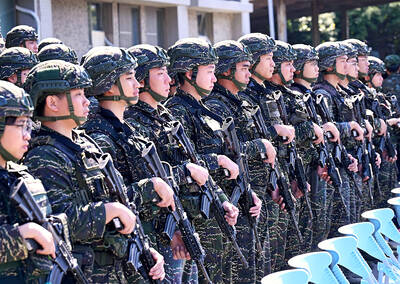
MORE RESPONSIBILITY: Draftees would be expected to fight alongside professional soldiers, likely requiring the transformation of some training brigades into combat units The armed forces are to start incorporating new conscripts into combined arms brigades this year to enhance combat readiness, the Executive Yuan’s latest policy report said. The new policy would affect Taiwanese men entering the military for their compulsory service, which was extended to one year under reforms by then-president Tsai Ing-wen (蔡英文) in 2022. The conscripts would be trained to operate machine guns, uncrewed aerial vehicles, anti-tank guided missile launchers and Stinger air defense systems, the report said, adding that the basic training would be lengthened to eight weeks. After basic training, conscripts would be sorted into infantry battalions that would take
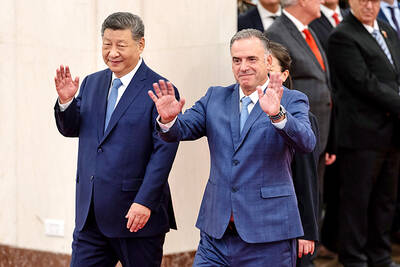
EMERGING FIELDS: The Chinese president said that the two countries would explore cooperation in green technology, the digital economy and artificial intelligence Chinese President Xi Jinping (習近平) yesterday called for an “equal and orderly multipolar world” in the face of “unilateral bullying,” in an apparent jab at the US. Xi was speaking during talks in Beijing with Uruguayan President Yamandu Orsi, the first South American leader to visit China since US special forces captured then-Venezuelan president Nicolas Maduro last month — an operation that Beijing condemned as a violation of sovereignty. Orsi follows a slew of leaders to have visited China seeking to boost ties with the world’s second-largest economy to hedge against US President Donald Trump’s increasingly unpredictable administration. “The international situation is fraught
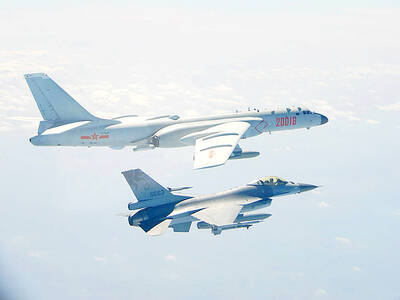
GROWING AMBITIONS: The scale and tempo of the operations show that the Strait has become the core theater for China to expand its security interests, the report said Chinese military aircraft incursions around Taiwan have surged nearly 15-fold over the past five years, according to a report released yesterday by the Democratic Progressive Party’s (DPP) Department of China Affairs. Sorties in the Taiwan Strait were previously irregular, totaling 380 in 2020, but have since evolved into routine operations, the report showed. “This demonstrates that the Taiwan Strait has become both the starting point and testing ground for Beijing’s expansionist ambitions,” it said. Driven by military expansionism, China is systematically pursuing actions aimed at altering the regional “status quo,” the department said, adding that Taiwan represents the most critical link in China’s


 RSS
RSS