


The Democratic Progressive Party (DPP) yesterday filed a lawsuit against Chinese Nationalist Party (KMT) lawmakers Alex Tsai (蔡正元) and Alicia Wang (王育敏) and former legislator Chiu Yi (邱毅) over their allegations that DPP presidential candidate Tsai Ing-wen (蔡英文) had speculated in real estate.
“In the past few days, Alex Tsai, Wang and Chiu have been making false accusations against Tsai Ing-wen with the intention of defaming her,” DPP spokesman Huang Di-ying (黃帝穎) told an afternoon news conference held outside the Taipei District Prosecutors’ Office. “We are filing a lawsuit claiming that they have violated Article 90 of the Presidential and Vice Presidential Election and Recall Act (總統副總統選舉罷免法).”
Under the article, anyone convicted of “spreading a rumor or false saying by text, picture, audio tape, video tape, speech or other method for the purpose of making a candidate elected or not elected” can face up to five years in prison.
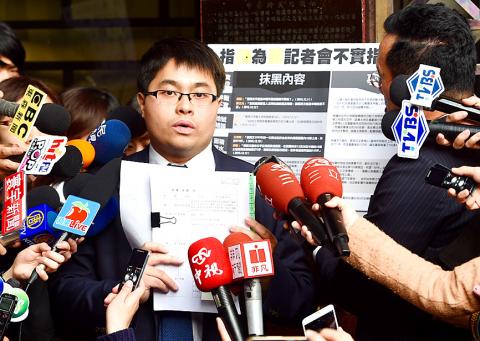
Photo: Lo Pei-der, Taipei Times
Huang said the allegations the trio have made against Tsai Ing-wen are patently false, since their details about the number of plots of land, the size of the plots and the prices have all been incorrect.
Attorney Wellington Koo (顧立雄), one of the DPP’s legislator-at-large candidates, said the party would prefer to ignore the trio, but it needs to take legal action to prove the allegations are false.
“Alex Tsai and the other two are [making allegations] only because they need to prove their own existence, they need to attract attention,” Koo said. “However, it is not just the trio. The whole KMT is anxious about the lack of evidence.”
Comparing DPP Legislator Tuan Yi-kang’s (段宜康) criticism that KMT vice presidential candidate Jennifer Wang (王如玄) had also engaged in real-estate speculation, with the allegations against the DPP chairperson, Wang’s case is more problematic since military dependents’ housing units were built for disadvantaged people, Koo said.
Tuan has accused Wang of engaging in speculative sales of military dependents’ apartments, which were converted by the government from old housing for military dependents — and sold at a subsidized price — solely for the purpose of improving their living conditions.
By law, such apartments cannot be resold within five years of their original purchase.
Tuan has accused Wang of circumventing the law by making debt assumption transactions, in which the buyer makes a payment in cash or in a promissory note in exchange for future ownership of the property after the five-year waiting period.
“Tsai Ing-wen’s case is rather simple. She bought land 30 years ago and sold it nearly 20 years ago,” Koo said. “Yet the KMT trio has made false accusations based on wrong information about land size, plot numbers and selling prices.”
Koo said the DPP would continue to monitor the KMT’s moves and would take legal actions accordingly.

‘NO SECURITY RISK’: The Railway Bureau reassured the public that the technicians’ activities were limited to technical guidance and did not involve sensitive systems The Railway Bureau yesterday said it had invited eight Chinese technicians to assist with an airport MRT construction project. The bureau issued the confirmation after an Internet user said Chinese nationals had entered the construction zone of Taiwan Taoyuan International Airport’s Terminal 3 project. They asked why “individuals from an enemy state” were allowed access to such a major national infrastructure project, which raised serious concerns over Taiwan’s industrial safety, sensitive systems and information security. The bureau’s Northern Region Engineering Branch Office said subcontractor Taiwan Handle Industrial Co (台灣手把工業) of the Taoyuan airport MRT’s “Contract No. CU05 Project A14 Station Civil, MEP &

Taiwan is still in the process of assessing the possibility of recruiting workers from Eswatini, the Ministry of Foreign Affairs said yesterday, adding that its goal is to help Eswatini upgrade its vocational training centers. If there are plans to recruit workers from Eswatini, safeguarding national security, protecting public health and ensuring the employment rights of Taiwanese would be prerequisites, Department of West Asian and African Affairs Director-General Yen Chia-liang (顏嘉良) told a news conference. Key considerations would also include filling labor shortages in specific industries, and fostering bilateral professional and technical exchanges, he said. Yen was asked about the progress of labor

A US uncrewed surface vessel (USV) encountered multiple Chinese warships during an autonomous transit of the Taiwan Strait, US defense company Seasats said in a statement on Wednesday. Seasats announced that a Lightfish USV had completed the first autonomous transit of the Taiwan Strait. Over five days, the USV traversed the entire length of the Strait while constantly monitoring surface vessel traffic, the company said. The Lightfish encountered multiple Chinese warships, one of which was a Chinese People’s Liberation Army Navy (PLAN) Type 056 corvette, it said. The Chinese vessels were operating “well within Taiwan’s exclusive economic zone without transmitting their identity via the
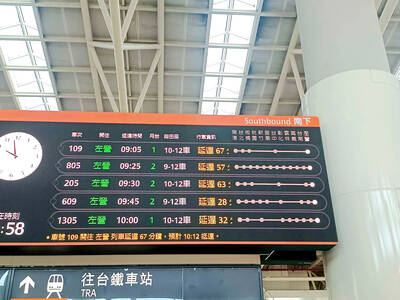
The nation’s usually punctual high-speed rail system yesterday was hit by major disruptions after all scheduled services were canceled and replaced with three hourly trains offering only non-reserved seating, affecting more than 200,000 passengers. Preliminary findings indicate the disruption was caused by a faulty power module in a track switch control cabinet, Taiwan High-Speed Rail Corp (THSRC) said, adding that as a full system inspection could only be conducted after operations end for the day, a decision on whether normal service would resume today would be announced before the first train departs. During a routine inspection early yesterday, a switch signal abnormality


 RSS
RSS