


Chinese Nationalist Party (KMT) vice presidential candidate Jennifer Wang (王如玄) yesterday filed a slander lawsuit against Democratic Progressive Party (DPP) Legislator Tuan Yi-kang (段宜康) over allegations of illegal speculative sales of military housing units.
“Before I assumed public office [as minister of the Council of Labor Affairs in 2008,] I did make investments in real estate. However, all of my property transactions were reported in accordance with the law,” Wang said after filing the charges at the Taipei District Prosecutors’ Office yesterday afternoon. “I might not be a perfect person, but I am without doubt a law-abiding citizen.”
Wang said she decided to resort to the law to defend her innocence after being subjected to various mudslinging attacks, apologizing to the public for stirring up so much social tumult recently.

Photo: CNA
When asked to comment on Tuan’s latest accusations that she had purchased at least 19 military apartments over the past two decades, rather than just five as she claimed, Wang said that none of the accusations were true, before quickly leaving the scene.
Wang filed the lawsuit hours after Tuan held a press conference yesterday morning, during which he presented property declaration documents filed since 1993 by Wang’s husband, Judicial Yuan Department of Government Ethics Director Huang Tung-hsun (黃東焄), to back his claims.
Tuan alleged that one of the 19 military apartments Wang had bought was in a residential complex called Shih Mao Hsin Cheng (世貿新城) in Taipei’s Xinyi District (信義), for which he had obtained a copy of a rental contract signed by Wang and her tenant in 1999.
However, the apartment was not included in Huang and Wang’s joint property declarations, he said.
Tuan has more than once accused Wang of having engaged in speculative sales of military apartments, which were subsidized and converted by the government from old housing for military dependents for the sole purpose of improving their living conditions and providing housing.
Wang has only acknowledged acquiring five military housing units, two of which have been sold and the remaining three are owned by her mother, sister and husband.
However, prior to Wang’s arrival at the office yesterday, her campaign staff handed out copies of a property sales contract for a unit at Shih Mao Hsin Cheng inked by Wang and a man, surnamed Lien (連), in 2001.
He also provided copies of a property declaration form filed by Huang in 1997, which included the transaction of the unit.
“These documents prove that this property was traded legally and that its sale was filed with relevant agencies accordingly,” the staff said, without responding to reporters’ questions as to why it was not among the five military units Wang had claimed.
Wang’s campaign spokesman, Lee Cheng-hao (李正皓), said that Tuan’s accusations were false since the number of military apartments Wang had obtained was far less than 19.
“We feel like our recent explanations in response to Tuan’s accusations have only sparked more political rows. That is why we have decided to take this matter to the court, where we can confront the legislator and relevant evidences will be examined more scrupulously,” Lee said.
Asked about the exact number of military housing units Wang had bought, Lee said: “It is definitely less than 19.”
Tuan later yesterday said he is not afraid because his criticism was made based on Wang’s official property declaration to the Control Yuan.
“If she had time to file a lawsuit against me, why does she not take time to explain all the details about her [real-estate] trades?” Tuan asked.
Meanwhile, the latest issue of the Chinese-language weekly Next Magazine yesterday quoted a buyer of a Shih Mao Hsin Cheng unit owned by Wang as saying that Wang had purchased the property for about NT$5 million (US$151,962), but sold it to her in 2003 for NT$14.5 million.
The buyer, surnamed Kuo (郭), said that since the address Wang listed in their sales contract was none of the five military houses she has acknowledged, but rather a house on Taipei’s Chongqing N Road, she might possess more properties than she had admitted.
Additional reporting by Loa Iok-sin

LEVERAGE: China did not ‘need to fire a shot’ to deny Taiwan airspace over Africa when it owns ‘half the continent’s debt,’ a US official said, calling it economic warfare The EU has raised concerns about overflight rights following the delay of President William Lai’s (賴清德) planned state visit to the Kingdom of Eswatini after three African nations denied overflight clearance for his charter at the last minute. Taiwanese allies Paraguay and Saint Kitts and Nevis, as well as several US lawmakers and the Inter-Parliamentary Alliance on China (IPAC) condemned China for allegedly pressuring the countries. Lai was scheduled to fly directly to Taiwan’s only African ally from yesterday to Sunday to celebrate the 40th anniversary of King Mswati III’s accession and his 58th birthday, but Seychelles, Mauritius and Madagascar suddenly revoked
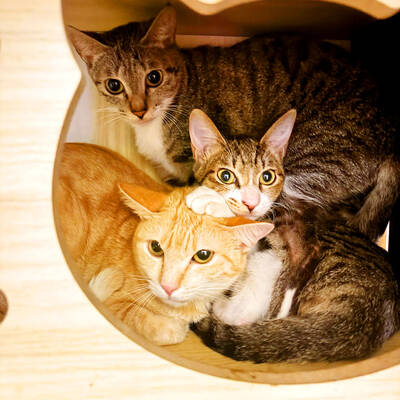
The number of pet cats in Taiwan surpassed that of pet dogs for the first time last year, reaching 1,742,033, a 32.8 percent increase from 2023, the Ministry of Agriculture said yesterday, citing a survey. By contrast, the number of pet dogs declined slightly by 1.2 percent over the same period to 1,462,528, the ministry said. Despite the shift, households with dogs still slightly outnumber those with cats by 1.2 percent. However, while the number of households with multiple dogs has remained relatively stable, households keeping more than two cats have increased, contributing to the overall rise in the feline population. The trend
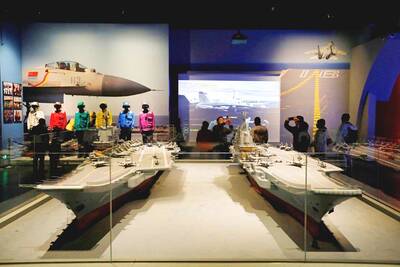
China on Wednesday teased in a video an aircraft carrier that could be its fourth, and the first using nuclear power, while making an allusion to Taiwan and vowing to further build up its islands, as it looks to boost maritime power, secure resources and bolster territorial claims. The video, issued on the eve of the 77th founding anniversary of the Chinese People’s Liberation Army Navy, featured fictional officers with names that are homophones of three commissioned aircraft carriers, the Liaoning (遼寧), Shandong (山東) and Fujian (福建). Titled Into the Deep, it showed a 19-year-old named “Hejian” (何劍) joining the group, sparking
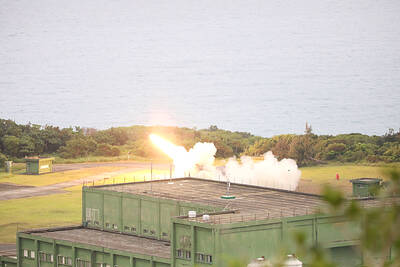
Taiwan has signed six arms procurement offers from the US totaling more than NT$208 billion (US$6.59 billion) covering long-range precision strike systems, missile stockpile replenishment and joint production of large-caliber ammunition, the Ministry of National Defense said yesterday. The government’s proposed NT$1.25 trillion special defense budget has been stalled in the Legislative Yuan as opposition lawmakers question the amount and procurement items, while the Presidential Office and defense ministry say that the full amount is necessary to safeguard Taiwan. Minister of National Defense Wellington Koo (顧立雄) on Monday briefed the legislature’s Foreign Affairs and National Defense Committee on the defense budget for


 RSS
RSS