


The Taiwan Solidarity Union (TSU) yesterday demonstrated in front of the Presidential Office Building to protest President Ma Ying-jeou’s (馬英九) planned meeting with Chinese President Xi Jinping (習近平), accusing him of breaking away from the institutionalized cross-strait negotiation system, while vowing to launch a recall campaign.
Joined by dozens of taxis, protesters held placards condemning Ma for his decision to meet with Xi in Singapore tomorrow and calling on Ma to resign.
TSU Chairman Huang Kun-huei (黃昆輝) said Ma’s rushed decision to meet with Xi has breached the institutionalized mechanism on cross-strait exchanges.
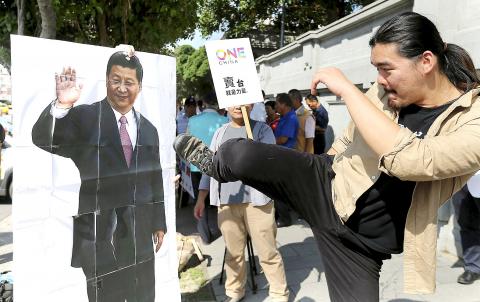
Photo: Edward Lau, Reuters
“When the historical cross-strait negotiations between the Taiwan’s then-Straits Exchange Foundation chairman Koo Chen-fu (辜振甫) and China’s then-Association for Relations Across the Taiwan Straits chairman Wang Daohan (汪道涵) took place in Singapore in 1993, I was Mainland Affairs Council (MAC) minister and Ma was my deputy,” Huang told the crowd. “The preparations for the meeting took a long time, with one preparatory meeting after another, while what to talk about and what would be the main objectives were clearly set.”
Huang said that the meeting only happened after both sides approved the issues to be discussed.
Transparency was the key to institutionalized negotiations, but this time no one knows what issues are to be discussed during the Ma-Xi meeting and the decision was a rushed one, Huang said.
“Ma said that he wanted to institutionalize cross-strait summits at the top level, but instead what he is doing now is breaking the institutionalized mechanism for cross-strait talks,” Huang said.
TSU Secretary-General Lin Chih-chia (林志嘉) said the TSU caucus would immediately launch a campaign to recall the president.
“The law stipulates that a presidential recall proposal has to be endorsed by one-quarter of the legislature. At the moment, three TSU lawmakers have signed the endorsement and we will try to reach the threshold of 29 as soon as possible,” Lin said.
TSU Legislator Chou Ni-an (周倪安) said that when the legislature reviewed MAC’s budget proposals for the next fiscal year, MAC Minister Andrew Hsia (夏立言) said nothing about Ma’s planned meeting with Xi.
“We put forward a motion to restart the review of MAC budgets,” she said.
At 10am, when a press conference started inside the Presidential Office Building, the dozens of taxis at the demonstration blew their horns in unison in protest.

NATIONAL SECURITY THREAT: An official said that Guan Guan’s comments had gone beyond the threshold of free speech, as she advocated for the destruction of the ROC China-born media influencer Guan Guan’s (關關) residency permit has been revoked for repeatedly posting pro-China content that threatens national security, the National Immigration Agency said yesterday. Guan Guan has said many controversial things in her videos posted to Douyin (抖音), including “the red flag will soon be painted all over Taiwan” and “Taiwan is an inseparable part of China,” while expressing hope for expedited “reunification.” The agency received multiple reports alleging that Guan Guan had advocated for armed reunification last year. After investigating, the agency last month issued a notice requiring her to appear and account for her actions. Guan Guan appeared as required,
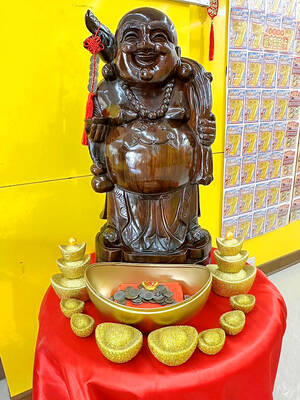
A Vietnamese migrant worker yesterday won NT$12 million (US$379,627) on a Lunar New Year scratch card in Kaohsiung as part of Taiwan Lottery Co’s (台灣彩券) “NT$12 Million Grand Fortune” (1200萬大吉利) game. The man was the first top-prize winner of the new game launched on Jan. 6 to mark the Lunar New Year. Three Vietnamese migrant workers visited a Taiwan Lottery shop on Xinyue Street in Kaohsiung’s Gangshan District (崗山), a store representative said. The player bought multiple tickets and, after winning nothing, held the final lottery ticket in one hand and rubbed the store’s statue of the Maitreya Buddha’s belly with the other,
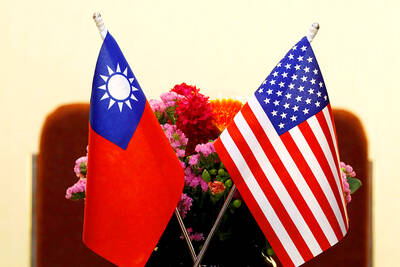
‘NATO-PLUS’: ‘Our strategic partners in the Indo-Pacific are facing increasing aggression by the Chinese Communist Party,’ US Representative Rob Wittman said The US House of Representatives on Monday released its version of the Consolidated Appropriations Act, which includes US$1.15 billion to support security cooperation with Taiwan. The omnibus act, covering US$1.2 trillion of spending, allocates US$1 billion for the Taiwan Security Cooperation Initiative, as well as US$150 million for the replacement of defense articles and reimbursement of defense services provided to Taiwan. The fund allocations were based on the US National Defense Authorization Act for fiscal 2026 that was passed by the US Congress last month and authorized up to US$1 billion to the US Defense Security Cooperation Agency in support of the
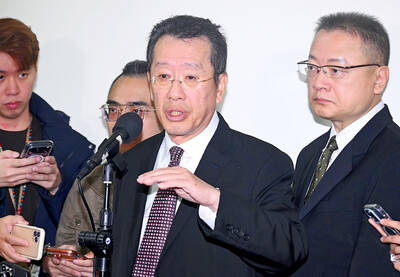
CLASSIFIED BRIEFING: The ministry said the special budget focuses on building a comprehensive defense system and strengthening the domestic defense industry The Ministry of National Defense yesterday released information on seven categories of weapons systems to be procured under a stalled NT$1.25 trillion (US$39.57 billion) special defense budget, including precision artillery, long-range missiles, air defense anti-tank missiles and more than 200,000 uncrewed aerial vehicles (UAVs). The Executive Yuan approved a draft version of the budget on Nov. 27 last year and submitted it to the legislature for review. The legislature’s Foreign Affairs and National Defense Committee yesterday invited Minister of National Defense Wellington Koo (顧立雄) to deliver a classified briefing and answer questions at a closed-door session. Koo said he hoped to provide lawmakers


 RSS
RSS