


Chinese Nationalist Party (KMT) Chairman Eric Chu (朱立倫) yesterday shrugged off a media report alleging that he plans to resign as mayor of New Taipei City next week so that he can replace Deputy Legislative Speaker Hung Hsiu-chu (洪秀柱) as the party’s presidential candidate.
At a public event in New Taipei City yesterday afternoon, Chu refused to comment on “nonsense and groundless rumors.”
When asked whether he would honor his pledge to serve out his mayoral term, Chu said that he would try his best to fulfill his duties as a mayor every day.
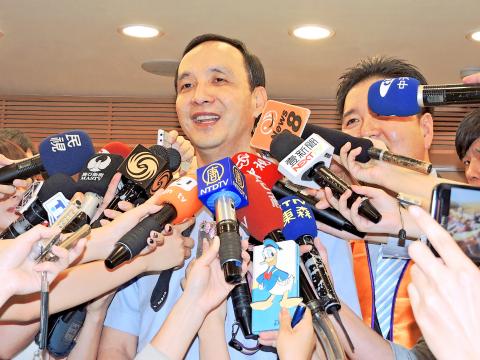
Photo: Lai Hsiao-tung, Taipei Times
The media storm was ignited by an article published yesterday in the Chinese-language Liberty Times (the Taipei Times’ sister paper), which cited anonymous sources as saying that Chu has reached an agreement with the Presidential Office to run for president in Hung’s stead.
The article alleged that Chu had decided to take over the responsibility in an effort to rescue his own career and the fortunes of the KMT from the impact of a potential drubbing in next year’s polls. If he were to throw his hat into the ring, it would directly contradict his oft-repeated promises to serve out the full term of his mayorship and to back Hung’s candidacy.
Chu is likely to announce his plan next week, the report said, as it would mean the by-election for New Taipei City could be combined with the Jan. 16 presidential and legislative elections, which could boost the KMT’s effort to maintain control of the special municipality.
The law requires that mayoral by-elections be held within three months of the resignation of the incumbent.
On Sunday, KMT Central Standing Committee member Chiang Shuo-ping (江碩平) also demanded a provisional party congress be held — likely at a routine meeting of the committee tomorrow — to assess whether Hung should be replaced.
Asked about Chiang’s requests, Chu yesterday said that opinions in the party have been divided recently and he has urged party members to speak their minds and freely exchange opinions.
“Only through deliberation and the exchange of opinions can true unity be forged among party members... in the face of difficulties stemming from next year’s elections,” Chu said.
Chu said he welcomed face-to-face communication and the submission of a diversity of ideas at committee meetings.
Later yesteday, a KMT official who declined to be named confirmed that Chu has twice urged Hung to quit the race because her chance of winning the election is too small.
Meanwhile, Hung’s supporters have taken to Facebook to vent their discontent over Chiang’s plan to oust the deputy legislative speaker as the KMT’s presidential candidate.
Hundreds of Facebook users have threatened to converge on KMT headquarters tomorrow in a show of support for Hung.
About 1,000 netizens have also signed an online petition urging pro-KMT supporters to abstain from voting in the legislative election if Hung is forced to drop out of the presidential race.
“Not wanting to vote for the Democratic Progressive Party does not necessarily mean we would vote for the KMT,” the petition’s initiators said.
“Do you [the KMT] really think that abandoning Hung would only get you a few days of criticism and that her supporters would still vote for the party with a sour taste in their mouths? Only in your dreams,” they said.

DRONE CENTRAL: Taiwan aims to become Asia’s democratic hub for drones, with most exports focused on high-quality military-grade models, an official said Taiwan’s drone industry is expected to expand significantly by 2030, producing 100,000 units per month and exporting half of them, the Ministry of Economic Affairs said yesterday. Current drone production capacity is about 15,000 units per month, but the industry can quickly scale up as demand increases, Industrial Development Administration Director-General Chiou Chyou-huey (邱求慧) told a news conference in Taipei. Taiwan’s drone output grew 2.5-fold last year to NT$12.9 billion (US$408.3 million) under a government program to develop the uncrewed vehicle sector, he said. The Executive Yuan in October last year approved plans to invest NT$44.2 billion into domestic production of uncrewed aerial
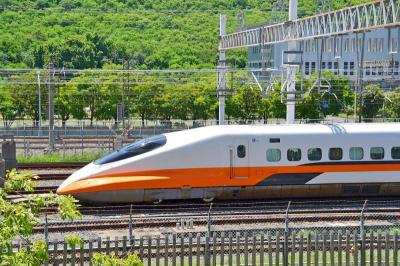
A signaling system malfunction disrupted high-speed rail (HSR) services beginning at 8am today, with trains temporarily reduced to three northbound and three southbound trains per hour as authorities conduct inspections. The malfunction occurred on a section of track in Miaoli County during pre-operation checks early this morning, forcing northbound and southbound trains to use a single track, the HSR operator said. The regular schedule has been replaced with three hourly trains offering only nonreserved seating in each direction, stopping at every station, it said, adding that business class cars would still have reserved seating. Departures from terminal stations are scheduled at the top
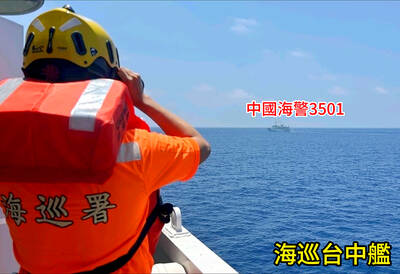
VERBOSE VESSELS: A CGA cutter and a China Coast Guard exchanged verbal barbs for more than a day in Taiwanese-controlled waters before the Chinese vessel left The Taiwanese and Chinese coast guards had a standoff near the strategically located Pratas Islands (Dongsha Islands, 東沙群島) in the north of the South China Sea, the Coast Guard Administration (CGA) said yesterday. The two sides engaged in intense radio exchanges over sovereignty claims during the 33-hour standoff. China Coast Guard vessel 3501 eventually left the restricted waters, 26.6 nautical miles (49.2km) west of the Pratas Islands, at 5pm yesterday, the CGA said. Lying approximately between southern Taiwan and Hong Kong, the Taiwan-controlled Pratas are seen by some security experts as vulnerable to Chinese attack due to their distance — more than
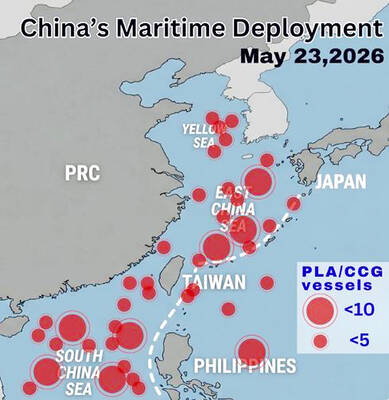
WARNING: China should stop engaging in actions that undermine regional peace and stability, as it would only build resentment among people across the Strait, the CGA said China has deployed more than 100 navy, coast guard and other vessels in waters from the Yellow Sea to the South China Sea and the western Pacific since US President Donald Trump and Chinese President Xi Jinping (習近平) met in Beijing, National Security Council Secretary-General Joseph Wu (吳釗燮) said yesterday. “In this part of the world, #China is the one & only PROBLEM wrecking the #StatusQuo & threatening regional peace & stability,” Wu wrote on X. In a separate post, he said Beijing was coercing Taiwan’s maritime domain, calling it illegal and provocative, after the Coast Guard Administration (CGA) expelled a


 RSS
RSS