


Students from the Northern Taiwan Anti-Curriculum Changes Alliance yesterday stormed out of a Ministry of Education sponsored forum in Taipei on controversial adjustments to high-school curriculum guidelines.
Alliance spokesman Brian Sung (宋運川) said that K-12 Education Administration Director Wu Ching-shan’s (吳清山) responses to students’ questions lacked sincerity, with Wu avoiding key issues and deliberately wasting time.
“[Wu] was unable to give an account for why the ministry waited until now to put on the forums, or where in the world Minister [of Education Wu Se-hwa (吳思華)] is,” Sung said.
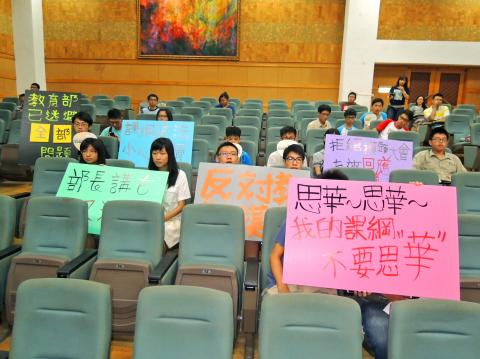
Photo: Wang Chun-chung, Taipei Times
He rejected offers by Wu Ching-shan to arrange a meeting between student representatives and Wu, saying it was too late.
“We are running out of time, with less than seven days left [before curriculum guidelines take effect],” Sung said. “Books are already printed — talks with us should have taken place two or three months ago.”
Alliance convener Chu Chen (朱震) said that the group intended to “fight a rearguard action” if the curriculum guideline adjustments go into effect next month as planned. While the level of sacrifice individual students were willing to make varied, student activists would continue to express support for any action opposing the curriculum guidelines, he said.
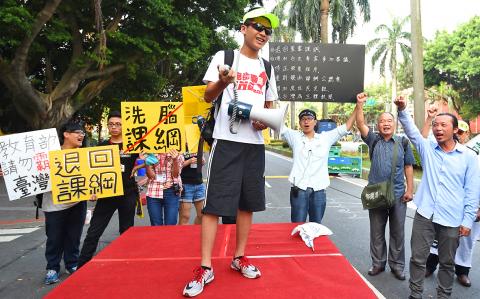
Photo: Liu Hsin-de, Taipei Times
About 40 students had trickled into the auditorium of the Affiliated Senior High School of National Taiwan Normal University to listen to a report on the adjustments by ministry officials, the majority of them alliance students wearing headbands and carrying protest banners and placards.
After the conclusion of the ministry’s report, Wu Ching-shan participated in a question-and-answer session that saw students question what critics call the “China-centric” focus of the changes and an opaque, “black box” approval process.
Forums were simultaneously held at National Hsinchu High School, National Changhua Senior High School and Tainan First High School.
Earlier forums had been canceled after the first forum saw student activists confront Wu Se-hwa, who did not attend any of yesterday’s forums.
Students attended the forum after breaking up their protest outside the Ministry of Education ahead of schedule yesterday morning after being “snubbed” by Deputy Minister of Education Lucia Lin (林思伶).
Lin appeared at the protest site early yesterday to “show concern” for students’ health and safety, having a brief exchange with another alliance spokesman, Wang Pin-chen (王品蓁), before being interviewed by reporters and walking into the ministry building.
Lin said she was sure there would be opportunities for talks with the students in the future, but ruled out on-site talks.
“When students are putting on an event, they often do not think about communicating because they just want to complete the event,” she said.
Lin’s remarks drew an angry response from student protesters.
Wang said that Lin had not stated her identity and had only asked whether a nearby student lying on the ground was sleeping or had “fainted” before walking over to media to be interviewed.
“Our central demand in putting on this event was that a deputy minister would come out for talks,” Chu said.
Given Lin’s unwillingness to engage in dialogue with the students, it was unlikely that their demand for on-site talks would be met and they had decided to save time and energy to participate at the evening forum, he said.
Students had originally planned to continue their protest into the evening.
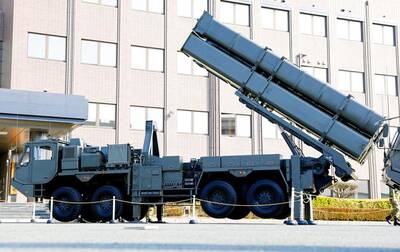
Japan has deployed long-range missiles in a southwestern region near China, the Japanese defense minister said yesterday, at a time when ties with Beijing are at their lowest in recent years. The missiles were installed in Kumamoto in the southern region of Kyushu, as Japan is attempting to shore up its military capacity as China steps up naval activity in the East China Sea. “Standoff defense capabilities enable us to counter the threat of enemy forces attempting to invade our country ... while ensuring the safety of our personnel,” Japanese Minister of Defense Shinjiro Koizumi said. “This is an extremely important initiative for

The nation’s fastest supercomputer, Nano 4 (晶創26), is scheduled to be launched in the third quarter, and would be used to train large language models in finance and national defense sectors, the National Center for High-Performance Computing (NCHC) said. The supercomputer, which would operate at about 86.05 petaflops, is being tested at a new cloud computing center in the Southern Taiwan Science Park in Tainan. The exterior of the server cabinet features chip circuitry patterns overlaid with a map of Taiwan, highlighting the nation’s central position in the semiconductor industry. The center also houses Taiwania 2, Taiwania 3, Forerunner 1 and
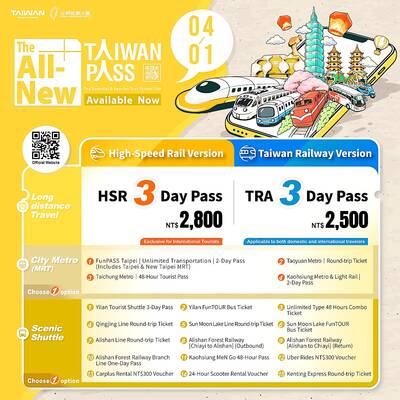
MORE POPULAR: Taiwan Pass sales increased by 59 percent during the first quarter compared with the same period last year, the Tourism Administration said The Tourism Administration yesterday said that it has streamlined the Taiwan Pass, with two versions available for purchase beginning today. The tourism agency has made the pass available to international tourists since 2024, allowing them to access the high-speed rail, Taiwan Railway Corp services, four MRT systems and four Taiwan Tourist Shuttles. Previously, five types of Taiwan Pass were available, but some tourists have said that the offerings were too complicated. The agency said only two types of Taiwan Pass would be available, starting from a three-day pass with the high-speed rail and a three-day pass with Taiwan Railway Corp. The former costs NT$2,800
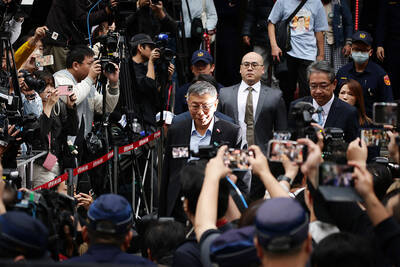
FIRST TRIAL: Ko’s lawyers sought reduced bail and other concessions, as did other defendants, but the bail judge denied their requests, citing the severity of the sentences Former Taipei mayor Ko Wen-je (柯文哲) was yesterday sentenced to 17 years in prison and had his civil rights suspended for six years over corruption, embezzlement and other charges. Taipei prosecutors in December last year asked the Taipei District Court for a combined 28-year, six-month sentence for the four cases against Ko, who founded the Taiwan People’s Party (TPP). The cases were linked to the Core Pacific City (京華城購物中心) redevelopment project and the mismanagement of political donations. Other defendants convicted on separate charges included Chinese Nationalist Party (KMT) Taipei City Councilor Angela Ying (應曉薇), who was handed a 15-year, six-month sentence; Core Pacific


 RSS
RSS