


The Ministry of Education yesterday announced new security measures following a third intrusion late on Friday night by students protesting adjustments to high-school curriculum guidelines.
Rows of 3m-tall iron barricades were put up around the ministry and the nearby K-12 Education Administration building late on Friday night, replacing barbed wire within the ministry’s short perimeter fence.
The K-12 Education Administration entrance was completely sealed off behind layers of defenses, while piles of barricade panels were stacked at intervals inside the ministry’s courtyard, ready to be placed on short notice.
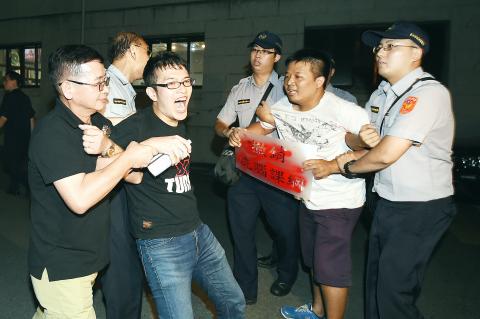
Photo: Chien Jung-fong, Taipei Times
The ministry said police erected the barriers to make the building easier to seal off following several incursions by students and a number of large protests planned at the entrance throughout next week.
It added that it reserved the right to file charges against intruders.
Controversy over what critics call “China-centric” adjustments to high-school curriculum guidelines has drawn fire from student groups, with one small group forcing its way into the K-12 Education Administration’s office last week.
The announcement followed an incursion at the ministry’s entrance late on Friday night by students from the Secondary Education Protection Front. Six students carrying spray paint and metal stencils climbed over the barriers and rushed to the front of the building to spray slogans.
Following a brief encounter with police, the students were subdued, pressing stencils, which called for the withdrawal of “brainwashing” curriculum guidelines, against the police car windows as they were driven off.
About six group members stayed outside the ministry’s gates holding up plaques opposing the “black box” curriculum guidelines and calling for the resignation of Minister of Education Wu Se-hwa (吳思華).
Group spokesman Tsai Hsi-chih (蔡習之), who is to start classes at Taipei Municipal Cheng Yuan High School in the fall, said that new high-school students will be impacted the most by curriculum guideline adjustments.
She added that, while many students had been looking forward to classes this fall, they are now depressed by the prospect of being “brainwashed” with material that is historically inaccurate.
Meanwhile, National Taichung First Senior High School student group Apple Tree Commune yesterday held the first of a series of forums outside the ministry’s gates opposing the curriculum adjustments, with the Northern Taiwan Anti-Curriculum Changes Alliance announcing that they would “surround” the ministry on Wednesday if their demands are not met.
The ministry announced four forums on the guideline changes to be held simultaneously on Thursday at the Affiliated Senior High School of National Taiwan Normal University, National Hsinchu Senior High School, National Changhua Senior High School and Tainan First High School.
The forums were scheduled to take place last month, but were canceled after the first forum ended with students confronting Wu.
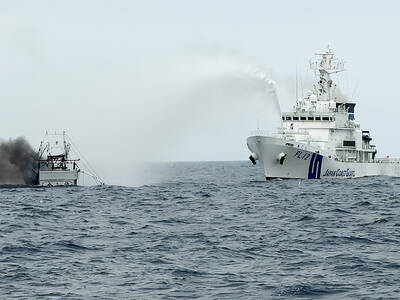
CREDIT-GRABBER: China said its coast guard rescued the crew of a fishing vessel that caught fire, who were actually rescued by a nearby Taiwanese boat and the CGA Maritime search and rescue operations do not have borders, and China should not use a shipwreck to infringe upon Taiwanese sovereignty, the Coast Guard Administration (CGA) said yesterday. The coast guard made the statement in response to the China Coast Guard (CCG) saying it saved a Taiwanese fishing boat. The Chuan Yu No. 6 (全漁6號), a fishing vessel registered in Keelung, on Thursday caught fire and sank in waters northeast of Diaoyutai Islands (釣魚台). The vessel left Keelung’s Badouzih Fishing Harbor (八斗子漁港) at 3:35pm on Sunday last week, with seven people on board — a 62-year-old Taiwanese captain surnamed Chang (張) and six
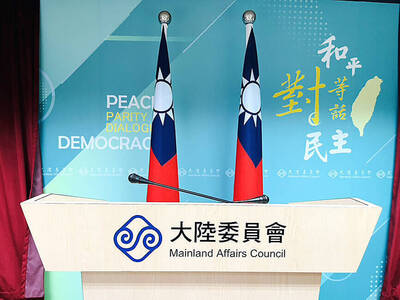
RISKY BUSINESS: The ‘incentives’ include initiatives that get suspended for no reason, creating uncertainty and resulting in considerable losses for Taiwanese, the MAC said China’s “incentives” failed to sway sentiment in Taiwan, as willingness to work in China hit a record low of 1.6 percent, a Ministry of Labor survey showed. The Directorate-General of Budget, Accounting and Statistics (DGBAS) also reported that the number of Taiwanese workers in China has nearly halved from a peak of 430,000 in 2012 to an estimated 231,000 in 2024. That marked a new low in the proportion of Taiwanese going abroad to work. The ministry’s annual survey on “Labor Life and Employment Status” includes questions respondents’ willingness to seek employment overseas. Willingness to work in China has steadily declined from

The Legislative Yuan’s Finance Committee yesterday approved proposed amendments to the Amusement Tax Act (娛樂稅法) that would abolish taxes on films, cultural activities and competitive sporting events, retaining the fee only for dance halls and golf courses. The proposed changes would set the maximum tax rate for dance halls and golf courses at 50 and 20 percent respectively, with local governments authorized to suspend the levies. Article 2 of the act says that “amusement tax shall be levied on tickets sold or fees charged by amusement places, facilities or activities” in six categories: “Cinema; professional singing, story-telling, dancing, circus, magic show, acrobatics
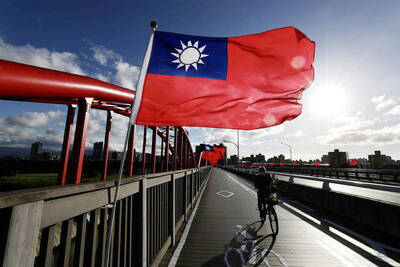
INFLATION UP? The IMF said CPI would increase to 1.5 percent this year, while the DGBAS projected it would rise to 1.68 percent, with GDP per capita of US$44,181 The IMF projected Taiwan’s real GDP would grow 5.2 percent this year, up from its 2.1 percent outlook in January, despite fears of global economic disruptions sparked by the US-Iran conflict. Taiwan’s consumer price index (CPI) is projected to increase to 1.5 percent, while unemployment would be 3.4 percent, roughly in line with estimates for Asia as a whole, the international body wrote in its Global Economic Outlook Report published in the US on Monday. The figures are comparatively better than the IMF outlook for the rest of the world, which pegged real GDP growth at 3.1 percent, down from 3.3 percent


 RSS
RSS