


Chinese Nationalist Party (KMT) presumptive presidential nominee Hung Hsiu-chu (洪秀柱) said her “one China, same interpretation” formula aims to have China recognize the existence of “the government of the Republic of China [ROC], not the existence of the ROC, otherwise it would become a ‘two-state theory.’”
Hung was interviewed on a TV talk show late on Thursday in which the host questioned her about the implications of her “one China, same interpretation” cross-strait proposal that calls for China to recognize the ROC.
“If we want China to recognize the ROC, but at the same time it is impossible for them to deny the People’s Republic of China [PRC], wouldn’t that be suggesting there are two Chinas?” the host asked.
“You have completely misunderstood [my policy],” Hung said. “It is the existence of the ROC government [that we want Beijing to recognize]. And we would also recognize the existence of the PRC government.”
“We have overlapping sovereignty claims, but are two separate governing bodies. The logic is clear and simple,” Hung said. “Taiwanese independence, if possible, would be good as well, but it is simply not possible. Changing the Constitution would incur strong opposition from both [China] and the US.”
Regarding the difficulty of obtaining the recognition of the ROC government by the PRC, which the host said had not been achieved so many years after the efforts of late Straits Exchange Foundation chairman Koo Chen-fu (辜振甫), Hung said that it should not be given up just because it is hard.
“After so many interactions and signed agreements, the fact we have still failed to achieve what we want shows there still is a lack of mutual trust between the two sides of the Taiwan Strait,” she said. “It shows that we have come to face a bottleneck in the structure built up based on the ‘1992 consensus,’ and it should be eased.”
“However, we would not say the step [of easing the bottleneck] should not be taken simply because it is difficult,” Hung said.
In response to media queries after the interview, Hung said that although the sovereignty claims of the two governments overlap, “I cannot [ask the PRC to recognize] the existence of the ROC, as that entails the [simultaneous existence] of the PRC and the ROC, which would become a ‘two-state theory.’”
Separately, during an interview with Chinese Television System aired on Thursday night and last night, President Ma Ying-jeou (馬英九) endorsed Hung’s “one China, same interpretation” formula, which he said was “almost the same as my proposal.”
The “one China, same interpretation” proposal did not go beyond “one China, different interpretations,” known as the so-called “1992 consensus,” Ma said, referring to a supposed tacit understanding between the KMT and Beijing that both sides agree there is “one China,” with each side having its own interpretation of what “China” means.
“The ‘one China, same interpretation’ proposal adheres to the ‘one China’ principle and she interprets China as the ROC, as I do,” he said.
After Hung’s “one China, same interpretation” was put forward, the US did not send its representative to meet with Hung like some other countries did, Ma said.
“That meant that [the US] is not worried about her policy,” Ma said.
Ma is expected to meet with some US officials, lawmakers and academics during transit stops in Boston and Los Angeles on his way to visit three of the nation’s allies in Central America and the Caribbean, which starts on Saturday next week.
“I will explain [Hung’s policy] to the US should they ask me about it,” Ma said.
Ma said that after he returns to Taiwan on July 18, he would attend the KMT’s national congress, which is expected to confirm Hung’s nomination.
“I don’t see any possibility that her nomination would fail to pass the national congress,” Ma said.

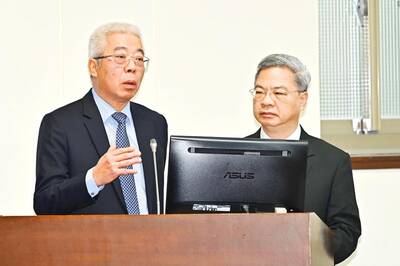
Taiwan has arranged for about 8 million barrels of crude oil, or about one-third of its monthly needs, to be shipped from the Red Sea this month to bypass the Strait of Hormuz and ease domestic supply pressures, CPC Corp, Taiwan (CPC, 台灣中油) said yesterday. The state-run oil company has worked with Middle Eastern suppliers to secure routes other than the Strait of Hormuz, through which about 20 percent of the world’s oil and liquefied natural gas typically passes, CPC chairman Fang Jeng-zen (方振仁) said at a meeting of the legislature’s Economics Committee in Taipei. Suppliers in Saudi Arabia have indicated they
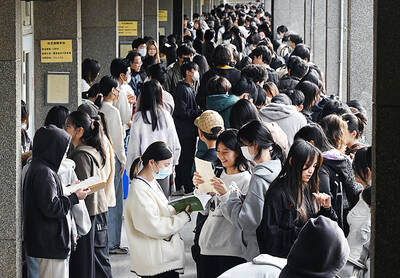
A global survey showed that 60 percent of Taiwanese had attained higher education, second only to Canada, the Ministry of the Interior said. Taiwan easily surpassed the global average of 43 percent and ranked ahead of major economies, including Japan, South Korea and the US, data from the Organisation for Economic Co-operation and Development (OECD) for 2024 showed. Taiwan has a high literacy rate, data released by the ministry showed. As of the end of last year, Taiwan had 20.617 million people aged 15 or older, accounting for 88.5 percent of the total population, with a literacy rate of 99.4 percent, the data
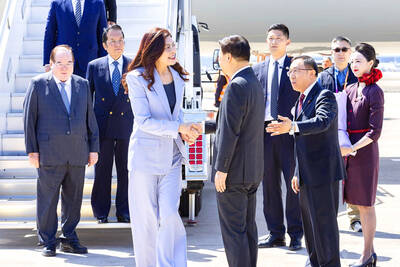
CCP ‘PAWN’? Beijing could use the KMT chairwoman’s visit to signal to the world that many people in Taiwan support the ‘one China’ principle, an academic said Chinese Nationalist Party (KMT) Chairwoman Cheng Li-wun (鄭麗文) yesterday arrived in China for a “peace” mission and potential meeting with Chinese President Xi Jinping (習近平), while a Taiwanese minister detailed the number of Chinese warships currently deployed around the nation. Cheng is visiting at a time of increased Chinese military pressure on Taiwan, as the opposition-dominated Legislative Yuan stalls a government plan for US$40 billion in extra defense spending. Speaking to reporters before going to the airport, Cheng said she was going on a “historic journey for peace,” but added that some people felt uneasy about her trip. “If you truly love Taiwan,

NEW LOW: The council in 2024 based predictions on a pessimistic estimate for the nation’s total fertility rate of 0.84, but last year that rate was 0.69, 17 percent lower An expected National Development Council (NDC) report expects the nation’s population to drop below 12 million by 2065, with the old-age dependency ratio to top 100 percent sooner than 2070, sources said yesterday. The council is slated to release its latest population projections in August, using an ultra-low fertility model, the sources said. The previous report projected that Taiwan’s population would fall to 14.37 million by 2070, but based on a new estimate of the total fertility rate (TFR) — the average number of children born to a woman over her lifetime — the population is expected to reach 12 million by


 RSS
RSS