


Students yesterday protested in Taipei and Tainan against the unexpected cancelation by the Ministry of Education of three hearings scheduled for this weekend that would have reviewed the curriculum guidelines for high-school textbooks.
Holding two large banners that read “anti-brainwashing” and “oppose the adjustments made to the curriculum guidelines,” as well as various smaller placards expressing their dissatisfaction, dozens of students, some wearing their school uniforms, called for Minister of Education Wu Se-hwa (吳思華) to listen to their demands outside the ministry yesterday afternoon.
In Tainan, students from Tainan First High School (TFHS), National Tainan Girls’ Senior High School and Kuang Hua High School yesterday morning protested at the TFHS entrance, where a hearing was supposed to take place.
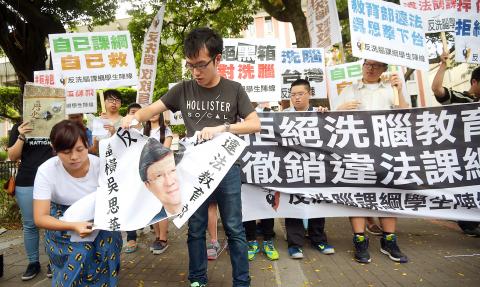
Photo: Wang Min-wei, Taipei Times
In a video clip on the Chinese-language Apple Daily’s Web site, students were heard saying “[you are] lying, lying” in response to a school staffer telling reporters that the school was unable to host the hearing because it was understaffed due to a high-school entrance exam.
At 8:30pm on Friday night, the ministry announced the postponement of the TFHS hearing, as well as the others at the Affiliated Senior High School of National Taiwan Normal University (HSNU) in Taipei yesterday and at National Hsinchu Senior High School in Hsinchu City today.
Wu is scheduled to appear on the Executive Yuan’s “open microphone” YouTube broadcast at 7pm tomorrow to explain the guideline adjustments, the ministry said.
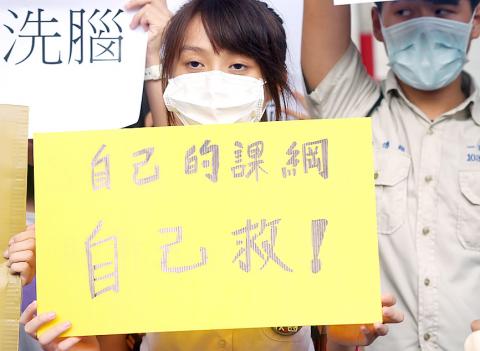
Photo: Wang Min-wei, Taipei Times
As the hearings that were to be held to dispel doubts over what critics have called “China-centric” guidelines “have gone amiss,” the government has decided to proceed with the implementation of the guidelines in August without the hearings, sources said.
The first hearing, held at National Taichung First Senior High School on Tuesday last week, apparently fueled student furor over the changes, the source said.
Concerns have been raised within government circles that high-school students could react angrily if the hearings fail to address their issues regarding the amendments, triggering a civic movement similar to the student-led Sunflower movement last year against a cross-strait service trade agreement, the sources said.
Speaking to reporters on Friday night, Wu apologized to students, teachers and parents who had signed up for the three cancelled hearings, adding that he would answer their questions during the “open mic” session.
“I thought it was a satirical piece when I first heard that today’s hearing was canceled in a news broadcast,” HSNU student Chung Hsin-ting (鍾欣庭) said yesterday. “This is ridiculous. Is the ministry deliberately trying to infuriate students?”
Taipei Municipal Jianguo High School student Ho Wei-tzu (何蔚慈) said he knew students in Yilan County and Taoyuan who had made time in their schedules to attend the Taipei hearing.
“There was no reason for the meetings to be canceled,” Ho said.
“We were disappointed, because many of us have been studying the guideline changes so that we could discuss them with the minister,” an anti-curriculum amendment alliance member said.
The decision to hold the four hearings was announced by the ministry on June 5.
Additional reporting by Shih Hsiu-chuan and Liang Pei-chi and Hung Mei-hsiu

A signaling system malfunction disrupted high-speed rail (HSR) services beginning at 8am today, with trains temporarily reduced to three northbound and three southbound trains per hour as authorities conduct inspections. The malfunction occurred on a section of track in Miaoli County during pre-operation checks early this morning, forcing northbound and southbound trains to use a single track, the HSR operator said. The regular schedule has been replaced with three hourly trains offering only nonreserved seating in each direction, stopping at every station, it said, adding that business class cars would still have reserved seating. Departures from terminal stations are scheduled at the top

Taiwan is still in the process of assessing the possibility of recruiting workers from Eswatini, the Ministry of Foreign Affairs said yesterday, adding that its goal is to help Eswatini upgrade its vocational training centers. If there are plans to recruit workers from Eswatini, safeguarding national security, protecting public health and ensuring the employment rights of Taiwanese would be prerequisites, Department of West Asian and African Affairs Director-General Yen Chia-liang (顏嘉良) told a news conference. Key considerations would also include filling labor shortages in specific industries, and fostering bilateral professional and technical exchanges, he said. Yen was asked about the progress of labor

A US uncrewed surface vessel (USV) encountered multiple Chinese warships during an autonomous transit of the Taiwan Strait, US defense company Seasats said in a statement on Wednesday. Seasats announced that a Lightfish USV had completed the first autonomous transit of the Taiwan Strait. Over five days, the USV traversed the entire length of the Strait while constantly monitoring surface vessel traffic, the company said. The Lightfish encountered multiple Chinese warships, one of which was a Chinese People’s Liberation Army Navy (PLAN) Type 056 corvette, it said. The Chinese vessels were operating “well within Taiwan’s exclusive economic zone without transmitting their identity via the

VERBOSE VESSELS: A CGA cutter and a China Coast Guard exchanged verbal barbs for more than a day in Taiwanese-controlled waters before the Chinese vessel left The Taiwanese and Chinese coast guards had a standoff near the strategically located Pratas Islands (Dongsha Islands, 東沙群島) in the north of the South China Sea, the Coast Guard Administration (CGA) said yesterday. The two sides engaged in intense radio exchanges over sovereignty claims during the 33-hour standoff. China Coast Guard vessel 3501 eventually left the restricted waters, 26.6 nautical miles (49.2km) west of the Pratas Islands, at 5pm yesterday, the CGA said. Lying approximately between southern Taiwan and Hong Kong, the Taiwan-controlled Pratas are seen by some security experts as vulnerable to Chinese attack due to their distance — more than


 RSS
RSS