


Former Chinese domestic security head Zhou Yongkang (周永康) yesterday was sentenced to life in prison on corruption charges, in a victory for Chinese President Xi Jinping’s (習近平) anti-graft campaign seen as further cementing his authority by removing a potential challenger.
Zhou, a former member of the Chinese Communist Party’s Politburo Standing Committee, is the biggest target to fall in Xi’s drive to end the longstanding culture of bribe-taking and improper influence among Chinese officials.
The First Intermediate People’s Court of Tianjin said Zhou was sentenced after being tried on May 22 on charges of receiving bribes, abuse of power and leaking state secrets. The trial was held behind closed doors because of the final charge.
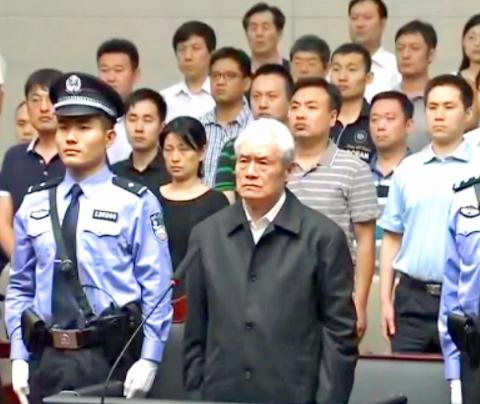
Photo: AFP
Zhou, 72, was sentenced to lesser terms on the abuse of power and state secrets charges, and was ordered to serve his sentences concurrently.
The sentence also mandates the seizure of all of Zhou’s personal assets.
While portrayed simply as a blow against corruption, Zhou’s sentencing removes a potential challenge to Xi’s authority and has been widely perceived as reflecting factional politics within the party’s uppermost echelon.
Zhou is the highest-ranking former politician to face court since the 1981 treason trial of Mao Zedong’s (毛澤東) wife and other members of the “Gang of Four” who persecuted political opponents during the 1966-1976 Cultural Revolution.
The dour-faced and once-feared Zhou had been under investigation since late 2013 and has been unavailable for comment since then.
The investigation also scrutinized Zhou’s former allies in the Chinese government and the oil industry.
According to the court, Zhou received, directly and indirectly, a total of 130 million yuan (US$21 million) in bribes and used his influence to allow others to realize 2.1 billion yuan in profits on business dealings that caused 1.4 billion yuan in losses for the state treasury — presumably through the sale of government assets at below cost.
Zhou’s actions “inflicted enormous damage to public finances and the interests of the nation and the people,” the court said in an explanation of the verdict on its Web site.
China frequently moves sensitive trials to other jurisdictions to avoid witness tampering and other potential problems.
The court said Zhou had accepted its decision and would not file an appeal. While the charges potentially mandated a death sentence, it said Zhou received leniency after confessing and showing repentance and ordering his relatives to hand over the majority of their ill-gotten gains.
While the charges of abuse of power and leaking state secrets were serious, they had not resulted in any major consequences, the court said.
“The court rendered the above verdict based on the facts of Zhou Yongkang’s crimes, their nature, circumstances and the degree of harm to society,” the court added.
Zhou was once seen as untouchable, with a vast patronage network covering the southwestern province of Sichuan, where he used to be party boss to the state oil sector, police and courts.

Japan has deployed long-range missiles in a southwestern region near China, the Japanese defense minister said yesterday, at a time when ties with Beijing are at their lowest in recent years. The missiles were installed in Kumamoto in the southern region of Kyushu, as Japan is attempting to shore up its military capacity as China steps up naval activity in the East China Sea. “Standoff defense capabilities enable us to counter the threat of enemy forces attempting to invade our country ... while ensuring the safety of our personnel,” Japanese Minister of Defense Shinjiro Koizumi said. “This is an extremely important initiative for

The nation’s fastest supercomputer, Nano 4 (晶創26), is scheduled to be launched in the third quarter, and would be used to train large language models in finance and national defense sectors, the National Center for High-Performance Computing (NCHC) said. The supercomputer, which would operate at about 86.05 petaflops, is being tested at a new cloud computing center in the Southern Taiwan Science Park in Tainan. The exterior of the server cabinet features chip circuitry patterns overlaid with a map of Taiwan, highlighting the nation’s central position in the semiconductor industry. The center also houses Taiwania 2, Taiwania 3, Forerunner 1 and

MORE POPULAR: Taiwan Pass sales increased by 59 percent during the first quarter compared with the same period last year, the Tourism Administration said The Tourism Administration yesterday said that it has streamlined the Taiwan Pass, with two versions available for purchase beginning today. The tourism agency has made the pass available to international tourists since 2024, allowing them to access the high-speed rail, Taiwan Railway Corp services, four MRT systems and four Taiwan Tourist Shuttles. Previously, five types of Taiwan Pass were available, but some tourists have said that the offerings were too complicated. The agency said only two types of Taiwan Pass would be available, starting from a three-day pass with the high-speed rail and a three-day pass with Taiwan Railway Corp. The former costs NT$2,800
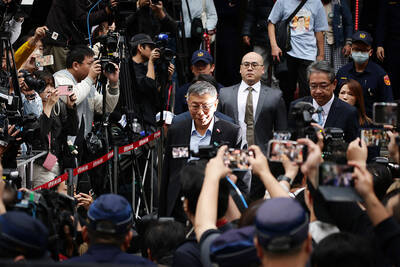
FIRST TRIAL: Ko’s lawyers sought reduced bail and other concessions, as did other defendants, but the bail judge denied their requests, citing the severity of the sentences Former Taipei mayor Ko Wen-je (柯文哲) was yesterday sentenced to 17 years in prison and had his civil rights suspended for six years over corruption, embezzlement and other charges. Taipei prosecutors in December last year asked the Taipei District Court for a combined 28-year, six-month sentence for the four cases against Ko, who founded the Taiwan People’s Party (TPP). The cases were linked to the Core Pacific City (京華城購物中心) redevelopment project and the mismanagement of political donations. Other defendants convicted on separate charges included Chinese Nationalist Party (KMT) Taipei City Councilor Angela Ying (應曉薇), who was handed a 15-year, six-month sentence; Core Pacific


 RSS
RSS