


The executions of six death-row inmates on Friday triggered a statement from the EU calling for an immediate moratorium on capital punishment in Taiwan, which in turn prompted heated debate among netizens.
The EU issued the statement hours after the executions on Friday night, which brought the number of prisoners executed by President Ma Ying-jeou’s (馬英九) administration to 32 since April 2010, when Ma ended a four-year moratorium on the death penalty.
The EU called on Taiwan to “introduce an immediate moratorium on executions” as recommended by international experts in March 2013 following Taiwan’s first human rights report and as had been the case in Taiwan from 2006 to April 2010, EU High Representative for Foreign Affairs and Security Policy Federica Mogherini said.
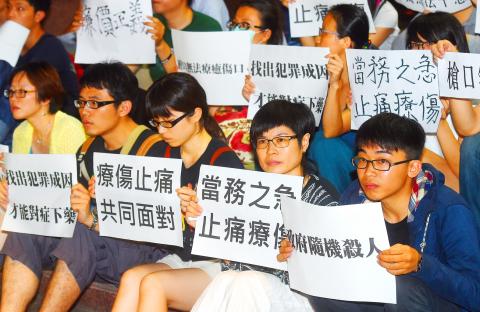
Photo: Chien Jung-fong, Taipei Times
“We recognize the suffering of the victims of the crimes involved and express our sincere sympathy to their families,” she said.
“However, the EU reiterates that the death penalty can never be justified and calls for its universal abolition,” Mogherini said.
The human rights report was reviewed by 10 international experts in 2013 on Taiwan’s compliance with two UN human rights covenants that the nation signed in 2009.
They recommend that the Government of Taiwan intensifies its efforts towards abolition of capital punishment and, as a first and decisive step, immediately introduces a moratorium on executions in accordance with the respective resolutions of the UN General Assembly.
Executions in April 2010, March 2011, December 2012, April 2013 and April last year also drew calls from the EU for an end to capital punishment.
The European Economic and Trade Office, the EU’s representative office in Taiwan, posted Mogherini’s statement on Facebook, prompting messages from netizens critical of the EU’s “interference in the nation’s internal affairs.”
“While I respect your opinions, I do not think the EU is in any position to interfere in the domestic affairs of a sovereign state,” Ellen Tsai wrote.
Liao Jen-te said the EU should pull its forces from operations against the Islamic State group if it thinks that killing is wrong and cannot be justified under any circumstances even if the person to be executed is a murderer.
Some netizens welcomed the EU’s statement.
Liu Che-wei said he hopes the EU will continue to press the government to accept a moratorium as an interim measure before Taiwan can move toward abolishing the death penalty.
“Refraining from interfering in the nation’s affairs is what China says to other countries when it threatens to attack Taiwan,” Lin Yun-mu said.
Miffie Chen said: “Am I in China?”
The European office made another post, saying that the EU is not interfering in anybody’s internal affairs.
“The EU is not lecturing anyone, not putting pressure on anybody, and even less giving orders or instructions,” it said.
“The EU is itself far from perfect from the point of view of human rights, but the very principle at the basis of human rights is that these are universal values which should be enjoyed by all members of humankind,” the office said.
The office said that the EU speaks out on human rights issues and is ready to conduct dialogue and cooperation because it cares.
In the same spirit as the office in 2013 presented a series of questions and answers regarding its position against the death penalty, the office continues to welcomes any questions and would try hard to answer, because communication provides momentum for making progress, it said.
Amnesty International also issued a statement condemning the executions on Friday.
“The public outrage at the horrific murder of an innocent schoolgirl is totally understandable and the perpetrators of such heinous crimes must face justice, but the death penalty is never the answer,” Amnesty International researcher William Nee said in a statement.
“The decision to carry out the executions reeks of political calculations by a government attempting to gain points by quelling public anger,” Nee said.
“The government has today demonstrated a failure of political leadership,” he added.
“The executions fly in the face of the government’s stated long-term goal to abolish the death penalty. The government must cease using executions as a political tool and should establish an official moratorium on executions as a first step towards abolition,” he said.
Additional reporting by Loa Iok-sin


RESILIENCE: Taiwan plays a key role in semiconductors, energy, information infrastructure and advanced manufacturing, AIT Director Raymond Greene said Taiwan’s continued investment in deterrence and resilience remains vital, especially in uncrewed systems and other emerging technologies, American Institute in Taiwan (AIT) Director Raymond Greene said yesterday. Greene made the remarks at the annual National Strategic Summit on Supply Chain Resilience held by the Research Institute for Democracy, Society and Emerging Technology (DSET), a government-backed think tank. As Taiwan last year became the US’ fourth-largest trading partner and supply chain security is becoming more important, cooperation in emerging technologies continues to deepen between the two countries, he said. The US is committed to accelerating innovation, building key infrastructure, strengthening cooperation

The National Chungshan Institute of Science and Technology yesterday showcased its locally developed variants of the Vision 60 robotic patrol dog, which it plans to deploy on the nation’s outlying territories in the South China Sea. The variants were produced under the Joint Lab project — created by the institute and domestic companies — and assembled with domestically produced motors, lenses and artificial intelligence (AI) systems alongside licensed tech from the US, Missile and Rocket Systems Research Division deputy director Jen Kuo-kang (任國光) told the media event at a military base in Taipei’s Dazhi (大直) area. Taiwan has built up its strengths

RIGHT DIRECTION: Taiwan’s efforts to prevent forced labor include a proposal to ‘fully prohibit’ employers from withholding workers’ documents, an official said Taiwan is to establish a mechanism to restrict imports of goods linked to forced labor, the Executive Yuan said yesterday, after the US proposed imposing additional tariffs on Taiwanese goods over labor concerns. “The Ministry of Labor and the Ministry of Economic Affairs are to establish an interministerial review procedure,” Executive Yuan spokesperson Michelle Lee (李慧芝) said at a news briefing in Taipei. “The government is to use the Foreign Trade Act [貿易法] as the legal basis to restrict imports of goods produced with forced labor” and bring its supply chain governance more in line with international standards on human rights, resilience
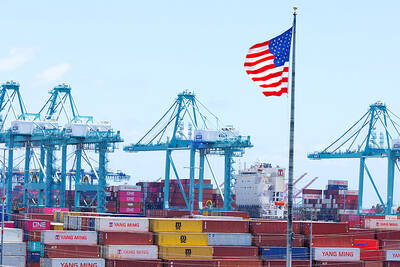
NOT IMMEDIATE: Taiwan has a chance to appeal the proposed 10 percent tariff before it starts, while other countries face a 12.5 percent tariff from the trade office Taiwan is among 60 economies determined by the US to have failed to impose or enforce a ban on the importation of goods produced with forced labor, according to a notice released on Tuesday by the Office of the US Trade Representative (USTR), which proposed imposing an additional 10 percent or more tariff on them. The USTR in a statement said that following an investigation, it had determined under Section 301 of the Trade Act of 1974 that the failure of the 60 economies to impose and effectively enforce a prohibition on the importation of goods produced with forced labor is


 RSS
RSS