


The nation yesterday celebrated film director Hou Hsiao-hsien (侯孝賢) winning the best director award at the Cannes Film Festival on Sunday night in France.
Hou’s film The Assassin (聶隱娘), a martial arts drama set in Tang Dynasty China, stars Taiwanese actress Shu Qi (舒淇) as a trained killer who is sent back to her home province to assassinate its governor, who is also the man she loves, portrayed by Taiwanese actor Chang Chen (張震).
In an interview with Chinese-language media after his win, Hou said that first impressions are more important than understanding the plot when it comes to movies, because images create feelings and thoughts.
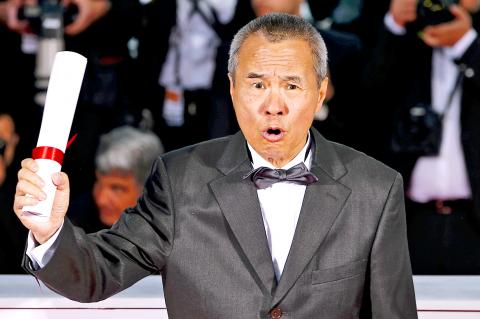
Photo: Reuters
Although some critics have said the film is not easy to understand, Hou said there are some people who think it is “very beautiful” and “very poetic.”
“Seeing a movie should not be just about understanding plots and details,” Hou said.
The Ministry of Culture yesterday said that Hou would receive NT$5 million (US$163,553) for winning the best director prize and another NT$500,000 for the film making it into the main competition of the festival.
The Assassin cost NT$450 million to make. The government gave Hou NT$45 million in subsidies during the production: NT$20 million in 2010 and NT$25 million in 2011.
Sunday night’s award was the first time the 68-year-old Hou has won the director’s award at Cannes. His film The Puppetmaster (戲夢人生) took the third-place Jury Prize at the 1993 festival.
President Ma Ying-jeou (馬英九) was among those sending congratulations to Hou after the winners were announced at the festival.
“[His] innovation and colorful way of telling the story has inspired a new trend in the world of film and shone in international skies, bringing glory for Taiwan,” he said.
The top prize, the Palme d’Or. went to a French film, Dheepan, directed by Jacques Audiard. about Sri Lankan asylum-seekers trying to build new lives, one of two movies at the festival to focus on the plight of migrants.
A Holocaust drama, Son of Saul, by Hungarian director Laszlo Nemes, claimed the runner-up Grand Prize, while The Lobster, a surreal black comedy about modern love by Greece’s Yorgos Lanthimos, starring Colin Farrell and Rachel Weisz, took the Jury Prize.
The best-actress trophy was won by Rooney Mara for her work in the lesbian love story Carol and Emmanuelle Bercot for Mon Roi (My King). France’s Vincent Lindon won best actor for his portrayal of a job-seeker trying to preserve his dignity in La Loi du Marche (The Measure of a Man).
Mexican director Michel Franco won best screenplay for Chronic, which stars British actor Tim Roth as a nurse caring for dying patients.

CREDIT-GRABBER: China said its coast guard rescued the crew of a fishing vessel that caught fire, who were actually rescued by a nearby Taiwanese boat and the CGA Maritime search and rescue operations do not have borders, and China should not use a shipwreck to infringe upon Taiwanese sovereignty, the Coast Guard Administration (CGA) said yesterday. The coast guard made the statement in response to the China Coast Guard (CCG) saying it saved a Taiwanese fishing boat. The Chuan Yu No. 6 (全漁6號), a fishing vessel registered in Keelung, on Thursday caught fire and sank in waters northeast of Diaoyutai Islands (釣魚台). The vessel left Keelung’s Badouzih Fishing Harbor (八斗子漁港) at 3:35pm on Sunday last week, with seven people on board — a 62-year-old Taiwanese captain surnamed Chang (張) and six
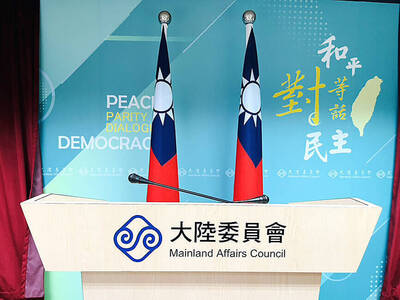
RISKY BUSINESS: The ‘incentives’ include initiatives that get suspended for no reason, creating uncertainty and resulting in considerable losses for Taiwanese, the MAC said China’s “incentives” failed to sway sentiment in Taiwan, as willingness to work in China hit a record low of 1.6 percent, a Ministry of Labor survey showed. The Directorate-General of Budget, Accounting and Statistics (DGBAS) also reported that the number of Taiwanese workers in China has nearly halved from a peak of 430,000 in 2012 to an estimated 231,000 in 2024. That marked a new low in the proportion of Taiwanese going abroad to work. The ministry’s annual survey on “Labor Life and Employment Status” includes questions respondents’ willingness to seek employment overseas. Willingness to work in China has steadily declined from

The Legislative Yuan’s Finance Committee yesterday approved proposed amendments to the Amusement Tax Act (娛樂稅法) that would abolish taxes on films, cultural activities and competitive sporting events, retaining the fee only for dance halls and golf courses. The proposed changes would set the maximum tax rate for dance halls and golf courses at 50 and 20 percent respectively, with local governments authorized to suspend the levies. Article 2 of the act says that “amusement tax shall be levied on tickets sold or fees charged by amusement places, facilities or activities” in six categories: “Cinema; professional singing, story-telling, dancing, circus, magic show, acrobatics

INFLATION UP? The IMF said CPI would increase to 1.5 percent this year, while the DGBAS projected it would rise to 1.68 percent, with GDP per capita of US$44,181 The IMF projected Taiwan’s real GDP would grow 5.2 percent this year, up from its 2.1 percent outlook in January, despite fears of global economic disruptions sparked by the US-Iran conflict. Taiwan’s consumer price index (CPI) is projected to increase to 1.5 percent, while unemployment would be 3.4 percent, roughly in line with estimates for Asia as a whole, the international body wrote in its Global Economic Outlook Report published in the US on Monday. The figures are comparatively better than the IMF outlook for the rest of the world, which pegged real GDP growth at 3.1 percent, down from 3.3 percent


 RSS
RSS