

Civic groups and opposition legislators yesterday railed against new high-school textbooks that are to be introduced in August, saying that a notice by the National Academy for Educational Research (NAER) to textbook publishers asking them to withdraw older versions infringes on teachers’ rights to select textbooks for their classes.
Opposition to the new high-school curriculum stems from changes to history textbooks that critics say reflect a “China-centric” view and the editing or deleting of up to 60 percent of Taiwanese history, while civics syllabi omit references to the White Terror era, the 228 Incident and democracy activist Deng Nan-jung (鄭南榕).
Civic groups said that teachers should be able to choose their own textbooks, because older textbooks are still valid.
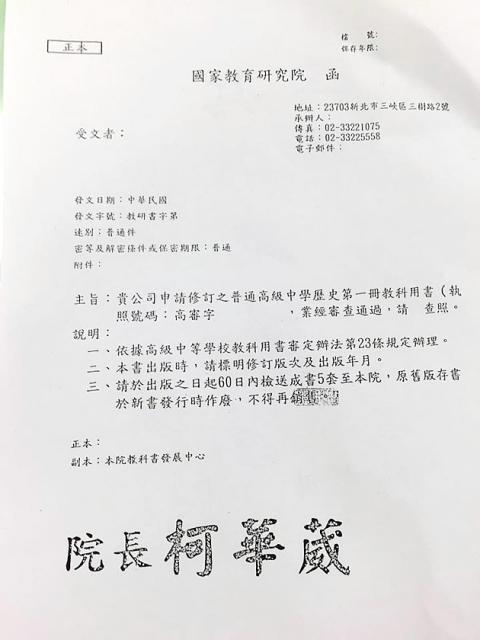
Photo: Lin Hsiao-yun, Taipei Times
Democratic Progressive Party Legislator Cheng Li-chun (鄭麗君) said that all textbooks on the market have been inspected in accordance with the Regulations on the Review and Approval of Senior-High School Textbooks (高級中等學校教科用書審定辦法).
The Ministry of Education is overreaching its powers and is in danger of infringing on constitutionally protected rights, as the regulation does not prohibit publishers from publishing older versions of textbooks.
Humanist Education Foundation executive director Joanna Feng (馮喬蘭) said that teachers are entitled to select which books to use in their classes under the Senior Secondary Education Act (高級中等教育法), adding that if teachers ask for older versions of books, publishers should be able to meet the demand.
Students from National Taichung First Senior High School and Municipal Kaohsiung Senior High School expressed their support for publishers and their discontent over the allegedly illegal textbooks.
Teachers said that the administration’s official notice was forcing teachers to pick new versions of textbooks, adding that the ministry’s handling of the matter bordered on dictatorial.
National Alliance of Parents Organizations director-general Wu Fu-pin (吳福濱) said the ministry was setting a bad example for children.
Civic groups said they would call on the Control Yuan to look into allegations of an abuse of power by the ministry or launch administrative lawsuits against the administration on the grounds that the official notice sent to publishers was illegal.
Publishers mostly declined to comment on the issue, but some said in private to reporters that the official notice to publishers by the administration was the equivalent of an imperial edict, adding that they were afraid of the administration “settling scores” with the publishers afterward if they did not comply.
However, NAER Development Center for Textbooks director Yang Kuo-yang (楊國揚) said that only one valid version of a textbook is allowed at a time.
It is customary for the government to ask publishers to invalidate, offload and halt all sales of older textbooks when a new version is about to be published, Yang said, adding that the official notice did not specifically target textbooks due to adjustments to the high-school curriculum.
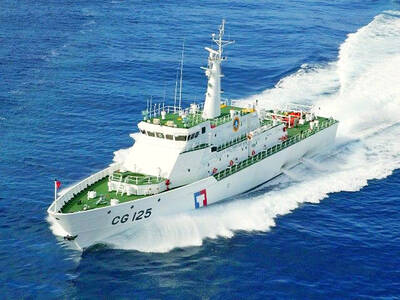
GEOPOLITICAL SIGNIFICANCE: The CGA’s nonmilitary role makes it a tool to avert diplomatic issues, an official said, while confirming the donation of a ship to Manila Coast Guard Administration (CGA) ships are scheduled to sail to the Philippines bearing the words “Taiwan Coast Guard” in a high-profile visit in October next year, the first such visit by a Taiwanese maritime law enforcement vessel to the Southeast Asian nation, the agency said yesterday. The CGA also confirmed that it had donated one of its decommissioned patrol vessels to the Philippines in a rare transfer of a retired ship to a nondiplomatic ally. The Republic of China (ROC) Navy last made such a visit in 1974, shortly before the Philippines switched diplomatic recognition to the People’s Republic of China in

SOFT TENNIS: Yu Kai-wen and Huang Shih-yuan narrowly defeated their Japanese rivals to capture Taiwan’s first gold at the Asian Games in Nagoya Yu Kai-wen (余凱文) and Huang Shih-yuan (黃詩媛) won Taiwan’s first gold of this year’s Asian Games, defeating a Japanese duo in a nail-biter in the soft tennis mixed doubles final in Nagoya, Japan, while Johnny Sun (孫家閎) won silver in wushu and Shih Cheng-chung (石政中) won bronze in men’s kumite. Yu and Huang narrowly defeated Japan’s Toshiki Uematsu and Rena Temma 5-4 (2-4, 5-3, 4-2, 1-4, 1-4, 4-0, 1-4, 4-1, 7-5) to give Taiwan its first gold in soft tennis mixed doubles at an Asian Games since 2018. Sun secured Taiwan’s first wushu medal at this year’s game, with a combined score
CALL FOR CHANGE: They urged the UN to facilitate Taiwan’s involvement in the body, recognize its peace efforts and to work with members in preventing military conflict Representatives to the UN from five of Taiwan’s diplomatic allies sent a joint letter to UN Secretary-General Antonio Guterres on Friday, calling for the country’s inclusion in the body. Allies in the letter sent ahead of the 81st session of the UN General Assembly General Debate made three demands in support of Taiwan: inclusion, recognition and camaraderie. They implored the UN to seek an appropriate way to facilitate Taiwan’s meaningful involvement in the world governing body, saying that UN Resolution 2758, which accepted the People’s Republic of China (PRC) as a member of the UN, does not exclude Taiwan. Beijing claims that the
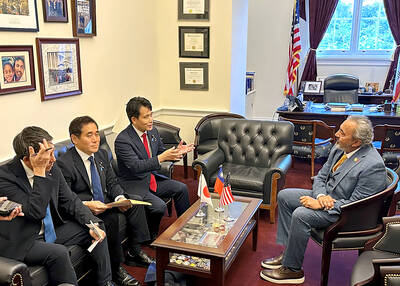
WASHINGTON MEETING: Japan’s Hirofumi Takinami said participants rejected the idea that the US should limit its defensive perimeter to the Second Island Chain US and Japanese lawmakers agree that the US must defend the First Island Chain, including Taiwan, and should not fall back to the Second Island Chain, while “a Taiwan contingency is a Japan contingency and therefore a US-Japan alliance contingency,” media reported after a meeting between officials of the two nations in Washington on Tuesday. A delegation of Japanese lawmakers from the Liberal Democratic Party met with US Senator Thom Tillis, co-chair of the Senate Taiwan Caucus, and US Representative Ami Bera, co-chair of the US Congressional Taiwan caucus, to discuss issues concerning East Asia and the Taiwan Strait. The Japanese and


 RSS
RSS