


Chinese concerns over Taiwan’s student movement have held up negotiations to establish cross-strait representative offices, President Ma Ying-jeou (馬英九) said yesterday.
“[China] is worried that any organization it establishes in Taiwan would become a focal point for the student movement,” Ma said, adding that the Chinese government might have been “frightened” by last year’s Sunflower movement, despite the Taiwanese government’s assurances of protection.
The concern was a “technical question” compared with deeper Chinese fears over the “political connotations” of setting up the offices, Ma said, reiterating his position that the offices would not amount to “foreign relations” and were necessitated by extensive cross-strait exchanges.
Ma said that Chinese reluctance was the key factor preventing an agreement on Chinese travelers changing flights in Taiwan. Even though allowing such transfers would be convenient and relieve congestion at Chinese airports, Beijing currently demands additional unspecified “supplementary measures” before agreeing to allow the transfers, he said.
He added that negotiations over the bilateral trade in goods pact with China had run into “bottlenecks,” while promising that his government would push forward “full thrust” without being influenced by next year’s presidential and legislative elections.
Ma said that after the articles for the Chinese-led Asian Infrastructure Investment Bank (AIIB) come out next month, Taiwan’s role in the organization would become “clear.”
China has issued repeated promises that Taiwan would be able to participate using an “appropriate” identity and means, he said.
Ma made the remarks yesterday at a reception to mark the seventh anniversary of his time in office.
Ma also reiterated his position that cross-strait relations could only thrive under the so-called “1992 consensus,” stating that departing from or opposing the “consensus” would undermine cross-strait ties. He criticized former president Lee Teng-hui’s (李登輝) promulgation of the “two states” model of cross-strait relations.
The “1992 consensus” is a term former Mainland Affairs Council chairman Su Chi (蘇起) admitted having made up in 2000. While Lee in 1999 said that relations between Taiwan and China were “special” ties between two sovereign states, Ma has maintained that in 1992 talks, Taiwan and China arrived at a consensus that both sides acknowledge that there is “one China,” with each side having its own interpretation of what “China” means.
The “two states” theory has done a lot of damage to Taiwan and has obstructed cross-strait relations, Ma said.
He said that while the opposition Democratic Progressive Party (DPP) wants to “maintain the status quo” that his government “established,” it is unclear what means it would adopt to realize that goal.
Focusing only on domestic governance without emphasizing cross-strait relations would “exact a price,” which would quickly be felt domestically, because of the intimate ties between Taiwan and China, Ma said.
Ma was referring to DPP Chairperson and presidential candidate Tsai ing-wen’s (蔡英文) recent remarks that playing the “cross-strait card” cannot solve all of the problems in Taiwan and that attention should be shifted back to domestic economic and social issues that truly concern all Taiwanese.
Ma said he has mixed feelings about Tsai’s “status quo maintenance” policy.
The president said it was “comforting” to him that the DPP supported a continuation of his policy to maintain the “status quo,” but sometimes he was “puzzled” because “in a democracy, the opposition usually appeals for change,” citing US President Barack Obama’s campaign slogan as an example.
In response, DPP Legislator Tsai Chi-chang (蔡其昌) said he did not see the logic of Ma questioning the DPP’s pledge to maintain the cross-strait “status quo.”
“Why does [Ma] tout his achievements in maintaining the status quo on one hand and say it is wrong that the DPP has vowed to maintain the status quo on the other?” Tsai Chi-chang said.
Additional reporting by Shih Hsiu-chuan
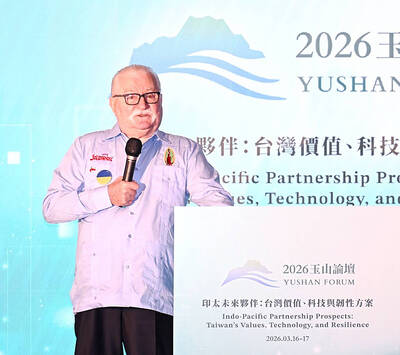
RECOGNITION: Former Fijian prime minister Mahendra Chaudhry said that Taiwan’s New Southbound Policy serves as a stabilizing force in the Indo-Pacific region Taiwan can lead the unification of the Chinese people, Nobel Peace Prize laureate and former Polish president Lech Walesa said in Taipei yesterday, adding that as the world order is changing, peaceful discussion would find good solutions, and that the use of force and coercion would always fail. Walesa made the remarks during his keynote address at a luncheon of the Yushan Forum in Taipei, titled “Indo-Pacific Partnership Prospects: Taiwan’s Values, Technology and Resilience,” organized by the Taiwan-Asia Exchange Foundation with the Ministry of Foreign Affairs. Walesa said that he had been at the forefront of a big peaceful revolution and “if
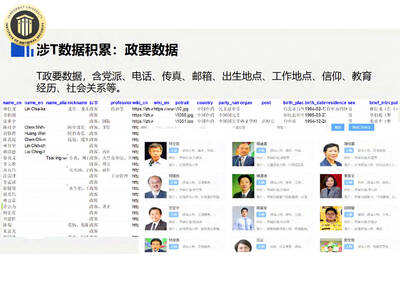
NETWORK-MAPPING PROJECT: The database contains 170 detailed files of Taiwanese politicians and about 23 million records of household registration data in Taiwan China has developed a network-mapping project targeting political figures and parties in Taiwan to monitor public opinion during elections and to craft tailored influence campaigns aimed at dividing Taiwanese society, according to documents leaked by Chinese technology firm GoLaxy (中科天璣). The documents, collected by Taipei-based Doublethink Lab, showed a database was specifically created to gather detailed information on Taiwanese political figures, including their political affiliations, job histories, birthplaces, residences, education, religion and a brief biography about them. Several notable Taiwanese politicians are in the database, including President William Lai (賴清德), former president Tsai Ing-wen (蔡英文), Minister of Foreign Affairs Lin Chia-lung (林佳龍),
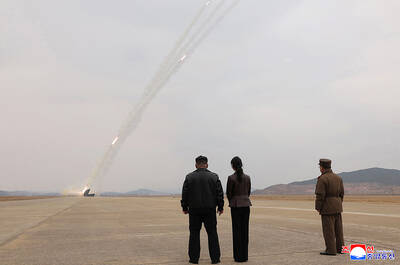
North Korea tested nuclear-capable rocket launchers, state media reported yesterday, a day after Seoul detected the launch of about 10 ballistic missiles. The test comes after South Korean and US forces launched their springtime military drills, due to run until Thursday. North Korean leader Kim Jong-un on Saturday oversaw the testing of the multiple rocket launcher system (MRLS), the Korean Central News Agency (KCNA) said. The test involved 12 600mm-caliber ultra-precision multiple rocket launchers and two artillery companies, it said. Kim said the drill gave Pyongyang’s enemies, within the 420km striking range, a sense of “uneasiness” and “a deep understanding
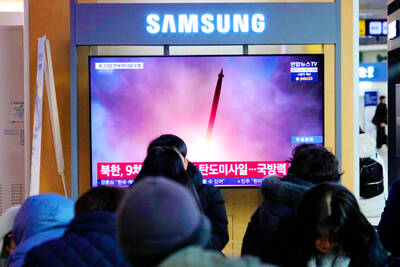
North Korea yesterday fired about 10 ballistic missiles to the sea toward Japan, the South Korean Joint Chiefs of Staff (JCS) said, days after Pyongyang warned of “terrible consequences” over ongoing South Korea-US military drills. Pyongyang recently dashed hopes of a diplomatic thaw with Seoul, Washington’s security ally, describing its latest peace efforts as a “clumsy, deceptive farce.” Seoul’s military detected “around 10 ballistic missiles launched from the Sunan area in North Korea toward the East Sea [Sea of Japan] at around 1:20pm,” JCS said in a statement, referring to South Korea’s name for the body of water. The missiles


 RSS
RSS