


Two Japanese destroyers and one of the Philippines’ newest warships yesterday began historic naval exercises in the flashpoint South China Sea, showcasing a deepening alliance aimed at countering a rising China.
The day-long war games, the first bilateral naval exercises between the former World War II enemies, took place less than 300km from a Philippine-claimed shoal now under Chinese control.
Philippine authorities insisted the exercises were merely focused on building military capabilities, but security analysts said they were clearly a signal to China over bitter maritime territorial disputes.
“First they demonstrate that China’s Pacific neighbors are beginning to balance against China,” said Michael Tkacik, a professor and foreign policy expert at the Texas-based Stephen F. Austin State University.
“Japan, the Philippines, Vietnam and assorted other states are threatened by China’s behavior, even as far away as India. Thus, the Philippines and Japan are jointly making an important statement about how seriously they view China’s actions,” he added.
China has caused deep concern regionally in recent years as it has become more aggressive in staking its claims to the South China Sea and Japanese-claimed islands in the East China Sea.
China insists it has sovereign rights to nearly all of the South China Sea.
However, Taiwan, the Philippines, Vietnam, Malaysia and Brunei have competing claims to parts of the sea, which is vital to the global shipping industry and is believed to contain huge deposits of fossil fuels.
In 2012, China took control of Scarborough Shoal, Huangyan Island (黃岩島) a rich fishing ground within the Philippines’ exclusive economic zone and more than 650km from the nearest major Chinese landmass.
Chinese coastguard vessels have since guarded the shoal and denied Filipino fishermen access, triggering a series of protests from the Philippines that have been brushed aside in Beijing.
Although the Philippine navy declined to say exactly where yesterday’s exercises would take place, it said the vessels would sail into the South China Sea from the former US naval base in Subic Bay.
That base is about 270km southeast of Scarborough Shoal.
A Philippine navy spokesman said the exercises were the first bilateral war games between the two nations. He said that one of the main drills would see an AW109 helicopter from the BRP Ramon Alcaraz, a frigate acquired from the US in 2012, flying to one of the Japanese destroyers when the three vessels meet at sea.
“It would be naive for anyone to think this is just an ordinary joint exercise in the light of some assertive actions by China in the South China Sea,” said Wilfrido Villacorta, an international relations lecturer at the Manila-based De la Salle University.
He described the event as a “natural reaction” by the Philippines after recent “provocations.”
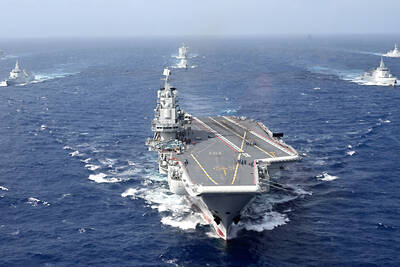
PROVOCATIVE: Chinese Deputy Ambassador to the UN Sun Lei accused Japan of sending military vessels to deliberately provoke tensions in the Taiwan Strait China denounced remarks by Japan and the EU about the South China Sea at a UN Security Council meeting on Monday, and accused Tokyo of provocative behavior in the Taiwan Strait and planning military expansion. Ayano Kunimitsu, a Japanese vice foreign minister, told the Council meeting on maritime security that Tokyo was seriously concerned about the situation in the East China and South China seas, and reiterated Japan’s opposition to any attempt to change the “status quo” by force, and obstruction of freedom of navigation and overflight. Stavros Lambrinidis, head of the EU delegation to the UN, also highlighted South China Sea

SILENCING CRITICS: In addition to blocking Taiwan, China aimed to prevent rights activists from speaking out against authoritarian states, a Cabinet department said The Ministry of Foreign Affairs (MOFA) yesterday condemned transnational repression by Beijing after RightsCon, a major digital human rights conference scheduled to be held in Zambia this week, was abruptly canceled due to Chinese pressure over Taiwanese participation. This year’s RightsCon, the world’s largest conference discussing issues “at the intersection of human rights and technology,” was scheduled to take place from tomorrow to Friday in Lusaka, and expected to draw 2,600 in-person attendees from 150 countries, along with 1,100 online participants. However, organizers were forced to cancel the event due to behind-the-scenes pressure from China, the ministry said, expressing its “strongest condemnation”
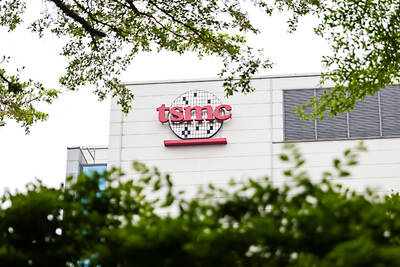
Taiwan Semiconductor Manufacturing Co (TSMC, 台積電), the world’s largest contract chipmaker, said it expects its 2-nanometer (2nm) chip capacity to grow at a compound annual rate of 70 percent from this year to 2028. The projection comes as five fabs begin volume production of 2-nanometer chips this year — two in Hsinchu and three in Kaohsiung — TSMC senior vice president and deputy cochief operating officer Cliff Hou (侯永清) said at the company’s annual technology symposium in Silicon Valley, California, last week. Output in the first year of 2-nanometer production, which began in the fourth quarter of last year, is expected to
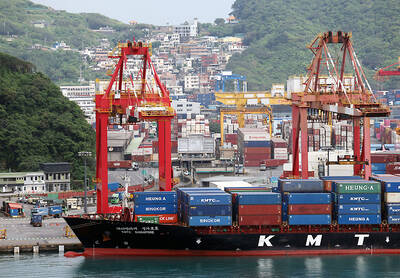
Taiwan’s economy grew far faster than expected in the first quarter, as booming demand for artificial intelligence (AI) applications drove a surge in exports, spilling over into investment and consumption, the Directorate-General of Budget, Accounting and Statistics (DGBAS) said yesterday. GDP growth was 13.69 percent year-on-year during the January-to-March period, beating the DGBAS’ February forecast by 2.23 percentage points and marking the most robust growth in nearly four decades, DGBAS senior official Chiang Hsin-yi (江心怡) told a news conference in Taipei. The result was powered by exports, which remain the backbone of Taiwan’s economy, Chiang said. Outbound shipments jumped 51.12 percent year-on-year to


 RSS
RSS