


US Secretary of State John Kerry is to meet senior Chinese leaders in Beijing this weekend at a time of heightened concerns in Asia and Washington over China’s pursuit of maritime claims and shared worries about North Korea, the US Department of State said.
Kerry will be the most senior US official to visit China since many US allies rushed to embrace a new China-led Asian Infrastructure Investment Bank (AIIB), which some see as a challenge to US leadership of the global financial system.
Kerry is set to spend Saturday and Sunday in the Chinese capital and plans to discuss the annual US-China Strategic and Economic Dialogue (S&ED) scheduled to be held in Washington late next month as well as Chinese President Xi Jinping’s (習近平) expected visit to the US capital in September.
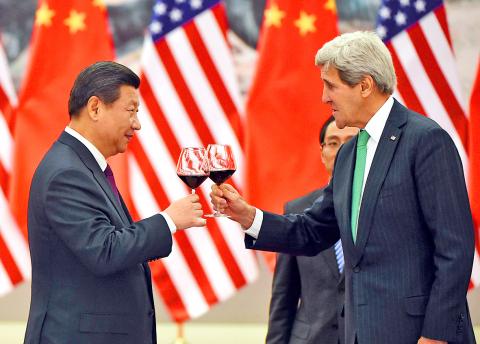
Photo: AFP
Kerry is also scheduled to visit Seoul on Sunday and Monday for talks with South Korean President Park Geun-hye, including preparations for her planned visit to the US next month.
South Korea’s Ministry of Foreign Affairs yesterday said it expects to have discussions with Kerry on North Korea and its missile tests.
Pyongyang on Saturday said it had successfully test-fired a missile from a submarine, which, if true, would mark a significant development for isolated North Korea’s military capability.
Kerry plans to visit Seattle on Tuesday to deliver a speech on trade, including a 12-nation Trans-Pacific Partnership deal, to which neither China nor South Korea is party, that Washington hopes to see concluded this year.
The S&ED is a discussion forum that highlights the nations’ economic interdependence as well as their strategic rivalry.
The US Department of State said the discussion would be headed by Kerry, US Secretary of the Treasury Jack Lew, Chinese State Councilor Yang Jiechi (楊潔篪) and Chinese Vice Premier Wang Yang (汪洋).
A senior US Treasury official last month said the US emphasis would be on governance standards for the AIIB, exchange-rate policy, climate change and Chinese regulation of information and communications technology.
The US has publicly welcomed the AIIB, but has announced no plans to join and stressed the need for it to ensure high standards. On exchange rates, it has repeatedly accused China of manipulating its currency to give it an unfair competitive advantage.
China last month suspended bank technology rules that Washington and others said amounted to unfair regulatory pressure on foreign firms, but Washington has said further discussion is needed on the issue.
Washington has expressed concern about the speed and scope of recent Chinese land reclamation work on islands in the South China Sea that it contests with Asian neighbors, including Taiwan, and US President Barack Obama last month accused China of “flexing its muscles” to advance its maritime claims.

PROVOCATIVE: Chinese Deputy Ambassador to the UN Sun Lei accused Japan of sending military vessels to deliberately provoke tensions in the Taiwan Strait China denounced remarks by Japan and the EU about the South China Sea at a UN Security Council meeting on Monday, and accused Tokyo of provocative behavior in the Taiwan Strait and planning military expansion. Ayano Kunimitsu, a Japanese vice foreign minister, told the Council meeting on maritime security that Tokyo was seriously concerned about the situation in the East China and South China seas, and reiterated Japan’s opposition to any attempt to change the “status quo” by force, and obstruction of freedom of navigation and overflight. Stavros Lambrinidis, head of the EU delegation to the UN, also highlighted South China Sea

SILENCING CRITICS: In addition to blocking Taiwan, China aimed to prevent rights activists from speaking out against authoritarian states, a Cabinet department said The Ministry of Foreign Affairs (MOFA) yesterday condemned transnational repression by Beijing after RightsCon, a major digital human rights conference scheduled to be held in Zambia this week, was abruptly canceled due to Chinese pressure over Taiwanese participation. This year’s RightsCon, the world’s largest conference discussing issues “at the intersection of human rights and technology,” was scheduled to take place from tomorrow to Friday in Lusaka, and expected to draw 2,600 in-person attendees from 150 countries, along with 1,100 online participants. However, organizers were forced to cancel the event due to behind-the-scenes pressure from China, the ministry said, expressing its “strongest condemnation”

Taiwan Semiconductor Manufacturing Co (TSMC, 台積電), the world’s largest contract chipmaker, said it expects its 2-nanometer (2nm) chip capacity to grow at a compound annual rate of 70 percent from this year to 2028. The projection comes as five fabs begin volume production of 2-nanometer chips this year — two in Hsinchu and three in Kaohsiung — TSMC senior vice president and deputy cochief operating officer Cliff Hou (侯永清) said at the company’s annual technology symposium in Silicon Valley, California, last week. Output in the first year of 2-nanometer production, which began in the fourth quarter of last year, is expected to
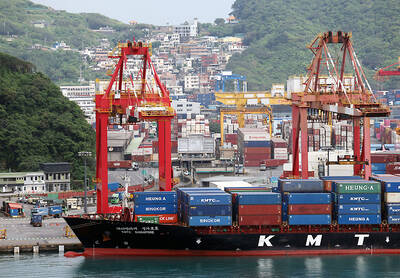
Taiwan’s economy grew far faster than expected in the first quarter, as booming demand for artificial intelligence (AI) applications drove a surge in exports, spilling over into investment and consumption, the Directorate-General of Budget, Accounting and Statistics (DGBAS) said yesterday. GDP growth was 13.69 percent year-on-year during the January-to-March period, beating the DGBAS’ February forecast by 2.23 percentage points and marking the most robust growth in nearly four decades, DGBAS senior official Chiang Hsin-yi (江心怡) told a news conference in Taipei. The result was powered by exports, which remain the backbone of Taiwan’s economy, Chiang said. Outbound shipments jumped 51.12 percent year-on-year to


 RSS
RSS