


Israeli Prime Minister Benjamin Netanyahu held on to his job on Wednesday, announcing that he had hammered together a new coalition government just ahead of a midnight legal deadline, but with a knife-edge majority of just one seat in the 120-member parliament, expectations were that he would have to expand the ruling alliance beyond his natural religious and rightist partners or battle for survival at every vote.
“I am leaving here to call the president and the speaker of the parliament to inform them that I have been able to build a government,” Netanyahu said in remarks at the Knesset after marathon talks with Jewish Home leader Naftali Bennett. “We need to launch it next week and we shall do so.”
Israeli President Reuven Rivlin’s office said he had sent a written note followed up with a telephone call.
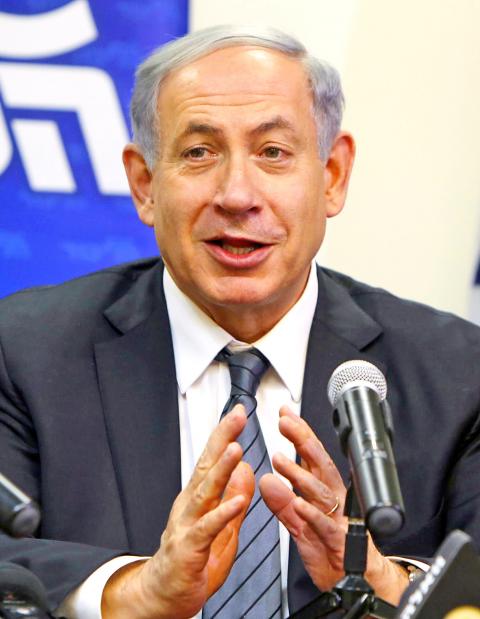
Photo: AFP
“I am honored to inform you that I have been successful in forming a government, which I will request is brought before the Knesset for its approval as soon as possible,” Rivlin’s office quoted the note as saying.
“The negotiations are over,” Bennett said on Twitter. “Now we get to work.”
The news came just over an hour ahead of a legal deadline at midnight after which the task of forming a government would have been given to another party leader — most likely Isaac Herzog, head of the center-left Zionist Union, which won 24 seats in the March 17 election, behind 30 for Netanyahu’s right-wing Likud.
The deal with Bennett leaves Netanyahu in command of 61 Knesset votes, bought at the cost of major concessions to his partners.
Analysts say he will be at the mercy of rebels, caprice, or even a bad cold the first time the coalition faces a crucial vote.
He would then be forced to expand the ruling alliance beyond his natural religious and rightist partners, and turn reluctantly to the Zionist Union, which has so far said it will sit in opposition.
“Netanyahu is left with an unmanageable situation,” Tel Aviv University political scientist Emmanuel Navon said.
“The first thing he’ll do tomorrow... is take his phone and start working on a coalition with [the Zionist Union],” he said.
Netanyahu “is a general without soldiers,” the Maariv daily wrote.
Netanyahu himself said he hoped to expand the alliance, without elaborating.
“I have said that 61 is a good number and 61-plus is better still, but it starts at 61,” Netanyahu said.
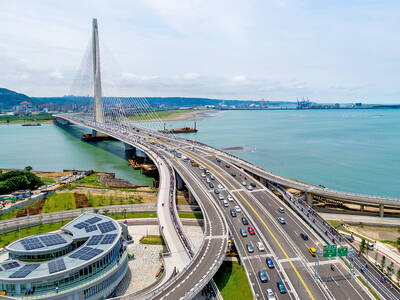
The Ministry of Transportation and Communications yesterday inaugurated the Danjiang Bridge across the Tamsui River in New Taipei City, saying that the structure would be an architectural icon and traffic artery for Taiwan. Feted as a major engineering achievement, the Danjiang Bridge is 920m long, 211m tall at the top of its pylon, and is the longest single-pylon asymmetric cable-stayed bridge in the world, the government’s Web site for the structure said. It was designed by late Iraqi-British architect Zaha Hadid. The structure, with a maximum deck of 70m, accommodates road and light rail traffic, and affords a 200m navigation channel for boats,
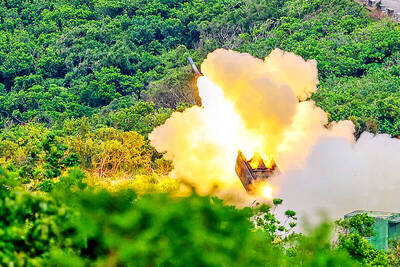
PRECISION STRIKES: The most significant reason to deploy HIMARS to outlying islands is to establish a ‘dead zone’ that the PLA would not dare enter, a source said A High Mobility Artillery Rocket System (HIMARS) would be deployed to Penghu County and Dongyin Island (東引) in Lienchiang County (Matsu) to force the Chinese military to retreat at least 100km from the coastline, a military source said yesterday. Taiwan has been procuring HIMARS and Army Tactical Missile Systems (ATACMS) from the US in batches. Once all batches have been delivered, Taiwan would possess 111 HIMARS units and 504 ATACMS, which have a range of 300km. Considering that “offense is the best defense,” the military plans to forward-deploy the systems to outlying islands such as Penghu and Dongyin so that
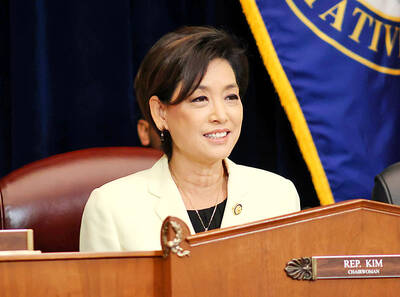
‘CLEAR MESSAGE’: The bill would set up an interagency ‘tiger team’ to review sanctions tools and other economic options to help deter any Chinese aggression toward Taiwan US Representative Young Kim has introduced a bill to deter Chinese aggression against Taiwan, calling for an interagency “tiger team” to preplan coordinated sanctions and economic measures in response to possible Chinese military or political action against Taiwan. “[Chinese President] Xi Jinping [習近平] has directed the People’s Liberation Army to be ready to invade Taiwan by 2027. China has a plan. America should have one too,” Kim said in a news release on Thursday last week. She introduced the “Deter PRC [People’s Republic of China] aggression against Taiwan act” to “ensure the US has a coordinated sanctions strategy ready should

TAIWAN ISSUE: US treasury secretary Scott Bessent said on the first day of meetings that ‘it wouldn’t be a US-China summit without the Taiwan issue coming up’ There were no surprises on the first day of the summit between US President Donald Trump and Chinese President Xi Jinping (習近平), the Mainland Affairs Council (MAC) said yesterday, as the government reiterated that cross-strait stability is crucial to the Asia-Pacific region, as well as the world. As the two presidents met for a highly anticipated summit yesterday, Chinese state media reported that Xi warned Trump that missteps regarding Taiwan could push their two countries into “conflict.” Trump arrived in China with accolades for his host, calling Xi a “great leader” and “friend,” and extending an invitation to visit the White House


 RSS
RSS