


Southeast Asian leaders yesterday edged closer to open criticism of China’s land reclamation in the disputed South China Sea at a regional summit, as the Philippines drew the ire of Beijing, which called its objections to the work “unreasonable.”
The ASEAN summit in Kuala Lumpur, which was supposed to showcase the 10-member bloc’s progress toward economic integration, was overshadowed by the long-running maritime territorial dispute.
ASEAN’s renowned “consensus” approach has been tested over the South China Sea, with several members, including host Malaysia, reluctant to antagonize China, but diplomatic sources said Kuala Lumpur would eventually give in to pressure from some neighbors and address the reclamation issue at the meeting.
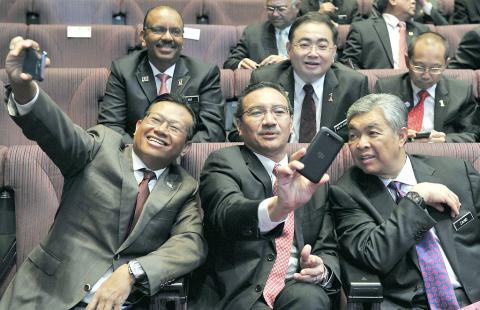
Photo: EPA
A statement to be issued after the closing ceremony later yesterday was to say that reclamations have “eroded trust and confidence and may undermine peace, security and stability in the South China Sea,” according to a draft seen by reporters.
“We reaffirmed the importance of maintaining peace, stability, security and freedom of navigation in and over-flight over the South China Sea,” it will say.
The draft does not refer specifically to China, but would nonetheless be ASEAN’s strongest response yet on the controversial reclamations in the disputed waters.
In 2012, host Cambodia’s refusal to be drawn on China’s actions in the South China Sea resulted in the customary end-of-summit communique not being issued for the first time in the bloc’s 45-year history.
Diplomatic sources said that apart from the Philippines, which has been the loudest critic of China, concerns were also raised privately by Vietnam and Indonesia.
In a speech to ASEAN heads of state yesterday, Philippine President Benigno Aquino III said the “massive reclamations” by China posed a threat to the security and stability of the region.
China responded by saying the criticisms were totally unreasonable.
“China’s building on islands in the South China Sea is completely within the scope of China’s sovereignty; it is reasonable, fair and lawful. It does not affect any other country,” Ministry of Foreign Affairs spokesman Hong Lei (洪磊) said.
China claims 90 percent of the South China Sea, with overlapping claims from Taiwan, Brunei, Malaysia, the Philippines and Vietnam.
Recent satellite images show China has made rapid progress in building an airstrip suitable for military use in the Spratly Islands (Nansha Islands, 南沙群島) and might be planning another.
While many of the claimants have built facilities such as airstrips on some of the islets and shoals they occupy, China’s efforts have been by far the most extensive and dramatic.
An earlier draft statement dated April 16 made no mention of the reclamations.
Malaysian Prime Minister Najib Razak yesterday said at a news conference that he hoped ASEAN could resolve issues with China in a constructive manner.
“We hope to be able to influence China that it’s also to their interest not to be seen as confronting ASEAN and that any attempt to destabilize this region would not benefit China either,” he said.
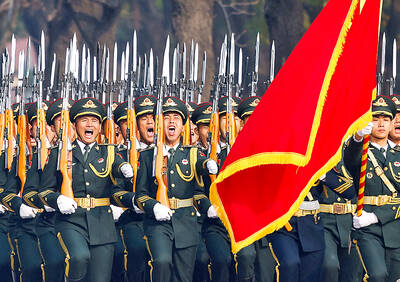
Conflict with Taiwan could leave China with “massive economic disruption, catastrophic military losses, significant social unrest, and devastating sanctions,” a US think tank said in a report released on Monday. The German Marshall Fund released a report titled If China Attacks Taiwan: The Consequences for China of “Minor Conflict” and “Major War” Scenarios. The report details the “massive” economic, military, social and international costs to China in the event of a minor conflict or major war with Taiwan, estimating that the Chinese People’s Liberation Army (PLA) could sustain losses of more than half of its active-duty ground forces, including 100,000 troops. Understanding Chinese
The Ministry of Foreign Affairs (MOFA) yesterday said it is closely monitoring developments in Venezuela, and would continue to cooperate with democratic allies and work together for regional and global security, stability, and prosperity. The remarks came after the US on Saturday launched a series of airstrikes in Venezuela and kidnapped Venezuelan President Nicolas Maduro, who was later flown to New York along with his wife. The pair face US charges related to drug trafficking and alleged cooperation with gangs designated as terrorist organizations. Maduro has denied the allegations. The ministry said that it is closely monitoring the political and economic situation

UNRELENTING: China attempted cyberattacks on Taiwan’s critical infrastructure 2.63 million times per day last year, up from 1.23 million in 2023, the NSB said China’s cyberarmy has long engaged in cyberattacks against Taiwan’s critical infrastructure, employing diverse and evolving tactics, the National Security Bureau (NSB) said yesterday, adding that cyberattacks on critical energy infrastructure last year increased 10-fold compared with the previous year. The NSB yesterday released a report titled Analysis on China’s Cyber Threats to Taiwan’s Critical Infrastructure in 2025, outlining the number of cyberattacks, major tactics and hacker groups. Taiwan’s national intelligence community identified a large number of cybersecurity incidents last year, the bureau said in a statement. China’s cyberarmy last year launched an average of 2.63 million intrusion attempts per day targeting Taiwan’s critical
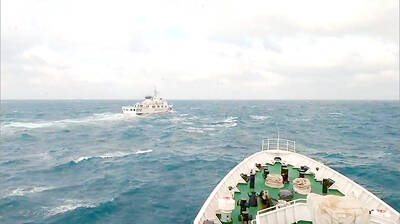
‘SLICING METHOD’: In the event of a blockade, the China Coast Guard would intercept Taiwanese ships while its navy would seek to deter foreign intervention China’s military drills around Taiwan this week signaled potential strategies to cut the nation off from energy supplies and foreign military assistance, a US think tank report said. The Chinese People’s Liberation Army (PLA) conducted what it called “Justice Mission 2025” exercises from Monday to Tuesday in five maritime zones and airspace around Taiwan, calling them a warning to “Taiwanese independence” forces. In a report released on Wednesday, the Institute for the Study of War said the exercises effectively simulated blocking shipping routes to major port cities, including Kaohsiung, Keelung and Hualien. Taiwan would be highly vulnerable under such a blockade, because it


 RSS
RSS