


Amid calls from politicians and the public for stricter regulations governing acceptable behavior on social media Web sites, Democratic Progressive Party Chairperson Tsai Ing-wen (蔡英文) yesterday expressed concern that such measures would harm Taiwan’s hard-earned right to freedom of speech.
Following the suicide of entertainer Cindy Yang (楊又穎), which her family attributes to vituperative online criticism, a number of politicians, media outlets and academics have called for laws to be amended to allow for stricter penalties for “online bullying,” — aimed at preventing a similar tragedy from occurring.
However, Tsai, the DPP’s presidential candidate, said she was opposed to such moves.
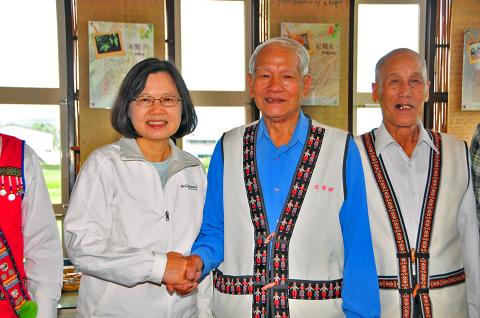
Photo: Hua Meng-ching, Taipei Times
“Malicious criticism, twisting facts and spreading rumors on the Internet are definitely very bad things, but if the problem was addressed by legislation, we worry what harm such legislation might do to freedom of speech,” Tsai said in response to media queries while on a visit to Hualien County. “In a democracy, people cherish freedom of speech, especially for a society like Taiwan, which has been through the Martial Law era, and we expect to have freedom of speech.”
She said that as well as encouraging self-restraint, Web site administers should take responsibility for preventing such language on the Internet.
“In a democracy, everyone is responsible for solving such issues, and it is not something that can be dealt with through legislation,” she said.
There is existing legislation that can be applied to online bullying, and she would encourage all victims to take legal action against those who make malicious statements online, she said.
Tsai has been on a tour of Hualien since Friday, visiting opinion leaders, businesspeople and young people, aiming to listen to their views on Taiwan’s future.
Tsai said she would assist local communities to develop their own specialty industries, so that young people from Hualien County and Taitung County could return home to work after gaining university degrees elsewhere.

‘NO SECURITY RISK’: The Railway Bureau reassured the public that the technicians’ activities were limited to technical guidance and did not involve sensitive systems The Railway Bureau yesterday said it had invited eight Chinese technicians to assist with an airport MRT construction project. The bureau issued the confirmation after an Internet user said Chinese nationals had entered the construction zone of Taiwan Taoyuan International Airport’s Terminal 3 project. They asked why “individuals from an enemy state” were allowed access to such a major national infrastructure project, which raised serious concerns over Taiwan’s industrial safety, sensitive systems and information security. The bureau’s Northern Region Engineering Branch Office said subcontractor Taiwan Handle Industrial Co (台灣手把工業) of the Taoyuan airport MRT’s “Contract No. CU05 Project A14 Station Civil, MEP &

The National Chungshan Institute of Science and Technology yesterday showcased its locally developed variants of the Vision 60 robotic patrol dog, which it plans to deploy on the nation’s outlying territories in the South China Sea. The variants were produced under the Joint Lab project — created by the institute and domestic companies — and assembled with domestically produced motors, lenses and artificial intelligence (AI) systems alongside licensed tech from the US, Missile and Rocket Systems Research Division deputy director Jen Kuo-kang (任國光) told the media event at a military base in Taipei’s Dazhi (大直) area. Taiwan has built up its strengths

RIGHT DIRECTION: Taiwan’s efforts to prevent forced labor include a proposal to ‘fully prohibit’ employers from withholding workers’ documents, an official said Taiwan is to establish a mechanism to restrict imports of goods linked to forced labor, the Executive Yuan said yesterday, after the US proposed imposing additional tariffs on Taiwanese goods over labor concerns. “The Ministry of Labor and the Ministry of Economic Affairs are to establish an interministerial review procedure,” Executive Yuan spokesperson Michelle Lee (李慧芝) said at a news briefing in Taipei. “The government is to use the Foreign Trade Act [貿易法] as the legal basis to restrict imports of goods produced with forced labor” and bring its supply chain governance more in line with international standards on human rights, resilience

NOT IMMEDIATE: Taiwan has a chance to appeal the proposed 10 percent tariff before it starts, while other countries face a 12.5 percent tariff from the trade office Taiwan is among 60 economies determined by the US to have failed to impose or enforce a ban on the importation of goods produced with forced labor, according to a notice released on Tuesday by the Office of the US Trade Representative (USTR), which proposed imposing an additional 10 percent or more tariff on them. The USTR in a statement said that following an investigation, it had determined under Section 301 of the Trade Act of 1974 that the failure of the 60 economies to impose and effectively enforce a prohibition on the importation of goods produced with forced labor is


 RSS
RSS